MCQ
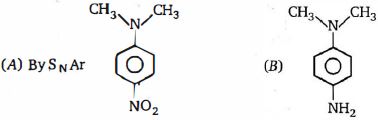
Product $(B)$ of this reaction is
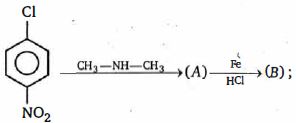
- ✓
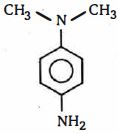
- B
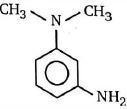
- C
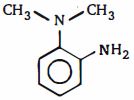
- DNone of these
Generate a complete, print-ready paper with questions like this in minutes — across 16+ boards, with answer keys.
Choose the correct statement($s$) about the above process
$(A)$ $OH ^{-}$ions react with $N _2 H _4$ at the anode to form $N _2( g )$ and water, releasing 4 electrons to the anode.
$(B)$ At the cathode, $N _2 H _4$ breaks to $N _2( g )$ and nascent hydrogen released at the electrode reacts with oxygen to form water.
$(C)$ At the cathode, molecular oxygen gets converted to $OH ^{-}$.
$(D)$ Oxides of nitrogen are major by-products of the electrochemical process.
$R-Br + Cl^- \xrightarrow{{DMF}} R-Cl + Br^-$
which one of the following has the highest relative rate?
Reason : Raoult’s law is a special case of Henry’s law.
$(I)\,\,Zn\,+\,Conc. HNO_3\,(hot) \to Zn(NO_3)_2\,+\,X\,+\,H_2O$
$(II)\,\,Zn\,+\,dil. HNO_3\,(Cold) \to Zn(NO_3)_2\,+\,Y\,+\,H_2O$
Compound $X$ and $Y$ are respectively