MCQ
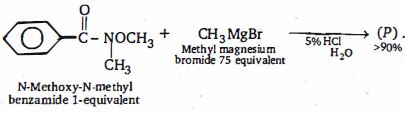
Product $(P)$ is
  • A
    $\begin{array}{*{20}{c}}
      {\,\,\,\,\,\,OH} \\ 
      {\,|} \\ 
      {Ph - {\text{  }}C - {\text{ }}Ph} \\ 
      {\,|} \\ 
      {\,\,\,Ph} 
    \end{array}$
  • $\begin{array}{*{20}{c}}
      {\,\,\,\,\,\,OH}\,\,\,\,\, \\ 
      {\,|} \,\,\,\,\\ 
      {Ph - {\text{  }}C - {\text{ }}C{H_3}} \\ 
      {\,|}\,\,\,\,\, \\ 
      {\,\,\,\,\,\,\,C{H_3}}\,\,\,
    \end{array}$
  • C
    $\begin{array}{*{20}{c}}
      O \\ 
      {||\,} \\ 
      {Ph - {\text{  }}C - {\text{ }}C{H_3}} 
    \end{array}$
  • D
    $\begin{array}{*{20}{c}}
      {\,\,\,O} \\ 
      {\,\,\,\,||\,} \\ 
      {Ph - {\text{  }}C - {\text{ }}Ph} 
    \end{array}$

Answer

Correct option: B.
$\begin{array}{*{20}{c}}
  {\,\,\,\,\,\,OH}\,\,\,\,\, \\ 
  {\,|} \,\,\,\,\\ 
  {Ph - {\text{  }}C - {\text{ }}C{H_3}} \\ 
  {\,|}\,\,\,\,\, \\ 
  {\,\,\,\,\,\,\,C{H_3}}\,\,\,
\end{array}$
b
excess of $CH_3MgBr$ is used to maximise the yield.

$\begin{matrix}
   \begin{matrix}
   O\,\,\, \,\,\, \\
   ||\,\,\,\,\,\,  \\
\end{matrix}\,\,\,\,\,\,\,\,\,\,\,\,\,\,\,\,\,\,\,\,\,\,  \\
   Ph-C-N-O-C{{H}_{3}}  \\
   |\,\,\,\,\,  \\
   \,C{{H}_{3}}  \\
\end{matrix}$ $\xrightarrow{C{{H}_{3}}MgBr}$  $\begin{matrix}
   O\,\,\,  \\
   ||\,\,\,  \\
   Ph-C-C{{H}_{3}}  \\
\end{matrix}$ $\xrightarrow{C{{H}_{3}}MgBr}$  $\begin{matrix}
   \begin{matrix}
   \overset{\,\,\,\,\,\,\,\,\,\,\,\,\,\,\,\,\,\,\,\,\,\,\Theta }{\mathop{\,\,\,\,\,\,\,\,\,\,\,\,\,\,\,\,O}}\,\overset{\oplus }{\mathop{Mg}}\,Br  \\
   |\,\,\,\,  \\
\end{matrix}  \\
   Ph-C-C{{H}_{3}}  \\
   |\,\,\,\,\,  \\
   C{{H}_{3}}  \\ 
\end{matrix}$ $\xrightarrow{{{H}^{\oplus }}}$  $\begin{matrix}
   \begin{matrix}
   \,\,\,OH  \\
   |  \\
\end{matrix}\,\,  \\
   Ph-C-C{{H}_{3}}  \\
   |\,\,\,\,  \\
   \,C{{H}_{3}}  \\
\end{matrix}$

Need a full question paper?

Generate a complete, print-ready paper with questions like this in minutes — across 16+ boards, with answer keys.

Start Generating Free

Similar questions

Which of these reagents would accomplish the following reduction ?

$\begin{matrix}
   O\,\,\,\,\,\,\,\,\,\,\,\,\,\,\,\, \,\, \\
   ||\,\,\,\,\,\,\,\,\,\,\,\,\,\,\,\,\,\,  \\
   N\equiv C-C{{H}_{2}}-C-C{{H}_{2}}-CH=C{{H}_{2}}\to   \\
\end{matrix}$ $\begin{matrix}
   OH\,\,\,\,\,\,\,\,\,  \\
   |\,\,\,\,\,\,\,\,\, \,\,\,\, \\
   N\equiv C-C{{H}_{2}}-\underset{H}{\mathop{C}}\,-C{{H}_{2}}-CH=C{{H}_{2}}  \\
\end{matrix}$

In the given pair of compounds, in which pair second compound has higher boiling  point than first compound ?
The total number of reagents from those given below, that can convert nitrobenzene into aniline is ..... . (Integer answer)

$I.$ ${Sn}-{HCl}$       $II.$ ${Sn}-{NH}_{4} {OH}$         $III.$ ${Fe}-{HCl}$        ${IV} . {Zn}-{HCl}$               $V.$ ${H}_{2}-{Pd}$               $VI.$ ${H}_{2}-$ રેની નિકલ

Assign $A, B, C, D$ from given type of reaction. $NaN{O_3} + {H_2}S{O_4}\left( {conc.} \right)\xrightarrow{{Hot}}N{a_2}S{O_4} + N{O_2} \uparrow  + {O_2} \uparrow $
From the following thermochemical equations, find out the heat of ionisation $Z$ for a weak acid $HA$
$HA \to A^- + H^+ \,,\, \Delta H = Z$
$H^+ + OH^-\to H_2O\,, \, \Delta H = X$
$HA + OH^-\to A^-+ H_2O\,, \, \Delta H = Y$
Which of the following represents the correct order of increasing electron gain enthalpy with negative sign for the elements $O, S, F$ and $Cl$ ?
$50 \mathrm{~mL}$ of $0.2$ molal urea solution (density $=1.012 \mathrm{~g} \mathrm{~mL}^{-1}$ at $300 \mathrm{~K}$ ) is mixed with $250 \mathrm{~mL}$ of a solution containing $0.06 \mathrm{~g}$ of urea. Both the solutions were prepared in the same solvent. The osmotic pressure (in Torr) of the resulting solution at $300 \mathrm{~K}$ is . . . . .$\left.\Delta_{\operatorname{mix}} \mathrm{V}=0\right]$
Oxidation number of $S$ in $N{a_2}S{O_4}$ is
The electronic configuration of chromium is
The increasing order of magnetism of

$(I)$ $MnSO_4.4H_2O$              $(II)$ $FeSO_4.7H_2O$

$(III)$ $NiSO_4.6H_2O$              $(IV)$ $CuSO_4.5H_2O$