MCQ
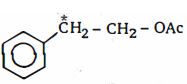
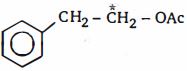
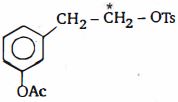
Product $(s)$ formed during this reaction is/are

  • A

  • B

  • C

  • Both $(a)$ & $(b)$

Answer

Correct option: D.
Both $(a)$ & $(b)$
d

Need a full question paper?

Generate a complete, print-ready paper with questions like this in minutes — across 16+ boards, with answer keys.

Start Generating Free

Similar questions

Which has the highest molar heat of vaporisation
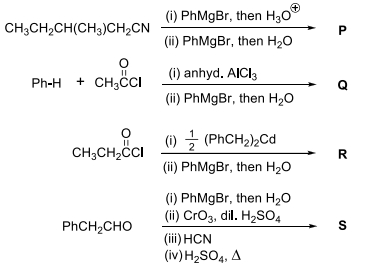
In the following reactions, $P, Q, R$, and $S$ are the major products.

The correct statement($s$) about $P, Q, R$, and $S$ is(are)

($A$) Both $P$ and $Q$ have asymmetric carbon($s$).

($B$) Both $Q$ and $R$ have asymmetric carbon($s$).

($C$) Both $P$ and $R$ have asymmetric carbon($s$).

($D$) $P$ has asymmetric carbon(s), $S$ does not have any asymmetric carbon.
$2\,moles$ of liquid $A$ is mixed with $3\,moles$ of liquid $B.$ The mole fraction of $A$ in vapour phase if $P_A^o\, = \,100\,\,mm$ and $P_B^o\, = \,200\,\,mm$
If the $pH$ of a solution is $4.0 $ at ${25\,^o}C,$ its $pOH$ would be $({K_w} = {10^{ - 14}})$
If the pressure in a reaction vessel for the following reaction is increased by decreasing the volume, what will happen to the concetrations of  $CO$  and $CO_2$ ?

${H_2}O(g){\mkern 1mu} {\mkern 1mu}  + {\mkern 1mu} CO{\mkern 1mu} (g){\mkern 1mu} {\mkern 1mu} {\mkern 1mu}  \rightleftharpoons \,{H_2}(g)\, + \,C{O_2}(g)\, + \,Heat{\mkern 1mu} {\mkern 1mu} {\mkern 1mu} {\mkern 1mu} $

For a reaction to occur spontaneously
Select the correct statement regarding acid catalysed dehydration of ter-butylalcohol.
Number of optical isomers possible for $2$ - chlorobutane..........
 $1$ molal $K _{4} Fe ( CN )_{6}$ solution has a degree of dissociation of $0.4 .$ Its boiling point is equal to that of another solution which contains $18.1$ weight percent of a non electrolytic solute $A$. The molar mass of $A$ is $.......\, u$. (Round off to the Nearest Integer). [Density of water $\left.=1.0\, g\, cm ^{-3}\right]$
Aspirin can be prepared by the reaction of