Question
Prove geometrically that the image formed by a plane mirror is at the same distance behind the mirror as the objects in front of the mirror.
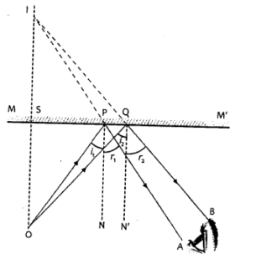
The rays of light travel out in all directions from O. Consider two light rays OP and OQ from O (point object) and incident on the mirror at points P and Q, respectively. Let these two rays be reflected along PA and QB. Draw the normals PN and QN to the mirror at points P and Q, respectively. As per the laws of reflections, angle of incidence is equal to the angle of reflection for each incident ray and its corresponding reflected ray. Thus,
$\angle i_1=\angle r_1$And $\angle i _2=\angle r _2$
If the reflected rays PA and QB are produced backwards, they meet at a point I, behind the mirror, from where rays seem to be coming and image of the object O is formed. As the reflected rays PA and QB do not actually meet at I but only appear to do so, the image is said to be virtual. Draw a perpendicular from point I to the mirror MM’ to meet MM at S and extend it to meet point O. By measuring the length of OS and SI with a ruler, you will see that OS = SI
i. e., for a plane mirror, the image formed is at the same distance behind the mirror as the object in front of the mirror.
Generate a complete, print-ready paper with questions like this in minutes — across 16+ boards, with answer keys.
| COLUMN A | COLUMN B |
| 1. Running water | 1. heat energy |
| 2. Burning | 2. vibrations |
| 3.Energy | 3.atom bomb |
| 4.Sound energy | 4.kinetic energy |
| 5.Nuclear energy | 5.joule |