Questions

[5 Mark Question Answer]

🎯

Test yourself on this topic

6 questions · timed · auto-graded

Question 15 Marks
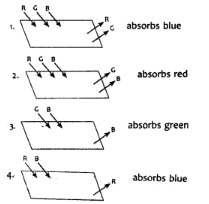
Look at the following figures and identify the colour of appearance of each surface.
Image
Answer
1. Yellow
2. Cyan
3. Blue
4. Red
View full question & answer
Question 25 Marks
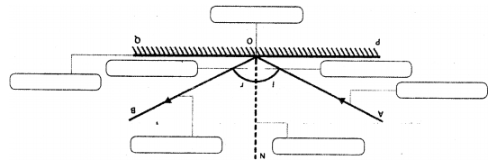
In the given figure, PQ is a mirror strip, AO is a ray incident at O. Label the different terms related to reflection in the figure
Image
View full question & answer
Question 35 Marks
State the characteristics of an image formed by a plane mirror.
Answer
Characteristics of an image formed by a plane mirror.
  1. An image formed by a plane mirror is always virtual, i. e., it cannot be obtained on a screen.
  2. The image formed is at the same distance behind the mirror as the object is in front of the mirror.
  3. The image formed is of the same size as the object,
  4. The image formed is laterally inverted.
  5. The image formed is always erect.
View full question & answer
Question 45 Marks
Prove geometrically that the image formed by a plane mirror is at the same distance behind the mirror as the objects in front of the mirror.
Answer
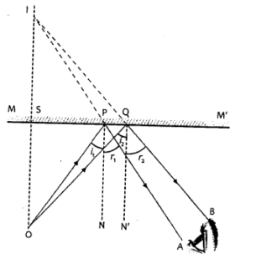
To understand the reflection from a plane mirror and the image formed due to it, let us consider a point object O kept in front, of the plane mirror strip, MM’.

Image
The rays of light travel out in all directions from O. Consider two light rays OP and OQ from O (point object) and incident on the mirror at points P and Q, respectively. Let these two rays be reflected along PA and QB. Draw the normals PN and QN to the mirror at points P and Q, respectively. As per the laws of reflections, angle of incidence is equal to the angle of reflection for each incident ray and its corresponding reflected ray. Thus,
$\angle i_1=\angle r_1$And $\angle i _2=\angle r _2$
If the reflected rays PA and QB are produced backwards, they meet at a point I, behind the mirror, from where rays seem to be coming and image of the object O is formed. As the reflected rays PA and QB do not actually meet at I but only appear to do so, the image is said to be virtual. Draw a perpendicular from point I to the mirror MM’ to meet MM at S and extend it to meet point O. By measuring the length of OS and SI with a ruler, you will see that OS = SI
i. e., for a plane mirror, the image formed is at the same distance behind the mirror as the object in front of the mirror.
View full question & answer
Question 55 Marks
Describe an experiment to show that the angle of incidence is equal to the angle of- reflection.
Answer
Aim : To verify the laws of reflection
Materials Required : A plane mirror, a pencil, some pins, A4 – sized white paper, drawing board and a protractor.
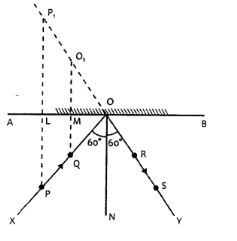
Procedure : Fix the paper on the drawing board. Near the longer side of the drawing paper, draw a straight line AB and mark its mid-point as O. Draw a perpendicular ON to AB at O. Using a protractor, draw angle XON equal to 60°.
Place the long face of the plane mirror strip and use plasticine to hold the mirror in a vertical position. Fix two pins P and Q on line XO. The pins should be at least 5 cm apart and in an upright position. Looking into the mirror from the side of the perpendicular ON, fix two more pins, R and S, in such a way that pin R, pin S and the respective images of pins P and Q appear to be in the same straight line.

Image
Remove the mirror and the pins one by one. Draw small circles around each pinhole, using a pencil to mark their respective positions. Join RS and produce the line to meet AB at O. Let this line ‘ be YO. From point P, draw a perpendicular to AB to meet AB at L and YO at P1 (when extended). Measure the angle YON.
Observation : Z XON is equal to z YON, that is, angle of incidence is equal to angle of reflection. You will also observe that the incident ray XO, the normal NO and the reflected ray YO all lie in the plane of the paper used, that is, in the same plane.
View full question & answer
Question 65 Marks
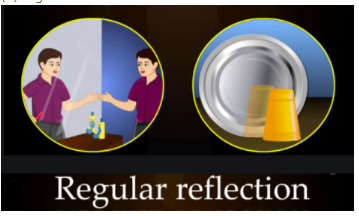
State the differences between regular and diffused reflection.
View full question & answer
[5 Mark Question Answer] - PHYSICS STD 7 Questions - Vidyadip