Question
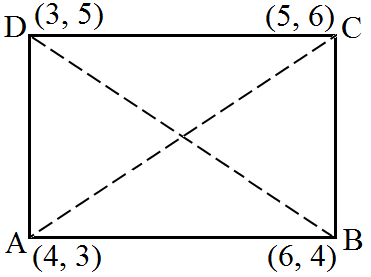
Prove that (4, 3), (6, 4) (5, 6) and (3, 5) are the angular points of a square.
Answer

Let the given points be, A(4, 3), B(6, 4) C(5, 6) and D(3, 5) respectively. Then, Now, $\text{AB}=\sqrt{(6-4)^2+(4-3)^2}$ $=\sqrt{4+1}$ $=\sqrt{5}\ \text{units}$ and $\text{BC}=\sqrt{(5-6)^2+(6-4)^2}$$=\sqrt{1+4}$
$=\sqrt{5}\ \text{units}$ $\text{CD}=\sqrt{(3-5)^2+(5-6)^2}$ $=\sqrt{4+1}$ $=\sqrt{5}\ \text{units}$ $\text{AD}=\sqrt{(3-4)^2+(5-3)^2}$ $=\sqrt{1+4}$ $=\sqrt{5}\ \text{units}$ Thus, AB = BC = CD = AD Diagonal $\text{AC}=\sqrt{(5-4)^2+(6-3)^2}$ $=\sqrt{1+9}$ $=\sqrt{10}\ \text{units}$ Diagonal $\text{BD}=\sqrt{(3-6)^2+(5-4)^2}$ $=\sqrt{9+1}$ $=\sqrt{10}\ \text{units}$ $\therefore$ AB = BC = CD = AD and diagonal AC = diagonal BD. Thus, ABCD is a quadrilateral in which all sides are equal and the diagonal are equal. Hence, ABCD is a square.

Need a full question paper?

Generate a complete, print-ready paper with questions like this in minutes — across 16+ boards, with answer keys.
Start Generating Free

Similar questions

Solve the following quadratic equations by factorization:
$\frac{1}{\text{x}-3}+\frac{2}{\text{x}-2}=\frac{8}{\text{x}},$ $\text{x}\neq0, 2, 3$
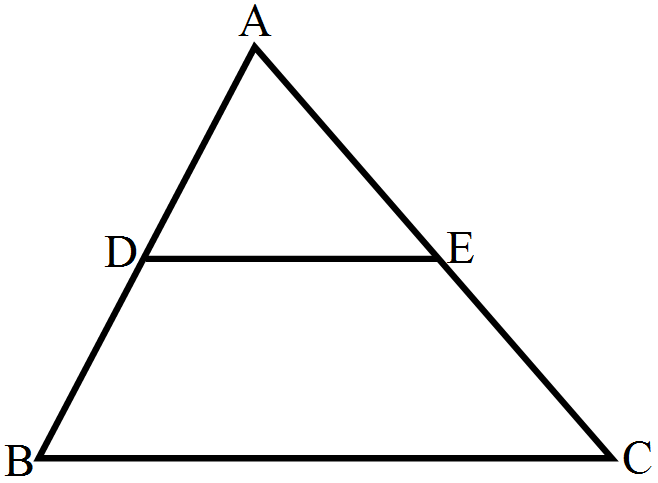
In $\triangle\text{ABC},\text{D}$ and $\text{E}$ are the midpoint of AB and AC respectively. Find the ratio of the areas of $\triangle\text{ADE}$ and $\triangle\text{ABC}.$
Is the pair of linear equation consistent/inconsistent? If consistent, obtain the solution graphically: $x + y = 5, 2x + 2y = 10$
Find the zeros of the following quadratic polynomial and verify the relationship between the zeros and the coefficients:
$4x^2 - 4x + 1$
If 45 is subtracted from twice the greater of two numbers, it result in the other number. If 21 is subtracted from twice the smaller number, it results in the greater number. Find the numbers.
Water flows through a cylindrical pipe, whose inner radius is 1cm, at the rate of 80cm/ sec in an empty cylindrical tank, the radius of whose base is 40cm. What is the rise of water level in tank in half an hour?
The sum of a natural number and its reciprocal is $\frac{65}{8}.$ Find the number.
A number consist of two digits whose sum is five. When the digits are reversed, the number becomes greater by nine. Find the number.
PQ is a post of given height a, and AB is a tower at some distance. If $\alpha$ and $\beta$ are the angles of elevation of B, the top of the tower, at P and Q respectively. Find the height of the tower and its distance from the post.
If $\sec\theta+\tan\theta=\text{p},$ prove that:$\sin\theta=\frac{\text{p}^2-1}{\text{p}^2+1}$