Question
What is meant by pure and impure spectrum?

Answer

Pure spectrum : When rays of white light pass through a prism, each ray forms a spectrum on the screen. If each colour is seen separately in the spectrum, then this type of spectrum is called 'pure spectrum'. The following are the conditions for obtaining a pure spectrum :
(i) The line aperture should be narrow and located at the focus of the converging lens.
(ii) The prism should be in a position of minimum deviation.
(iii) Rays of the same colour emanating from the prism should be focused at one place by the converging lens.
(iv) The incident rays should be parallel.
Impure spectrum : When rays of white light pass through a prism then each ray produces a spectrum on the screen. Due to overlapping of different colors, these colours are not visible separately on the screen. This type of spectrum is called 'impure spectrum'.
Need a full question paper?

Generate a complete, print-ready paper with questions like this in minutes — across 16+ boards, with answer keys.

Start Generating Free

Similar questions

Find the temperature at which the average thermal kinetic energy is equal to the energy needed to take a hydrogen atom from its ground state to $n = 3$ state. Hydrogen can now emit red light of wavelength $653.1\ nm.$ Because of Maxwellian distribution of speeds, a hydrogen sample emits red light at temperatures much lower than that obtained from this problem. Assume that hydrogen molecules dissociate into atoms.
A particle moves in a circle of diameter $1.0\ cm$ under the action of a magnetic field of $0.40T.$ An electric field of $200 Vm^{-1}$ makes the path straight. Find the charge/ mass ratio of the particle.
Draw a schematic ray diagram of reflecting telescope showing how rays coming from a distant object are received at the eye-piece. Write its two important advantages over a refracting telescope.
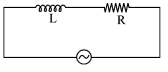
In the given figure, voltage across the ends of inductor ( L ) and resistor ( R ) is 120 V and 90 V respectively. The root mean square value of the current is 3 A. Calculate :
(i) impedance of the circuit and (ii) phase difference between voltage and current.
Image
The following table shows some measurements of the decay rate of a radionuclide sample. Find the disintegration constant.
Time (min) lnR (Bq)
36 5.08
100 3.29
164 1.54
218 0
Figure shows a cart. Complete the table shown.
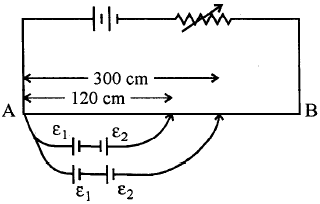
In the figure a long uniform potentiometer wire $AB$ is having a constant potential gradient along its length. The null points for the two primary cells of emfs $\varepsilon_{1}$ and $\varepsilon_{2}$
connected in the manner shown are obtained at a distance of $120 \ cm $ and $300 \ cm$ from the end $A$.
Find $(i) \varepsilon_{1} / \varepsilon_{2}$ and $(ii)$ position of null point for the cell $\varepsilon_{1}$. How is the sensitivity of a potentiometer increased?
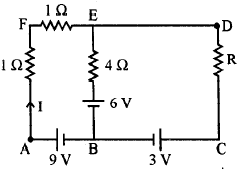
Using Kirchoffs rules determine the value of unknown resistance $R$ in the circuit so that no current flows through 4 $\Omega$ resistance. Also find the potential difference between $A$ and $D.$
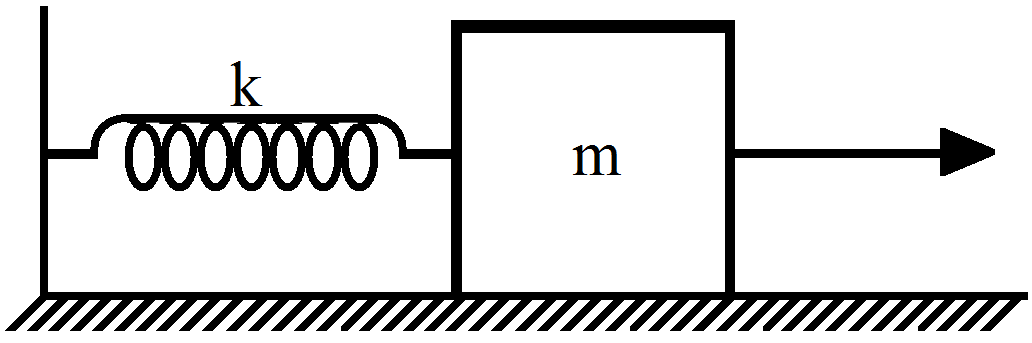
The spring shown in figure is unstretched when a man starts pulling on the cord. The mass of the block is M. If the man exerts a constant force F, find
  1. The amplitude and the time period of the motion of the block,
  2. The energy stored in the spring when the block passes through the equilibrium position and,
  3. The kinetic energy of the block at this position.
Draw a clear and labelled diagram of an alternating current generator.
What is meant by nuclear mass defect?