Question
Prove the following trigonometric identities.
$\frac{1+\tan^2\theta}{1+\cot^2\theta}=\Big(\frac{1-\tan\theta}{1-\cot\theta}\Big)^2=\tan^2\theta$
Answer

$\text{L.H.S}\Rightarrow\ \frac{1+\tan^2\theta}{1+\cot^2\theta}=\frac{\sec^2\theta}{\text{cosec}^2\theta}$
$\big[\because \tan^2\theta+1=\sec^2\theta,\ 1+\cot^2\theta=\text{cosec}^2\theta\big]$
$=\frac{1}{\cos^2\theta\times1}\ \sin^2=\tan^2\theta$
$\Rightarrow\ \Big[\frac{1-\tan\theta}{1-\cot\theta}\Big]^2\Rightarrow\ \Bigg[\frac{1-\tan\theta}{1-\frac{1}{\tan\theta}}\Bigg]^2$
$\Rightarrow\ \Big[\frac{1-\tan\theta}{(1-\tan\theta)}\times\tan\theta\Big]^2=\tan^2\theta$
$\therefore\ \text{L.H.S}=\text{R.H.S}$
Hence proved.

Need a full question paper?

Generate a complete, print-ready paper with questions like this in minutes — across 16+ boards, with answer keys.

Start Generating Free

Similar questions

Sushant has a vessel, of the form of an inverted cone, open at the top, of height $11\ cm$ and radius of top as $2.5\ cm$ and is full of water. Metallic spherical balls each of diameter $0.5\ cm$ are put in the vessel due to which $\Big(\frac{2}{5}\Big)^\text{th}$ of the water in the vessel flows out. Find how many balls were put in the vessel. Sushant made the arrangement so that the water that flows out irrigates the flower beds. What value has been shown by Sushant$?$
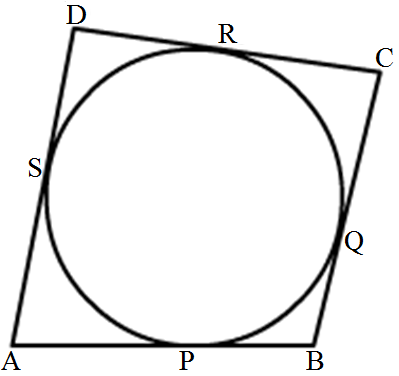
In the given figure, a circle touches all the four sides of a quadrilateral $ABCD$ with $AB = 6\ cm, BC = 7\ cm$ and $CD = 4\ cm.$ Find $AD.$
In a triangle $ABC, N$ is a point on $AC$ such that $\text{BN}\perp\text{AC}.$ If $BN^2= AN × NC,$ prove that $\angle\text{B}=90^\circ.$
Three sets of English, Mathematics and Science books containing $336, 240$ and $96$ books respectively have to be stacked in such a way that all the books are stored subject wise and the higher of each stack is the same. How many stacks will be there$?$
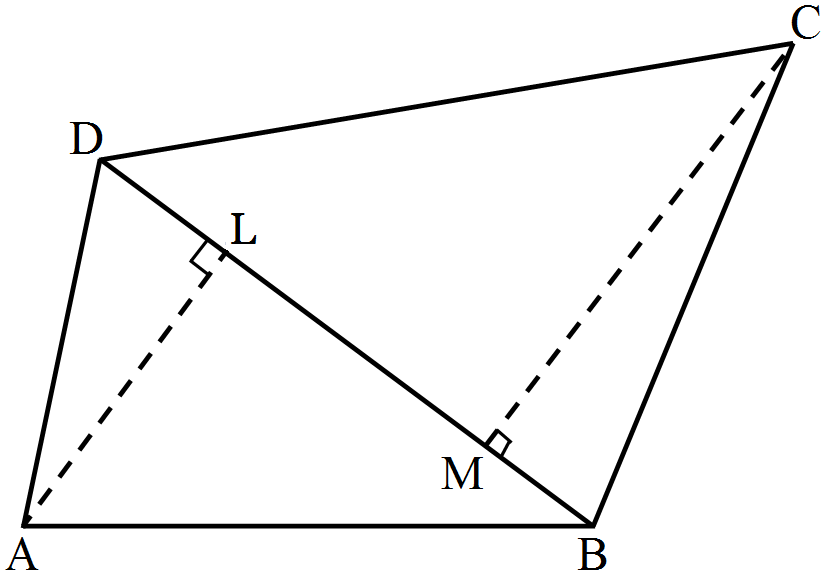
In the given figure, $ABCD$ is a quadrilateral in which diagonal $BD = 24\ cm,\text{AL}\perp\text{BD}$ and $\text{CM}\perp\text{BD}$ such that $AL = 9\ cm$ and $CM = 12\ cm.$ Calculate the area of the quadrilateral.
If the point $A(0, 2)$ is equidistant from the points $B(3, p)$ and $C(p, 5),$ find $p.$ Also, find the length of $AB.$
For what value of k does the system of equations:
$kx + 2y = 5, 3x - 4y = 10$
have;
  1. A unique solution,
  2. No solution?
For what value of $\alpha,$ the system of equations will have no solution
$\alpha\text{x}+3\text{y}=\alpha-3$
$12\text{x}+\alpha\text{y}=\alpha$
If $\cot\theta=\frac{3}{4},$ prove that $\sqrt{\frac{\sec\theta-\text{cosec }\theta}{\sec\theta+\text{cosec }\theta}}=\frac{1}{\sqrt{7}}.$
Compute the mean of following data:
Class
$1-3$
$3-5$
$5-7$
$7-9$
Frequency
$12$
$22$
$27$
$19$