Question
Provide the classification of semi-conductors with example.

Answer

The Semi-conductors can be classified as follows:
(i) Elemental Semi-conductors : $S i$ and Ge
(ii) Compound Semi-conductors :
Example are :
(a) Inorganic : $C d S, G a A s, C d S e, I n P$ etc.
(b) Organic : anthracene, doped pthalocyanines, etc.
(c) Organic polymers : polypyrrole, polyaniline, polythiophene etc.
Most of the currently available semi-conductor devices are based on elemental semiconductors $S i$ or $G e$ and compound inorganic semiconductors.

Need a full question paper?

Generate a complete, print-ready paper with questions like this in minutes — across 16+ boards, with answer keys.
Start Generating Free

Similar questions

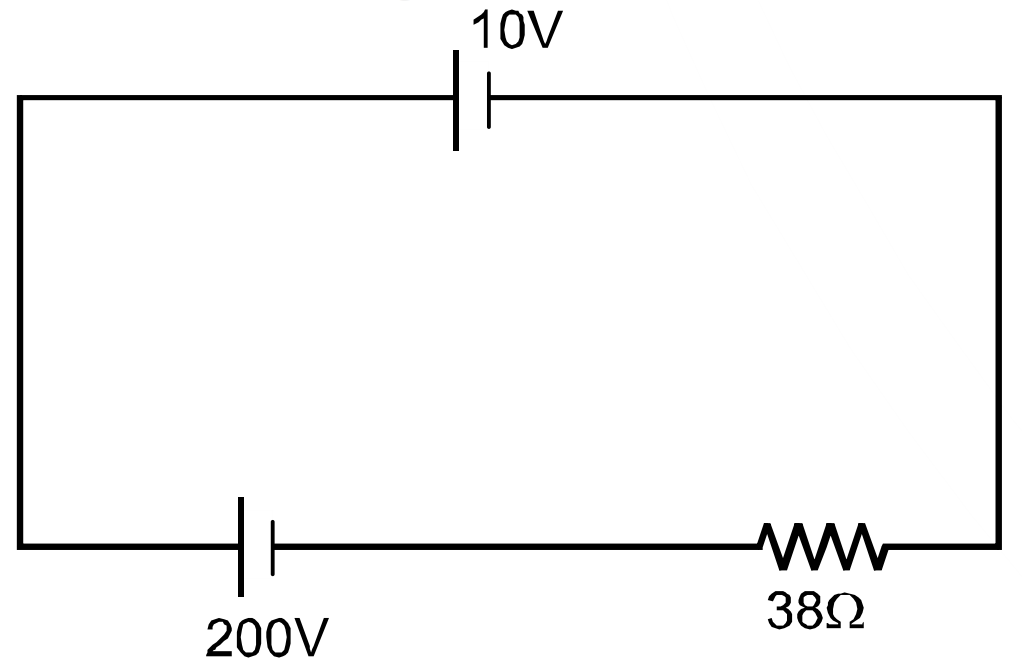
A 10V cell of negligible internal resistance is connected in parallel across a battery of emf 200V and internal resistance $38\Omega$ as shown in the figure. Find the value of current in the circuit.
At a hydroelectric power plant, the water pressure head is at a height of $300m$ and the water flow available is $100\ m^3s^{–1}.$ If the turbine generator efficiency is $60\%$, estimate the electric power available from the plant $(g = 9.8\ ms^{–2}).$
Answer the following questions:
An applied voltage signal consists of a superposition of a dc voltage and an ac voltage of high frequency. The circuit consists of an inductor and a capacitor in series. Show that the dc signal will appear across C and the ac signal across L.
 The oscillating magnetic field in a plane electromagnetic wave is given by $\text{B}_{y} = ( 8 \times 10^{-6}) sin [2\times 10 ^{11}t + 300 \pi\text{x}] T$.
  1. Calculate the wavelength of the electromagnetic wave.
  2. Write down the expression for the oscillating electric field.
What is rms value $($root mean square$)$?
Derive the equation of rms values of voltage and current?
(a) State two important features of Einstein's photoelectric equation.
(b) Radiation of frequency $ 10^{15} $ Hz is incident on two photo-sensitive surfaces P and Q. There is no photoemission from surface P. Photoemission occurs from surface Q but photoelectrons have zero kinetic energy. Explain these observations and find the value of work function for surface.
The net charge in a current-carrying wire is zero. Then, why does a magnetic field exert a force on it?
"The total energy of the electron in the hydrogen atom is negative." What does this fact indicate? If the total energy of the electron was positive than what result will have been achieved?
From what electric dipole of electric field is found and for which two cases is the result simple?
Explain the terms ‘depletion layer’ and ‘potential barrier’ in a $p-n$ junction diode. How are the $(a)$ Width of depletion layer, and $(b)$ Value of potential barrier affected when the $p-n$ junction is forward biased?