MCQ
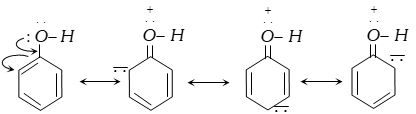
Rate of substitution reaction in phenol is
- ASlower than the rate of benzene
- ✓Faster than the rate of benzene
- CEqual to the rate of benzene
- DNone of these
Generate a complete, print-ready paper with questions like this in minutes — across 16+ boards, with answer keys.
$(I)\,K_3 [Fe(CN_6)]$ $(II)\, [Ni(CO)_4]^0$ $(III)\, [Cr(NH_3)_6]^{3+}$ $(IV)\, [Mn(CN)_6]^{4-}$
Choose the correct code
${C_({graphite)}} + {O_2} \to C{O_2};\,\Delta H = - 393.4\,kJ/mole$
${C_({graphite})} \to {C_{{\rm({diamond})}}};\,\Delta H = $
$1.$ Among the following, the correct statement is
$(A)$ Phosphates have no biological significance in humans
$(B)$ Between nitrates and phosphates, phosphates are less abundant in earth's crust
$(C)$ Between nitrates and phosphates, nitrates are less abundant in earth's crust
$(D)$ Oxidation of nitrates is possible in soil
$2.$ Among the following, the correct statement is
$(A)$ Between $\mathrm{NH}_3$ and $\mathrm{PH}_3, \mathrm{NH}_3$ is better electron donor because the lone pair of electrons occupies spherical ' $\mathrm{s}$ ' orbital and is less directional
$(B)$ Between $\mathrm{NH}_5$ and $\mathrm{PH}_5, \mathrm{PH}_5$ is better electron donor because the lone pair of electrons occupies $\mathrm{sp}^3$ orbital and is more directional
$(C)$ Between $\mathrm{NH}_3$ and $\mathrm{PH}_3, \mathrm{NH}_3$ is a better electron donor because the lone pair of electrons occupies $\mathrm{sp}^3$ orbital and is more directional
$(D)$ Between $\mathrm{NH}_3$ and $\mathrm{PH}_3, \mathrm{PH}_3$ is better electron donor because the lone pair of electrons occupies spherical ' $\mathrm{s}$ ' orbital and is less directional
$3.$ White phosphorus on reaction with $\mathrm{NaOH}$ gives $\mathrm{PH}_3$ as one of the products. This is a
$(A)$ dimerization reaction
$(B)$ disproportionation reaction
$(C)$ condensation reaction
$(D)$ precipitation reaction
Give the answer question $1,2$ and $3.$
$Cr\, | \,Cr^{3+}_{(0.1\,M)}\,||\, Fe^{2+}_{(0.01\, M)}\,|\, Fe$ is ......... $V$