MCQ
Ray optics fails when
  • A
    The size of the obstacle is $5 cm$
  • B
    The size of the obstacle is $3 cm$
  • The size of the obstacle is less than the wavelength of light
  • D
    $(a)$ and $(b)$ both

Answer

Correct option: C.
The size of the obstacle is less than the wavelength of light
c
(c) Ray optics fails if the size of the object is of the order of the wavelength.

Need a full question paper?

Generate a complete, print-ready paper with questions like this in minutes — across 16+ boards, with answer keys.

Start Generating Free

Similar questions

The relation between the number of free electrons in semiconductors $(n) $ and its temperature $ (T)$ is
Two similar thin equi-convex lenses, of focallength feach, are kept coaxially in contact with each other such that the focallength of the combination is $\mathrm{F}_{1}$. When the space between the two lenses is filled with gyoern(which has the same refractive index ( $\mu =1.5$ ) as that of glass then the equivalent focal length is $\mathrm{F}_{2} .$ The ratio $\mathrm{F}_{1}: \mathrm{F}_{2}$ will be


A potentiometer has uniform potential gradient. The specific resistance of the material of the potentiometer wire is $10^{-7} \, ohm-meter$ and the current passing through it is $0.1\, ampere$; cross-section of the wire is $10^{-6}\, m^2$. The potential gradient along the potentiometer wire is
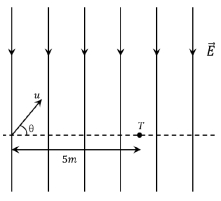
A uniform electric field, $\vec{E}=-400 \sqrt{3} \hat{y} NC ^{-1}$ is applied in a region. A charged particle of mass $m$ carrying positive charge $q$ is projected in this region with an initial speed of $2 \sqrt{10} \times 10^6 ms ^{-1}$. This particle is aimed to hit a target $T$, which is $5 m$ away from its entry point into the field as shown schematically in the figure. Take $\frac{ q }{ m }=10^{10} Ckg ^{-1}$. Then-

$(A)$ the particle will hit $T$ if projected at an angle $45^{\circ}$ from the horizontal

$(B)$ the particle will hit $T$ if projected either at an angle $30^{\circ}$ or $60^{\circ}$ from the horizontal

$(C)$ time taken by the particle to hit $T$ could be $\sqrt{\frac{5}{6}} \mu s$ as well as $\sqrt{\frac{5}{2}} \mu s$

$(D)$ time taken by the particle to hit $T$ is $\sqrt{\frac{5}{3}} \mu s$
Give the SI unit of magnetic dipole moment.
The average value of electric energy density in an electromagnetic wave is :
A planet which is born sister of earth is
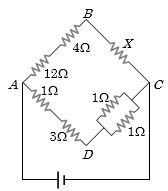
In the circuit shown in the adjoining figure, the current between $B$ and $D$ is zero, the unknown resistance is of ................ $\Omega$
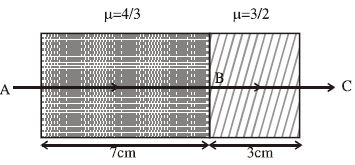
The given figure shows a ray of light passing through two media having refractive indices $4/3$ and $3/2$ respectively. The ratio of times taken by the ray in traversing the distances $AB$ and $BC$ is
A capacitor of reactance $4 \sqrt{3} \Omega$ and a resistor of resistance $4 \Omega$ are connected in series with an ac source of peak value $8 \sqrt{2} \mathrm{~V}$. The power dissipation in the circuit is. . . . .$W$.