Question
Read the case study given below and answer any four subparts:
Potential energy is the energy stored within an object, due to the object's position, arrangement or state. Potential energy is one of the two main forms of energy, along with kinetic energy. Potential energy depends on the force acting on the two objects.

  1. A body is falling freely under the action of gravity alone in vacuum. Which of the following quantities remain constant during the fall?
    1. kinetic energy
    2. potential energy
    3. mechanical energy
    4. none of these
  2. Work done by a conservative force is positive, if
    1. potential energy decreases
    2. potential energy increases
    3. kinetic energy decreases
    4. kinetic energy increases
  3. When does the potential energy of a spring increases?
    1. only when spring is stretched
    2. only when spring is compressed 
    3. both a and b
    4. none of these
  4. Dimension of k/m is, here k is force constant
    1. T2
    2. T-2
    3. T1
    4. T-1
  5. A vehicle of mass 5000kg climbs up a hill of 10 m. The potential energy gained by it
    1. 5J
    2. 500J
    3. 5 × 104J
    4. 5 × 105J

Answer

  1. (c) mechanical energy
  2. (a) potential energy decreases
  3. (c) both a and b
  4. (b) T-2
  5. (d) 5 × 105J

Need a full question paper?

Generate a complete, print-ready paper with questions like this in minutes — across 16+ boards, with answer keys.

Start Generating Free

Similar questions

Read the passage given below and answer the following questions from  1 to 5.
The rules for determining the uncertainty or error in the measured quantity in arithmetic operations can be understood from the following examples.
a.) If the length and breadth of a thin rectangular sheet are measured, using a metre scale as 16.2cm and, 10.1 cm respectively, there are three significant figures in each measurement. It means that the length L may be written as L = 16.2 ± 0.1cm   = 16.2cm ± 0.6%.
Similarly, the breadth b may be written as b = 10.1 ± 0.1 cm = 10.1 cm ± 1%
Then, the error of the product of two (or more) experimental values, using the combination of errors rule, will be L*b = 163.62cm2 + 1.6% = 163.62 + 2.6cm2
This leads us to quote the final result as L*b = 164 + 3cm2. Here 3cm2 is the uncertainty or error in the estimation of area of rectangular sheet.
b) If a set of experimental data is specified to n significant figures a result obtained by combining the data will also be valid to n significant figures.However, if data are subtracted, the number of significant figures can be reduced.For example, 12.9g – 7.06g, both specified to three significant figures, cannot properly be evaluated as 5.84g but only as 5.8g, as uncertainties in subtraction or addition combine in a different fashion (smallest number of decimal places rather than the number of significant figures in any of the number added or subtracted).
c.) The relative error of a value of number specified to significant figures depends not only on n but also on the number itself. For example, the accuracy in measurement of mass 1.02g is ± 0.01g whereas another measurement 9.89g is also accurate to ± 0.01g. The relative error in 1.02g is:
= (± 0.01/1.02) × 100% = ± 1%
Similarly, the relative error in 9.89 g is = (± 0.01/9.89) × 100% = ± 0.1%
Finally, remember that intermediate results in a multi-step computation should be calculated to one more significant figure in every measurement than the number of digits in the least precise measurement.
d.) The nature of a physical quantity is described by its dimensions. All the physical quantities represented by derived units can be expressed in terms of some combination of seven fundamental or base quantities. We shall call these base quantities as the seven dimensions of the physical world, which are denoted with square brackets [ ]. Thus, length has the dimension [L], mass [M], time [T], electric current [A], thermodynamic temperature [K], luminous intensity [cd], and amount of substance [mol]. The dimensions of a physical quantity are the powers (or exponents) to which the base quantities are raised to represent that quantity. Note that using the square brackets [ ] round a quantity means that we are dealing with ‘the dimensions of’ the quantity. In mechanics, all the physical quantities can be written in terms of the dimensions [L], [M] and [T]. For example, the volume occupied by an object is expressed as the product of length, breadth and height, or three lengths. Hence the dimensions of volume are [L] × [L] × [L] = [L3].
  1. Dimensions of area is:
  1. [L2]
  2. [L3]
  3. [M2]
  4. None of these
  1. dimensions of volume are:
  1. [L2]
  2. [L]
  3. [L3]
  4. None of these
  1. What is uncertainty in physics? Explain with one example:
  1. define dimensions of a physical quantity:
  1. Give list for 7 base quantities with dimensions:
Read the passage given below and answer the following questions from (i) to (v).
A motion that repeats itself at regular intervals of time is called periodic motion. Very often, the body undergoing periodic motion has an equilibrium position somewhere inside its path. When the body is at this position no net external force acts on it. Therefore, if it is left there at rest, it remains there forever. If the body is given a small displacement from the position, a force comes into play which tries to bring the body back to the equilibrium point, giving rise to oscillations or vibrations. Every oscillatory motion is periodic, but every periodic motion need not be oscillatory. Circular motion is a periodic motion, but it is not oscillatory. The smallest interval of time after which the motion is repeated is called its period. Let us denote the period by the symbol T. Its SI unit is second. The reciprocal of T gives the number of repetitions that occur per unit time. This quantity is called the frequency of the periodic motion. It is represented by the symbol n. The relation between n and T is $\text{n}=\frac{1}{\text{T}}$. The unit of n is thus s-1. After the discoverer of radio waves, Heinrich Rudolph Hertz (1857–1894), a special name has been given to the unit of frequency. It is called hertz (abbreviated as Hz). Answer the following.
  1. Every oscillatory motion is periodic motion true or false?
  1. True
  2. False
  1. Circular motion is
  1. Oscillatory motion
  2. Periodic motion
  3. Rotational motion
  4. None of these
  1. Define period. Give its SI unit and dimensions
  2. Define frequency of periodic motion. How it is related to time period
  3. What is oscillatory motion
A tungsten cathode and a thoriated-tungsten cathode have the same geometric dimensions and are operated at the same temperature. The thoriated-tungsten cathode gives 5000 times more current than the other cathode. Find the operating temperature. Take relevant data from the previous problem.
Answer the following :
(a) The casing of a rocket in flight burns up due to friction. At whose expense is the heat energy required for burning obtained? The rocket or the atmosphere?
(b) Comets move around the sun in highly elliptical orbits. The gravitational force on the comet due to the sun is not normal to the comet’s velocity in general. Yet the work done by the gravitational force over every complete orbit of the comet is zero. Why?
(c) An artificial satellite orbiting the earth in very thin atmosphere loses its energy gradually due to dissipation against atmospheric resistance, however small. Why then does its speed increase progressively as it comes closer and closer to the earth?
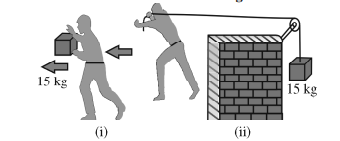
(d) In Fig. (i) the man walks 2m carrying a mass of 15 kg on his hands. In Fig. (ii), he walks the same distance pulling the rope behind him. The rope goes over a pulley, and a mass of 15 kg hangs at its other end. In wich case is the work done greater?
 Image
A solid cylinder of mass 20 kg is rotating about its axis with an angular speed of 100 rad s–1. The radius of the cylinder is 0.25 m. What is the kinetic energy associated with the rotation of the cylinder? What is the magnitude of the angular momentum of the cylinder about its axis?
What can be said about the centre of mass of a uniform hemisphere without making any calculation? Will its distance from the centre be more than $\frac{\text{r}}{2}$ or less than $\frac{\text{r}}{2}?$
Read the passage given below and answer the following questions from 1 to 5.

Rolling Motion
The rolling motion can be regarded as the combination of pure rotation and pure translation. It is also one of the most common motions observed in daily life.

Suppose the rolling motion (without slipping) of a circular disc on a level surface. At any instant, the point of contact P0 of the disc with the surface is at rest (as there is no slipping). If v CM is the velocity of centre of mass which is the geometric centre C of the disc, then the translational velocity of disc is v CM , which is parallel to the level surface. Velocity of centre of mass, $\text{V}_\text{cm}=\text{R}\omega$

  1. A solid cylinder is sliding on a smooth horizontal surface with velocity v0 without rotation. It enters on the rough surface. After that it has travelled some distance, the friction force increases its:
  1. translational kinetic energy
  2. rotational kinetic energy
  3. total mechanical energy
  4. angular momentum about an axis passing through point of contact of the cylinder and the surface
  1. A cylinder rolls down an inclined plane of inclination 30°, the acceleration of cylinder is:
  1. $\frac{\text{g}}{3}$
  2. g
  3. $\frac{\text{g}}{2}$
  4. $\frac{2g}{3}$
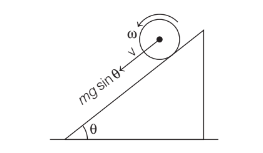
  1. Sphere is in pure accelerated rolling motion in the figure shown:

Choose the correct option.

  1. The direction of fs is upwards
  2. The direction of fs is downwards
  3. The direction of gravitational force is upwards
  4. The direction of normal reaction is downwards
  1. Kinetic energy of a rolling body will be:
  1. $\frac{1}{2}\text{mv}^2_\text{ cm}(\text{l}+\frac{\text{k}^2}{\text{R}^2}\big)$
  2. $\frac{1}{2}\text{I}\infty^2$
  3. $\frac{1}{2}\text{mv}^2\text{cm}$
  4. (d) None of the above
  1. A body is rolling down an inclined plane. Its translational and rotational kinetic energies are equal. The body is a:
  1. solid sphere
  2. hollow sphere
  3. solid cylinder
  4. hollow cylinder
An isolated metal sphere is heated to a high temperature. Will it become positively charged due to thermionic emission?