Question
. Read the paragraph and answer the questions given below:
Disasters can be properly classified into three categories, viz. natural disasters, technological disasters and man-made disasters. The forces that cause natural disasters cannot be controlled. Moreover, they are becoming more frequent in the current years due to phenomena of climate change. On and off incidences of cyclones, cloud bursting, floods, etc. am creating havoc in the lives of people. Technological disasters are due to improper and callous behaviour at the different processes carried out in technical establishments. Man-made disasters are conflicts arising due to different religions, regions and-terrorism.
1.What are three broad areas of disasters?
2.Which disasters cannot be controlled? Why?
3.Which type of disasters were very common in Western Maharashtra in recent times? Why?
4.Give any one example of technological disaster that shook the entire India.
5.Which types of disasters can be controlled in order to lead happy, peaceful and secured life? How?
Answer

1.Natural disasters, technological disasters and manmade disasters are three broad areas of disasters.
2.Natural disasters cannot be controlled as they are due to natural phenomena beyond the human power to stop them.
3.Cloud bursting and floods were very common in Western Maharashtra caused due to climate change.
4.Bhopal gas tragedy that occurred in 1984 was a worst disaster that shook the entire India.
5.We have to control manmade disasters such as wars, riots, terrorism, etc. by having peaceful negotiations, respect for each human being and feeling of brotherhood among all.

Need a full question paper?

Generate a complete, print-ready paper with questions like this in minutes — across 16+ boards, with answer keys.

Start Generating Free

Similar questions

When a black metal compound $XO$ is heated with a colourless gas $Y_2,$ then metal $X$ and another compound $Y_2O$ are formed. Metal $X$ is red-brown in colour which does not react with dilute acids at all. Gas $Y_2$ can be prepared by the action of a dilute acid on any active metal. The compound $Y_2O$ is a liquid at room temperature which can turn anhydrous copper sulphate blue.
  1. What do you think is metal $X?$
  2. What could be gas $Y_2?$
  3. What is compound $XO?$
  4. What is compound $Y_2O?$
  5. Write the chemical equation of the reaction which takes place on heating $XO$ with $Y_2.$
  6. What type of chemical reaction is illustrated in the above equation?
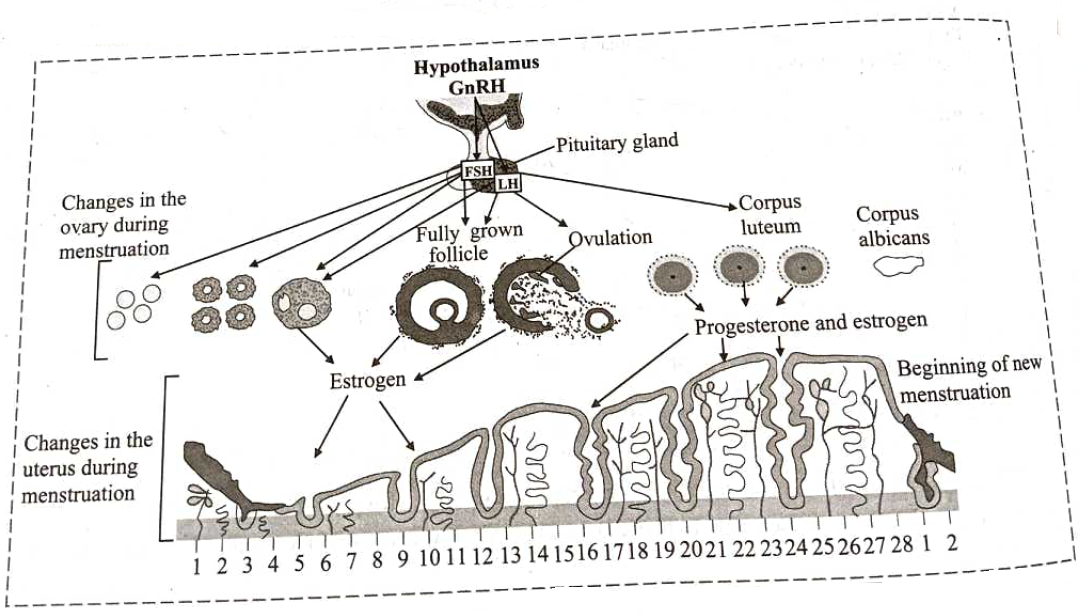
Answer the following questions by observing the diagram of menstrual cycle:
Image
i. What is the period of menstruation?
ii. On which day does ovulation occur during menstrual cycle?
iii. In menstrual cycle which reproductive organs undergo changes?
iv. Which period is said to be period of regeneration of endometrium?
v. Which period is said to be period of secretions of glands in endometrium?
Write the equations for the reactions of:
  1. Magnesium with dilute hydrochloric acid.
  2. Aluminium with dilute hydrochloric acid.
  3. Zinc with dilute hydrochloric acid.
  4. Iron with dilute hydrochloric acid.
Name the products formed in each case. Also indicate the physical states of all the substances involved.
What are the scientific names for the following receptors in animals?
  1. Receptors for light.
  2. Receptors for heat.
  3. Receptors for sound.
  4. Receptors for smell.
  5. Receptors for taste.
Which are the reasons for endangering the species of plants and animals? How can we save those?
Explain in brief the sensitive issues of general public about disaster.
(OR)
Which are the three aspects of disaster tjiat are important for common citizens?
Write a short note.
Regelation

Image

Draw a diagram of the human heart and label its parts.
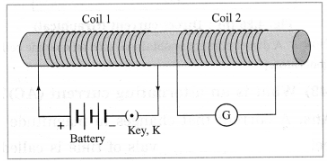
Take two coils of about 50 turns. Insert them over a nonconducting cylindrical roll as shown in Figure.
Image

(A thick paper roll can be used.) Connect coil 1 to a battery with a plug key K. Connect coil 2 to a galvanometer G. (1) Plug the key and observe the deflection in the galvanometer. (2) Unplug the key and again observe the deflection.
Note your observations. What conclusions do you draw from these observations?