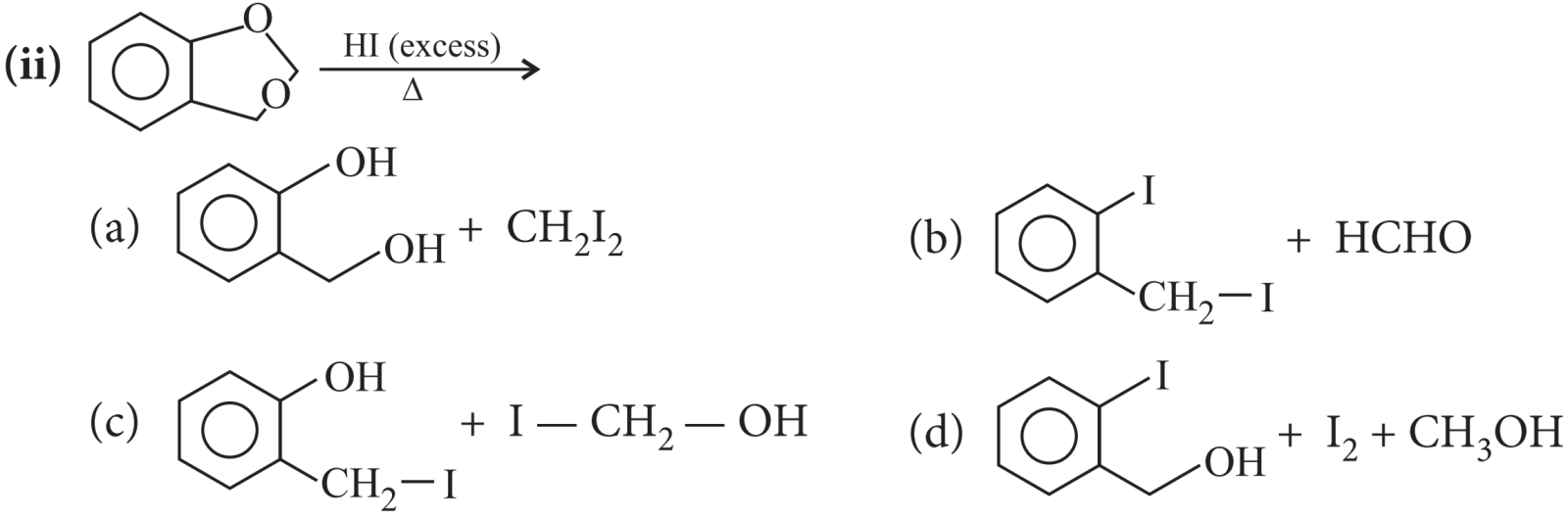
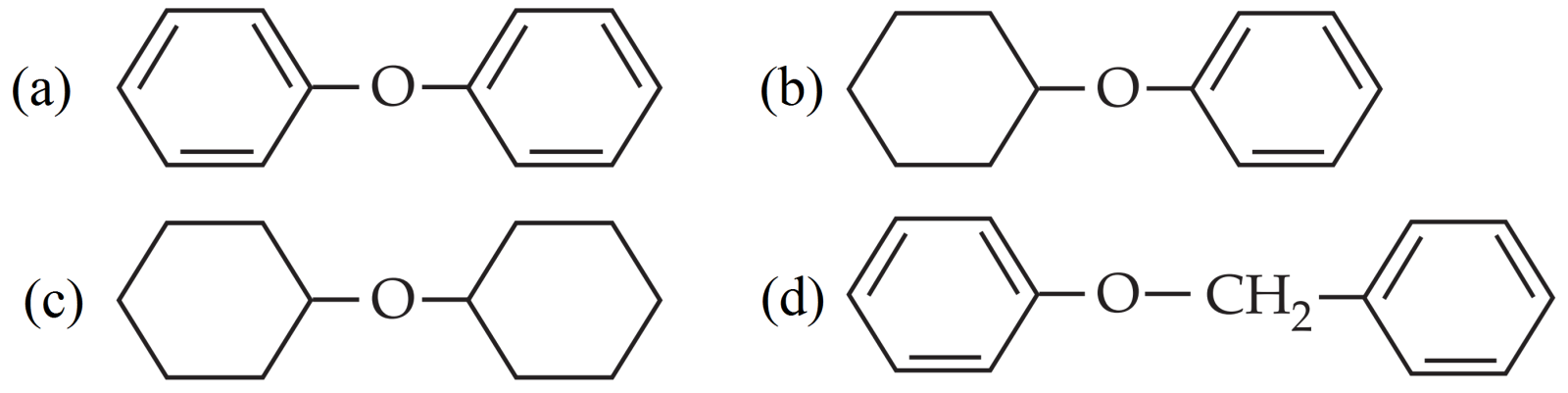
Question
Read the passage given below and answer the following questions:

Due to intermolecular hydrogen bonding, the boiling points of alcohols and phenols are much higher than those of corresponding haloalkanes, haloarenes, aliphatic and aromatic hydrocarbons. Among isomeric alcohols, the boiling points follow the order: primary > secondary > tertiary. Boiling points of ethers are much lower than those of isomeric alcohols. The solubility of alcohols in water decreases as the molecular mass of alcohols increases. Amongst isomeric alcohols solubility increases with branching. The solubility of phenols in water is much lower than that of alcohols. Lower ethers such as dimethyl ether and ethyl methyl ether are soluble in water, but the solubility decreases as the molecular mass increases.

In these questions (Q. No. i-iv), a statement of assertion followed by a statement of reason is given. Choose the correct answer out of the following choices.

  1. Assertion and reason both are correct statements and reason is correct explanation for assertion.
  2. Assertion and reason both are correct statements but reason is not correct explanation for assertion.
  3. Assertion is correct statement but reason is wrong statement.
  4. Assertion is wrong statement but reason is correct statement.
  1. Assertion: Alcohols have higher boiling points than ethers of comparable molecular masses.

Reason: Alcohols and ethers are isomeric in nature.

  1. Assertion: The solubility of phenols in water is much lower than that of alcohols.

Reason: Phenols do not form H-bonds with water.

  1. Assertion: Among n-butane, ethoxyethane, 1-propanol and 2-propanol, the increasing order of boiling points is, 1-butanol < 1-propanol < ethoxyethane < n-butane.

Reason: Boiling point increases with increase in molecular mass.

  1. Assertion: Dimethyl ether and diethylether are soluble in water.

Reason: As the molecular mass increases, solubility of ethers in water decreases.

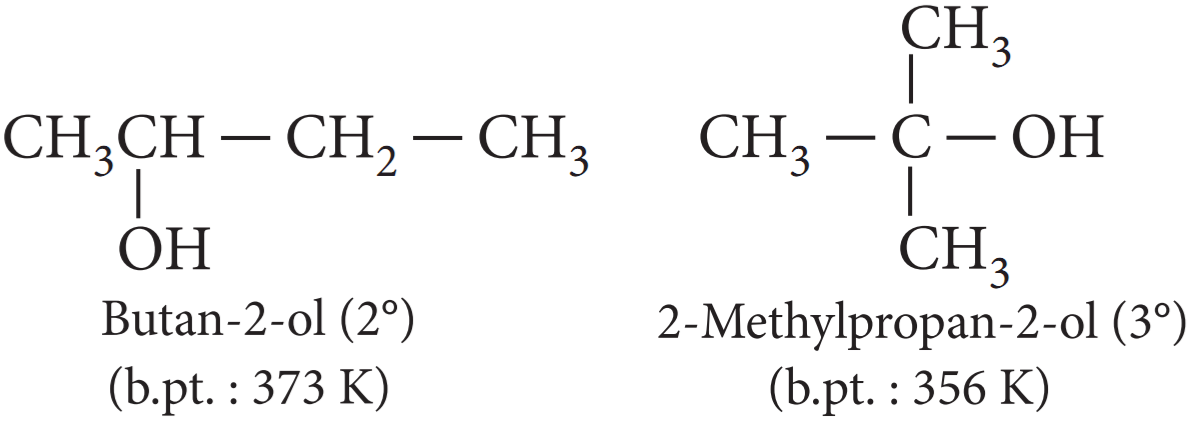
  1. Assertion: Butan-2-ol has higher boiling point than 2-methylpropan-2-ol.

Reason: Amongst isomeric alcohols, the boiling points decreases with branching.
Answer

  1. (b) Assertion and reason both are correct statements but reason is not correct explanation for assertion.

Explanation:

Due to the presence of intermolecular H-bondi ng in alcohols, they have higher boiling points than isomeric ethers.

  1. (c) Assertion is correct statement but reason is wrong statement.

​​​​​​​Explanation:

Like alcohols, phenols also form H-bond with water. But the solubility of phenols in water is much lower than that of alcohols because of the larger non-polar hydrocarbon part (benzene ring) present in their molecules.

  1. (d) Assertion is wrong statement but reason is correct statement.

​​​​​​​​​​​​​​​​​​​​​Explanation:

Boiling point increases with increase in molecular mass so, 1-butanol has higher boiling point than 1-propanol. Ethers do not form hydrogen bonds thus, they have lower boiling points than the corresponding alcohols.

Due to weak dipole-dipole interactions, the boiling points of lower ethers are only slightly higher than those of the n-alkanes having comparable molecular masses,

Thus, the increasing order of boiling points is n-butane < ethoxyethane < 1-propanol < l-butanol.

  1. (b) Assertion and reason both are correct statements but reason is not correct explanation for assertion.

​​​​​​​​​​​​​​​​​​​​​​​​​​​​Explanation:

The solubility of lower ethers in water is due to the formation of H-bonds between water and ether molecules. As the molecular mass increases, the solubility of ethers in water decreases due to corresponding increase in the hydrocarbon portion of the molecule.

  1. (a) Assertion and reason both are correct statements and reason is correct explanation for assertion.

​​​​​​​​​​​​​​​​​​​​​​​​​​​​​​​​​​​Explanation:

Amongst isomeric alcohols,the boiling points decrease with branching due to a corresponding decrease in surface area.

Need a full question paper?

Generate a complete, print-ready paper with questions like this in minutes — across 16+ boards, with answer keys.

Start Generating Free

Similar questions

The potential of each electrode is known as electrode potential. Standard electrode potential is the potential when concentration of each species taking part in electrode reaction is unity and the reaction is taking place at 298K. By convention, the standard electrode potential of hydrogen (SHE) is 0.0V. The electrode potential value for each electrode process is a measure of relative tendency of the active species in the process to remain in the oxidised/ reduced form. The negative electrode potential means that the redox couple is stronger reducing agent than $\frac{\text{H}^+}{\text{H}_2}$ couple. A positive electrode potential means that the redox couple is a weaker reducing agent than the $\frac{\text{H}^+}{\text{H}_2}$ couple. Metals which have higher positive value of standard reduction potential form the oxides of greater thermal stability.

In these questions (Q. No. i-iv), a statement of assertion followed by a statement ofreason is given. Choose the correct answer out of the following choices.

  1. Assertion and reason both are correct statements and reason is correct explanation for assertion.
  2. Assertion and reason both are correct statements but reason is not correct explanation for assertion.
  3. Assertion is correct statement but reason is wrong statement.
  4. Assertion is wrong statement but reason is correct statement.
  1. Assertion: An electrochemical cell can be set-up only if the redox reaction is spontaneous.

Reason: A reaction is spontaneous if the free energy change is negative.

  1. Assertion: The standard electrode potential of hydrogen is 0.0V.

Reason: It is by convention.

  1. Assertion: The more negative is the standard reduction potential, greater is its ability to displace H2 from acid.

Reason: Strength of reducing agent increases with the increase in negative value of the standard reduction potential.

  1. Assertion: The negative value of standard reduction potential means that reduction takes place on this electrode with reference to hydrogen electrode.

Reason: The standard electrode potential of a half cell has a fixed value.

  1. Assertion: The absolute value of electrode potential cannot be determined experimentally.

Reason: The electrode potential values are generally determined with respect to SHE.

Read the passage given below and answer the following questions:

When a solution of an et-amino acid is placed in an electric field depending on the pH of the medium, following three cases may happen.

  1. In alkaline solution, CL-amino acids exist as anion II, and there is a net migration of amino acid towards the anode.
  2. In acidic solution, a-amino acids exist as cation III, and there is a net migration of amino acid towards the cathode.
  3. If II and III are exactly balanced there is no net migration; under such conditions any one molecule exists as a positive ion and as a negative ion for exactly the same amount of time, and any small movement in the direction of one electrode is subsequently cancelled by an equal movement back toward the other electrode. The pH of the solution in which a particular amino acid does not migrate under the influence of an electric field is called the is oelectric point of that amino acid.

The following questions are multiple choice questions. Choose the most appropriate answer:

  1.  

Arrange in order of increasing acid strengths. 

  1. X > Z > Y
  2. Z < X < Y
  3. X > Y > Z
  4. Z > X > Y
  1. In aqueous solutions, amino acids mostly exist as:
  1. NH2 - CHR - COOH
  2. NH2 - CHR - COO-
  3. $\stackrel{+}{\hbox{ N}}\text{H}_3\text{CHRCOOH}$

  4. $\text{H}_3\stackrel{{+}}{\hbox{N}}\text{CHRCOO}^-$

  1. Amino acids are least soluble:
  1. at pH 1
  2. at pH 7
  3. At their isoelectric points.
  4. None of these.
  1. The $\text{pK}_{\text{a}_1}$ and $\text{pK}_{\text{a}_2}$ of an amino acid are 2.3 and 9.7 respectively. The is oelectric point of the amino acid is:
  1. 12.0
  2. 7.4
  3. 6.0
  4. 3.7
  1. A tripeptide (X) on partial hydrolysis gave two dipeptides Cys-Gly and Glu-Cys. Identify the tripeptide.
  1. Glu-Cys-Gly
  2. Gly-Glu-Cys
  3. Cys-Gly-Glu
  4. Cys-Glu-Gly
Read the passage given below and answer the following questions:
Nucleophilic substitution reactions are of two types; substitution nucleophilic bimolecular (SN2) and substitution nucleophilic unimolecular (SN1) depending on molecules taking part in determining the rate of reaction. Reactivity of alkyl halide towards SN1 and SN2 reactions depends on various factors such as steric hindrance, stability of intermediate or transition state, and polarity of solvent. SN2 reaction mechanism is favoured mostly by primary alkyl halide then secondary and then tertiary. This order is reversed in case of SN1 reactions.
The following questions are multiple choice questions. Choose the most appropriate answer:
  1. Which of the following is most reactive towards nucleophilic substitution reaction?
  1. C6H5Cl
  2. CH2 = CHCl
  3. ClCH2CH = CH2
  4. CH3CH = CHCl
  1. Isopropyl chloride undergoes hydrolysis by:
  1. SN1 mechanism.
  2. SN2 mechanism.
  3. SN1 and SN2 mechanism.
  4. Neither SN1 nor SN2 mechanism.
  1. The most reactive nucleophile among the following is:
  1. CH3O-
  2. C6H5O-
  3. (CH3)2CHO-
  4. (CH3)3CO-
  1. Tertiary alkyl halides are practically inert to substitution by SN2 mechanism because of:
  1. Insolubility.
  2. Instability.
  3. Inductive effect.
  4. Stearic hindrance.
  1. Which of the following is the correct order of decreasing SN2 reactivity?
  1. RCH2X > R2CHX > R3CX
  2. R3CX > R2CHX > RCH2X
  3. R2CHX > R3CX > RCH2X
  4. RCH2X > R3CX > R2CHX

Read the passage given below and answer the following questions:

Ethers are readily cleaved by HI or HBr at 373K to form an alcohol and an alkyl halide.

$\text{R}-\text{O}-\text{R}+\text{HX}\xrightarrow{373\text{K}}\text{R}-\text{X}+\text{R}-\text{OH}$

$\text{R}-\text{OH}+\text{HX}\xrightarrow{373\text{K}}\text{R}-\text{X}+\text{H}_2\text{O}$

Mixed ether, containing primary or secondary alkyl group, when heated with hydrogen halide, the lower alkyl group forms halide and higher will form an alcohol. Tertiary alkyl ether when heated with hydrogen halide gives tertiary alkyl halide.

The following questions are multiple choice questions. Choose the most appropriate answer:

  1. Among the following ethers, which one will produce methyl alcohol on treatment with hot concentrated HI?
  1. $\ \ \ \ \ \ \ \ \ \ \ \ \text{CH}_3\\\ \ \ \ \ \ \ \ \ \ \ \ \ \ |\\\text{CH}_3-\text{C}-\text{O}- \text{CH}_3\\\ \ \ \ \ \ \ \ \ \ \ \ \ \ |\\\ \ \ \ \ \ \ \ \ \ \ \ \ \text{CH}_3 $

  2. $\text{CH}_3-\text{CH}-\text{CH}_2-\text{O}-\text{CH}_3\\\ \ \ \ \ \ \ \ \ \ \ \ \ |\\\ \ \ \ \ \ \ \ \ \ \ \text{CH}_3$

  3. $\text{CH}_3-\text{CH}_2-\text{CH}_2-\text{CH}_2-\text{O}-\text{CH}_3$

  4. $\text{CH}_3-\text{CH}_2-\text{CH}-\text{O}-\text{CH}_3\\\ \ \ \ \ \ \ \ \ \ \ \ \ \ \ \ \ \ \ \ \ \ \ \ \ \ |\\\ \ \ \ \ \ \ \ \ \ \ \ \ \ \ \ \ \ \ \ \ \ \ \ \ \text{CH}_3$

  1. When CH2 = CH - O - CH2 - CH3 reacts with one mole of HI, one of the products formed is:
  1. Ethane.
  2. Ethanol.
  3. Iodoethene.
  4. Ethanal.
  1. (CH3)3COCH3 and CH3OC2H5 are treated with hydroiodic acid. The fragments obtained after reactions are respectively:
  1. (CH3)3CI + CH3OH; CH3I + C2H5OH

  2. (CH3)3CI + CH3OH; CH3OH + C2H5I

  3. (CH3)3COH + CH3I; CH3OH + C2H5I

  4. CH3I + (CH3)3COH; CH3I + C2H5OH

  1. Which of the following ether is unlikely to be cleaved by hot cone. HBr?

Read the passage given below and answer the following questions:

A primary alkyl halide (A) C4H9Br reacted with akoholic KOH to give compound (B). Compound (B) is reacted with HBr to give compound (C) which is an isomer of (A). When (A) reacted with sodium metal, it gave a compound (D) C8H18 that is different than the compound obtained when n-butyl bromide reacted with sodium metal.

The following questions are multiple choice questions. Choose the most appropriate answer:

  1. Compound (A) is:
  1. CH3CH2CH2CH2Br

  2. $\text{CH}_3\text{CH}-\text{CH}_2\text{Br}\\\ \ \ \ \ \ \ \ \ |\\\ \ \ \ \ \ \ \ \text{CH}_3$

  3. $\ \ \ \ \ \ \ \ \ \ \ \ \ \ \text{CH}_3\\\ \ \ \ \ \ \ \ \ \ \ \ \ \ \ |\\\text{CH}_3-\text{C}-\text{Br} \\\ \ \ \ \ \ \ \ \ \ \ \ \ \ \ \ |\\\ \ \ \ \ \ \ \ \ \ \ \ \ \ \ \text{CH}_3$

  4. CH3CH2CH2Br

  1. Which type of isomerism is present in compound (A) and (C)?
  1. Positional
  2. Functional
  3. Chain
  4. Both (a) and (c)
  1. Identify compound (B).
  1. $\text{CH}_3-\text{C}=\text{CH}_2 \ \ \\ \ \ \ \ \ \ \ \ \ \ \ \ \ \mid \\ \ \ \ \ \ \ \ \ \ \ \ \text{CH}_3$
  2. CH3 – CH = CH – CH3
  3. CH3 – CH2 – CH = CH2
  4. None of these.
  1. IUPAC name of compound (D) is:
  1. N - octane
  2. 2, 5 - dimethylhexane
  3. 2 - methylheptane
  4. 3, 4 - dimethyl hexane.
  1. When compoound (C) is treated with ale. KOH and then treated with presence of peroxide, the compound obtained is:
  1. $\ \ \ \ \ \ \ \ \ \ \ \ \ \ \text{CH}_3\\\ \ \ \ \ \ \ \ \ \ \ \ \ \ \ |\\\text{CH}_3-\text{C}-\text{Br} \\\ \ \ \ \ \ \ \ \ \ \ \ \ \ \ \ |\\\ \ \ \ \ \ \ \ \ \ \ \ \ \ \ \text{CH}_3$

  2. $\ \ \ \ \ \ \ \ \ \ \ \ \ \ \text{CH}_3\\\ \ \ \ \ \ \ \ \ \ \ \ \ \ \ |\\\text{CH}_3-\text{CH}-\text{CH}_2-\text{Br}$

  3. $\text{CH}_3\text{CH}_2\text{CH}_2\text{CH}_2\text{Br}$

  4. $$$\text{CH}_3\text{CH}_2\text{CH}_2\text{CH}-\text{Br}\\\ \ \ \ \ \ \ \ \ \ \ \ \ \ \ \ \ \ \ \ \ \ \ \ \ |\\\ \ \ \ \ \ \ \ \ \ \ \ \ \ \ \ \ \ \ \ \ \ \ \ \text{CH}_3$

The following reaction, $\text{A}_{(\text{g})}\xrightarrow{\ \ \triangle\ \ \ }\text{P}_{(\text{g})}+\text{Q}_{(\text{g})}+\text{R}_{(\text{g})},$ follows first order kinetics. The half-life period of this reaction is 69.3s at 500ºC. The gas A is enclosed in a container at 500ºC and at a pressure of 0.4 atm.
The following questions are multiple choice questions. Choose the most appropriate answer:
  1. The rate constant for the reaction is:
  1. 0.4s-1
  2. 0.02s-1
  3. 0.01s-1
  4. 0.3s-1
  1. The pressure of the gas A after 230 s will be:
  1. 0.04 atm
  2. 0.36 atm
  3. 0.4 atm
  4. 0.036 atm
  1. The total pressure of the system after 230 swill be:
  1. 2.15 atm
  2. 1.12 atm
  3. 0.4 atm
  4. 3.08 atm
  1. The plot ofln[A] vs twill be:
  1. Linear with slope = k
  2. Linear with intercept = In[A]0
  3. Linear with slope = In[A]0
  4. Linear with intercept = [A]0
  1. Which of the following is not an example of first order reaction?
  1. $\text{C}_2\text{H}_{4(\text{g})}+\text{H}_{2(\text{g})}\rightarrow\text{C}_2\text{H}_{6(\text{g})}$
  2. $2\text{N}_2\text{O}_{5(\text{g})}\rightarrow4\text{NO}_{2(\text{g})}+\text{O}_{2(\text{g})}$
  3. $2\text{N}\text{H}_{3(\text{g})}\xrightarrow[\triangle]{\text{pt}}\text{N}_{2(\text{g})}+3\text{H}_{2(\text{g})}$
  4. $2\text{N}_2\text{O}_{(\text{g})}\xrightarrow{\ \ \triangle\ \ }2\text{N}_{2(\text{g})}+\text{O}_{2(\text{g})}$
Electrical work done in unit time is equal to electrical potential multiplied by total charge passed. ln order to obtain maximum work from a cell, the charge has to be passed reversibly. The reversible work done by a cell is equal to decrease in its Gibb's energy. Hence, Gibb's energy of reaction is given by

$\Delta\text{G}=\text{nFE}_\text{cell}$

Hence, Eis the emfof the cell and nFis the amount of energy.

In these questions (Q. No. i-Iv), a statement of assertion followed by a statement ofreason is given. Choose the correct answer out of the following choices.

  1. Assertion and reason both are correct statements and reason is correct explanation for assertion.
  2. Assertion and reason both are correct statements but reason is not correct explanation for assertion.
  3. Assertion is correct statement but reason is wrong statement.
  4. Assertion is wrong statement but reason is correct statement.
  1. Assertion: $\Delta\text{G}^\circ=-\text{nFE}^\circ$

Reason: Eº should be positive for a spontaneous reaction.

  1. Assertion: An electrochemical cell can be set up only if the red ox reaction is spontaneous.

Reason: A reaction is spontaneous if free energy change is negative.

  1. Assertion: For an electrochemical cell, $\Delta\text{G}<0$ and $\text{E}_\text{cell}>0.$

Reason: The given cell is non-spontaneous.

  1. Assertion: Current stops flowing when Ecell = 0.

Reason: Equilibrium of the cell reaction is attained.

  1. Assertion: Ecell should have a positive value for the cell to function.

Reason: Ecell = Ecathode - Eanode

What is fructose? Explain the structure of fructose.
Read the passage given below and answer the following questions:

The sequence of bases along the DNA and RNA chain establishes its primary structure which controls the specific properties of the nucleic acid. An RNA molecule is usually a single chain ofribose-containing nucleotide. On the basis of X-ray analysis of DNA, J.D., Watson and EH.C. crick (shared noble prize in 1962) proposed a three dimensional secondary structure for DNA. DNA molecule is a long and highly complex, spirally twisted, double helix, ladder like structure. The two polynucleotide chains or strands are linked up by hydrogen bonding between the nitrogeneous base molecules of their nucleotide monomers. Adenine (purine) always links with thymine (pyrimidine) with the help of two hydrogen bonds and guanine (purine) with cytosine (pyrimidine) with the help of three hydrogen bonds. Hence, the two strands extend in opposite directions, i.e., are antiparallel and complimentary.

  1. Assertion and reason both are correct statements and reason is correct explanation for assertion.
  2. Assertion and reason both are correct statements but reason is not correct explanation for assertion.
  3. Assertion is correct statement but reason is wrong statement.
  4. Assertion is wrong statement but reason is correct statement.
  1. Assertion: DNA molecules and RNA molecules are found in the nucleus of a cell.

Reason: There are two types of nitrogenous bases, purines and pyrimidines. Adenine (A) and guanine (G) are substituted purines; cytosine (C), thymine (T) and uracil (U) are substituted pyrimidines.

  1. Assertion: In both DNA and RNA, heterocyclic base and phosphate ester linkages are at C-1' and C-5' respectively of the sugar molecule.

Reason: Nucleotides and nucleosides mainly differ from each other in presence of phosphate units.

  1. Assertion: The backbone of RNA molecule is a linear chain consisting of an alternating units of a heterocylic base, D-ribose and a phosphate.

Reason: The segment of DNA which acts as the instruction manual for the synthesis of protein is ribose.

  1. Assertion: The double helical structure of DNA was proposed by Emil Fischer.

Reason: A nucleoside is an N-glycoside of heterocyclic base.

  1. Assertion: In DNA, the complementary bases are, adenine and guanine; thymine and cytosine.

Reason: The phenomenon of mutation is chemical change in DNA molecule.

Describe detailed information on classification of carbohydrates.