Question
Read the passage given below and answer the following questions
Few colligative properties are:
  1. Relative lowering of vapour pressure: depends only on molar concentration of solute $($mole fraction$)$ and independent of its nature.
  2. Depression in freezing point: it is proportional to the molal concentration of solution.
  3. Elevation of boiling point: it is proportional to the molal concentration of solute.
  4. Osmotic pressure: it is proportional to the molar concentration of solute
A solution of glucose is prepared with $0.052 g$ at glucose in $80.2 g$ of water.$(KJ = 1.86K \ \text{kg \ mol}^{-1}$ and $K_b = 5.2K \ \text{kg \ mol}^{-1})$
The following questions are multiple choice questions. Choose the most appropriate answer:
  1. Molality of the given solution is.
  1. $0.0052m$
  2. $0.0036m$
  3. $0.0006m$
  4. $1.29m$
  1. Boiling point for the solution will be.
  1. $373.05K$
  2. $373.15K$
  3. $373.02K$
  4. $373.02K$
  1. The depression in freezing point of solution will be.
  1. $0.0187K$
  2. $0.035K$
  3. $0.082K$
  4. $0.067K$
  1. Mole fraction of glucose in the given solution is.
  1. $6.28 \times 10^{-5}$
  2. $6.28 \times 10^{-4}$
  3. $0.00625$
  4. $0.00028$
  1. If same amount of sucrose $\ce{(C_{12} H_{22} O_{11})}$ is taken instead of glucose, then.
  1. Elevation in boiling point will be higher.
  2. Depression in freezing point will be higher.
  3. Depression in freezing point will be lower.
  4. Both $(a)$ and $(b).$

Answer

  1. $(b) \ 0.0036\ m$
$\text{m}=\frac{0.052}{180}\times\frac{1000}{80.2}=0.0036$
  1. $(c) \ 373.02K$
$\Delta\text{T}_\text{b}=\text{k}_\text{b}\times\text{m}=5.2\times0.0036=0.0187\ \text{K}$
$T_b = 373 + 0.0187 = 373.0187 K $ approx $ 373.02 K$
  1. $(d)\  0.067 K$
$\Delta\text{T}_\text{f}=\text{k}_\text{f}\times\text{m}=1.86\times0.0036=0.067\ \text{K}$
  1. $(a) \ 6.28 \times 10^{-5}$
Moles of water $\frac{80.2}{18}=4.455$
Mole fraction of glucose $=\frac{0.00028}{4.45+0.00028}=6.28\times10^{-5}$
  1. $(c)$ Depression in freezing point will be lower.
Depression in freezing point or elevation in boiling point is proportional to molarity, which is proportional to number of moles.
For same amount, higher the molar mass of solute, lower will be number of moles.
Hence, lower will be the colligative property.

Need a full question paper?

Generate a complete, print-ready paper with questions like this in minutes — across 16+ boards, with answer keys.

Start Generating Free

Similar questions

Read the passage given below and answer the following questions: Carbohydrates are polyhydroxy aldehydes and ketones and those compounds which on hydrolysis give such compounds are also carbohydrates. The carbohydrates which are not hydrolysed are called monosaccharides. Monosaccharides with aldehydic group are called aldose and those which free ketonic groups are called ketose. Carbohydrates are optically active. Number of optical isomers $= 2^n$ Where $n =$ numberofasymmetric carbons. Carbohydrates are mainlysynthesised by plants during photosynthesis. The monosaccharides give the characteristic reactions of alcohols and carbonyl group $($aldehydes and ketones$).$ It has been found that these monosaccharides exist in the form of cyclic structures. In cyctization, the $-OH$ groups $($generally $C_5$ or $C_4$ in aldohexoses and $C_5$ or $C_6$ in ketohexoses$)$ combine with the aldehyde or keto group. As a result, cyclic structures of five or six membered rings containing one oxygen atom are formed, e.g., glucose forms a ring structure. Glucose contains one aldehyde group, one $IO$ alcoholic group and four $2^\circ$ alcoholic groups in its open chain structure. The following questions are multiple choice questions. Choose the most appropriate answer:
  1. First member of ketos sugar is:
  1. Ketotriose.
  2. Ketotetrose.
  3. Ketopentose.
  4. Ketohexose.
  1. In $\ce{CH_2OHCHOHCHOHCHOHCHOHCHO,}$ the number of optical isomers will be:
  1. $16$
  2. $8$
  3. $32$
  4. $4$
  1. Some statements are given below:
  1. Glucose is aldohexose.
  2. Naturally occurring glucose is dextrorotatory.
  3. Glucose contains three chiral centres.
  4. Glucose contains one $1^\circ $ alcoholic group and four $2^\circ$ alcoholic groups.
Among the above, correct statements are:
  1. $1$ and $2$ only
  2. $3$ and $4$ only
  3. $1, 2$ and $4$ only
  4. $1, 2, 3$ and $4$
  1. Two hexoses fonn the same osazone, find the correct statement about these hexoses.
  1. Both of them must be aldoses.
  2. They are epimers at $C-3.$
  3. The carbon atoms $I$ and $2$ in both have the same configuration.
  4. The carbon atoms $3, 4$ and $5$ in both have the same configuration.
  1. Which of the following reactions of glucose can be explained only by its cyclic structure?
  1. Glucose forms cyanohydrin with $\text{HCN}.$
  2. Glucose reacts with hydroxylamine to form an oxime.
  3. Pentaacetate of glucose does not react with hydroxylamine.
  4. Glucose is oxidised by nitric acid to gluconic acid.
For a reaction, $A + B \rightarrow$ Products, the rate law is $-$ Rate $= k[A][B]^{3/2}$ Can the reaction be an elementary reaction? Explain.
Read the passage given below and answer the following questions:
Coordination compounds are formulated and named according to the $\text{IUPAC}$ system.
Few rules for naming coordination compounds are:
  1. In ionic complex, the cation is named first and then the anion.
  2. In the coordination entity, the ligands are named first and then the central metal ion.
  3. When more than one type of ligands are present, they are named in alphabetical order of preference without any consideration of charge.
The following questions are multiple choice questions. Choose the most appropriate answer:
  1. The $\ce{[Pt(NH_3)_3Br(NO_2)Cl]Cl}$ name of the complex $\ce{[Pt(NH_3)_3Br(NO_2)Cl]Cl}$ is:
  1. Triamminechlorobromonitroplatinum $(IV)$ chloride.
  2. Triamminebromonitrochloroplatinum $(IV)$ chloride.
  3. Triamminebromidochloridonitroplatinum $(IV)$ chloride.
  4. Triamminenitrochlorobromoplatinum $(IV)$ chloride.
  1. The $\text{IUPAC}$ name of $\ce{[Ni(CO)_4]}$ is:
  1. Tetracarbonylnickel $(II).$
  2. Tetracarbonylnickel $(0).$
  3. Tetracarbonylnickelate $(II).$
  4. Tetracarbonylnickelate $(0).$
  1. As per $\text{IUPAC}$ nomenclature, the name of the complex $\ce{[Co(H_2O)_4(NH_3)_2]Cl_3}$ is:
  1. Tetraaquadiamminecobalt $(II)$ chloride.
  2. Tetraaquadiamminecobalt $(III)$ chloride.
  3. Diamminetetraaquacobalt $(II)$ chloride.
  4. Diamminetetraaquacobalt $(III)$ chloride.
  1. Which of the following represents correct formula of dichloridobis $($ethane $-1, 2-$diamine$)$ cobalt $(III)$ ion?
  1. $\ce{[CoCl_2(en)]^{2+}}$
  2. $\ce{[CoCl_2(en)_2]^{2+}}$
  3. $\ce{[CoCl_2(en)]^+}$
  4. $\ce{[CoCl_2(en)_2]^+}$
  1. Correct formula of pentaamminenitro$-O-$cobalt $(III)$ sulphate is:
  1. $\ce{[Co(NO_2)(NH_3)_5]SO_4}$
  2. $\ce{[Co(ONO)(NH_3)_5]SO_4}$
  3. $\ce{[Co(NO_2)(NH_3)_4](SO_4)_2}$
  4. $\ce{[Co(ONO)(NH_3)_4](SO_4)_2}$
Describe detailed information on classification of carbohydrates.
Read the passage given below and answer the following questions:
To explain bonding in coordination compounds various theories were proposed. One of the important theory was valence bond theory. According to that, the central metal ion in the complex makes available a number of empty orbitals for the formation of coordination bonds with suitable ligands. The appropriate atomic orbitals of the metal hybridise to give a set of equivalent orbitals of definite geometry.
The $d-$orbitals involved in the hybridisation may be either inner $d-$orbitals i.e.$, (n - 1)d$ or outer $d-$orbitals i.e.$, nd.$
For example, $Co^{3+}$ forms both inner orbital and outer orbital complexes, with ammonia it forms $[\ce{Co(NH3)6]^{3+}}$ and with fluorine it forms $[\ce{CoF6]^{3-}}$ complex ion.
The following questions are multiple choice questions. Choose the most appropriate answer :
  1. Which of the following is not true for $[\ce{CoF6}]^{3-}$?
  1. It is paramagnetic.
  2. It has coordination number of $6.$
  3. It is outer orbital complex.
  4. It involves $d^2sp^3$ hybridisation.
  1. $[\ce{Cr(H2O)6]Cl3}\ ($at. no. of $Cr = 24)$ has a magnetic moment of $3.83\ B.M.$ The correct distribution of $3d-$electrons in the central metal of the complex is :
  1. $3\text{d}^1_\text{xy},3\text{d}^1_{\text{x}^2-\text{y}^2},3\text{d}^1_\text{yz}$
  2. $3\text{d}^1_\text{xy},3\text{d}^1_{\text{yz}},3\text{d}^1_\text{zx}$
  3. $3\text{d}^1_\text{xy},3\text{d}^1_{\text{zy}},3\text{d}^1_{\text{z}^2}$
  4. $3\text{d}^1_{\text{x}^2-\text{y}^2},3\text{d}^1_{\text{z}^2},3\text{d}^1_\text{xz}$
  1. Which of the following is true for $[\ce{Co(NH3)6}]^{3+}$?
  1. It is an octahedral, di magnetic and outer orbital complex.
  2. It is an octahedral, paramagnetic and outer orbital complex.
  3. It is an octahedral, paramagnetic and inner orbital complex.
  4. It is an octahedral, di magnetic and inner orbital complex.
  1. The paramagnetism of $[\ce{CoF6}]^{3-}$ is due to.
  1. $3$ electrons.
  2. $4$ electrons.
  3. $2$ electrons.
  4. $1$ electron.
  1. Which of the following is an inner orbital or low spin complex?
  1. $[\ce{Ni(H2O)6}]^{3+}$
  2. $[\ce{FeF6}]^{3-}$
  3. $[\ce{Co(CN)6}]^{3-}$
  4. $[\ce{NiCl4}]^{2-}$
A reaction is said to be of the first order if the rate of the reaction depends upon one concentration term only. For a first order reaction of the type $A \rightarrow$ Products, the rate of the reaction is given as: rate $= k[A]$. The differential rate law is given as : $\frac{\text{dA}}{\text{dt}}=-\text{k}[\text{A}].$ The integrated rate law is : In $\frac{[\text{A}]}{[\text{A}]_0}=-\text{kt}, [A]$ is the concentration of reactant left at time $t$ and $[A]_0$ is the initial concentration of the reactant$, k$ is the rate constant.
The following questions are multiple choice questions. Choose the most appropriate answer :
  1. The unit of rate constant for a first order reaction is:
  1. $S^{-1}$
  2. $mol\ L^{-1} s^{-1}$
  3. $L\ mol^{-1} s^{-1}$
  4. $L^2\ mol^{-2} s^{-1}$
  1. Half$-$life period of a first order reaction is $10$ min. Starting with initial concentration $12M,$ the rate after $20$ min is:
  1. $0.693 \times 3M\ min^{-1}$
  2. $0.0693 \times 4M\ min^{-1}$
  3. $0.0693 \times M\ min^{-1}$
  4. $0.0693 \times 3M\ min^{-1}$
  1. $50\%$ of a first order reaction is complete in $23$ minutes. Calculate the ti me required to complete $90\%$ of the reaction.
  1. $70.4$ minutes.
  2. $76.4$ minutes.
  3. $38.7$ minutes.
  4. $35.2$ minutes.
  1. For a first order reaction$, (A) \rightarrow$ products, the concentration of $A$ changes from $0.1M$ to $0.025M$ in $40$ minutes. The rate of reaction when the concentration of $A$ is $0.01M,$ is:
  1. $3.47 \times 10^{-4} M/ min$
  2. $3.47 \times 10^{-5} M/ min$
  3. $1.73 \times 10^{-4} M/ min$
  4. $1.73 \times 10^{-5} M/ min$
  1. The half$-$life period ofa $1^{st}$ order reaction is $60$ minutes. What percentage will be left over after $240$ minutes?
  1. $6.25\%$
  2. $4.25\%$
  3. $5\%$
  4. $6\%$
Read the passage given below and answer the following questions:
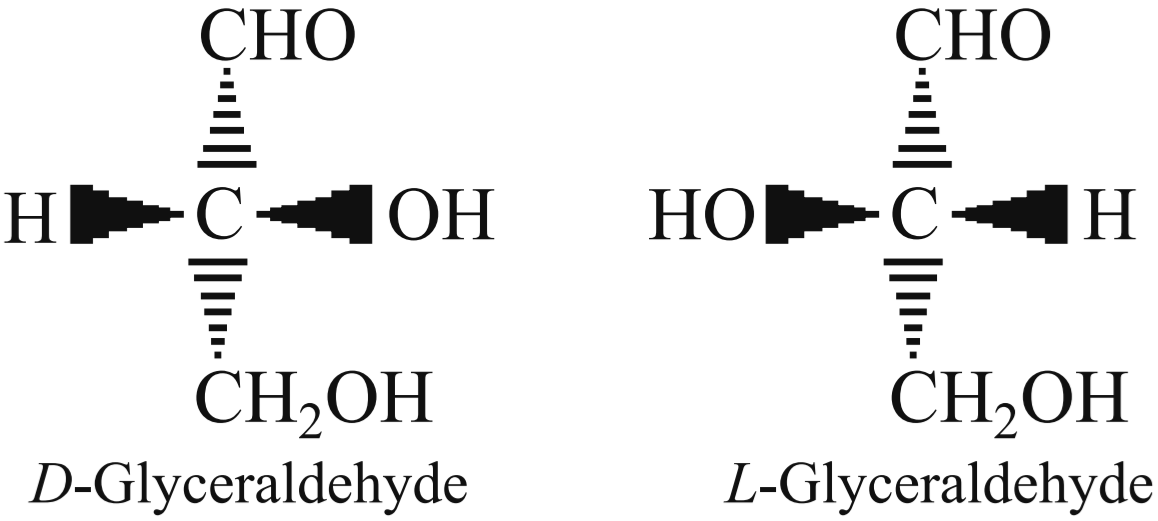
Carbohydrates can exist in either of two conformations, as determined by the orientation of the hydroxyl group about the asymmetric carbon farthest from the carbonyl.

By convention, a monosaccharide is said to have $D-$configuration if the hydroxyl group attached to the asymmetric carbon atom adjacent to the $-\ce{CH_2OH}$ group is on the right hand side irrespective of the positions of the other hydroxyl groups. On the other hand, the molecule is assigned $L-$configuration if the $-OH$ group attached to the carbon adjacent to the $- \ce{CH_2OH}$ group is on the left hand side.
The following questions are multiple choice questions. Choose the most appropriate answer:
  1. $D-$Glyceraldehyde and $L-$Glyceraldehyde are:
  1. Epimers.
  2. Enantiomers.
  3. Anomers.
  4. Conformational diasteriomers.
  1. Which of the following monosaccharides, is the majority found in the human body?
  1. $D-$type.
  2. $L-$type.
  3. Both of these.
  4. None of these.
  1. The two functional groups present in a typical carbohydrate are:
  1. $-\ce{OH}$ and $-\ce{COOH}$
  2. $-\ce{CHO}$ and $-\ce{COOH}$
  3. $ > \ce{C= O}$ and $-\ce{OH}$
  4. $-\ce{OH}$ and $-\ce{CHO}$
  1. Monosaccharides contain:
  1. Always six carbon atoms.
  2. Always five carbon atoms.
  3. Always four carbon atoms.
  4. May contain $3$ to $7$ carbon atoms.
  1. The correct corresponding order of names of four aldoses with configuration given below respectively, is:
  1. $L-$erythrose, $L-$threose, $L-$erythrose, $D-$threose.
  2. $D-$threose, $D-$erythrose, $L-$threose, $L-$erythrose.
  3. $L-$erythrose, $L-$threose, $D-$erythrose, $D-$threose.
  4. $D-$erythrose, $D-$threose, $L-$erythrose, $L-$threose.
Read the passage given below and answer the following questions: Proteins are high molecular mass complex biomolecules of amino acids. The important proteins required for our body are enzymes, hormones, antibodies, transport proteins, structural proteins, contractile proteins etc. Except for glycine, all $\alpha$-amino acids have chiral carbon atom and most of them have L-configuration. The amino acids exists as dipolar ion called zwitter ion, in which a proton goes from the carboxyl group to the amino group. A large number of $\alpha$-amino acids are joined by peptide bonds forming polypeptides. The peptides having very large molecular mass (more than 10,000) are called proteins. The structure of proteins is described as primary structure giving sequence of linking of amino acids; secondary structure giving manner in which polypeptide chains are arranged and folded; tertiary structure giving folding, coiling or bonding polypeptide chains producing three dimensional structures and quaternary structure giving arrangement of sub-units in an aggregate protein molecule. A statement of assertion followed by a statement of reason is given. Choose the correct answer out of the following choices.
  1. Assertion and reason both are correct statements and reason is correct explanation for assertion.
  2. Assertion and reason both are correct statements but reason is not correct explanation for assertion.
  3. Assertion is correct statement but reason is wrong statement.
  4. Assertion is wrong statement but reason is correct statement.
  1. Assertion: Except glycine, all naturally occurring CL-amino acids are optically active.
Reason: All naturally occurring CL-amino acids, except glycine, has at least one asymmetric carbon.
  1. Assertion: All amino acids are optically active.
Reason: Amino acids contain asymmetric carbon atoms.
  1. Assertion: In $\alpha$-helix structure, intramolecular H-bonding takes place whereas in $\beta$-pleated structure, intermolecular H-bonding takes place.
Reason: An egg contains a soluble globular protein called albumin which is present in the white part.
  1. Assertion: Secondary structure of protein refers to regular folding patterns of continuos portions of the polypeptide chain.
Reason: Out of 20 amino acids, only 12 amino acids can be synthesised by human body.
  1. Assertion: The helical structure of protein is stabilised by intramolecular hydrogen bond between -NH and carbonyl oxygen.
Reason: Sanger's reagent is used for the identification of N-tenninal amino acid of peptide chain.
Two types of conductors are generally used, metallic and electrolytic. Free electrons are the current carrier in metallic and in electrolytic conductors, free ions. Specific conductance or conductivity of an electrolytic solution is given by $\text{K}=\text{C}\times\frac{\text{l}}{\text{A}}$ where, $\text{C}\times\frac{1}{\text{R}}$ and $\frac{\text{l}}{\text{A}}=\text{G}^\star$ (cell constant) Molar conductance $(\wedge_\text{m})$ and equivalent conductance $(\wedge_\text{e})$ of an electrolyte solution are calculated as $\wedge_\text{m}=\frac{\text{K}\times1000}{\text{M}}$ or $\wedge_\text{e}=\frac{\text{K}\times1000}{\text{N}}$ where, M = molarity of solution and N is normality of solution. Molar conductance of strong electrolyte depends on the concentration. $\wedge_\text{m}=\wedge^\circ_{\text{m}^-}\text{b}\sqrt{\text{C}}$ $\wedge^\circ_\text{m}=$ molar conductance at infinite dilution, b = constant, C = cone.of solution In these questions (Q. No. i-iv), a statement of assertion followed by a statement of reason is given. Choose the correct answer out of the following choices.
  1. Assertion and reason both are correct statements and reason is correct explanation for assertion.
  2. Assertion and reason both are correct statements but reason is not correct explanation for assertion.
  3. Assertion is correct statement but reason is wrong statement.
  4. Assertion is wrong statement but reason is correct statement.
  1. Assertion: The molar conductivity of strong electrolyte decreases with increase in concentration.
Reason: At high concentration, migration ofions is slow.
  1. Assertion: The molar conductance of weak electrolyte at infinite dilution is equal to the sum of molar conductance of cations and anions.
Reason: Kohlrausch's law is applicable for strong electrolytes.
  1. Assertion: Equivalent conductance of all electrolytes increases with increasing concentration.
Reason: More number ofions are available per gram equivalent at higher concentration.
  1. Assertion: Specific conductance decreases with dilution whereas equivalent conductance increases.
Reason: On dilution, number of ions per millilitre decreases but total number ofions increases considerably.
  1. Assertion: The ratio of specific conductivity to the observed conductance does not depend upon the concentration of the solution taken in the conductivity cell.
Reason: Specific conductivity decreases with dilution whereas observed conductance increases with dilution.
Read the passage given below and answer the following questions:
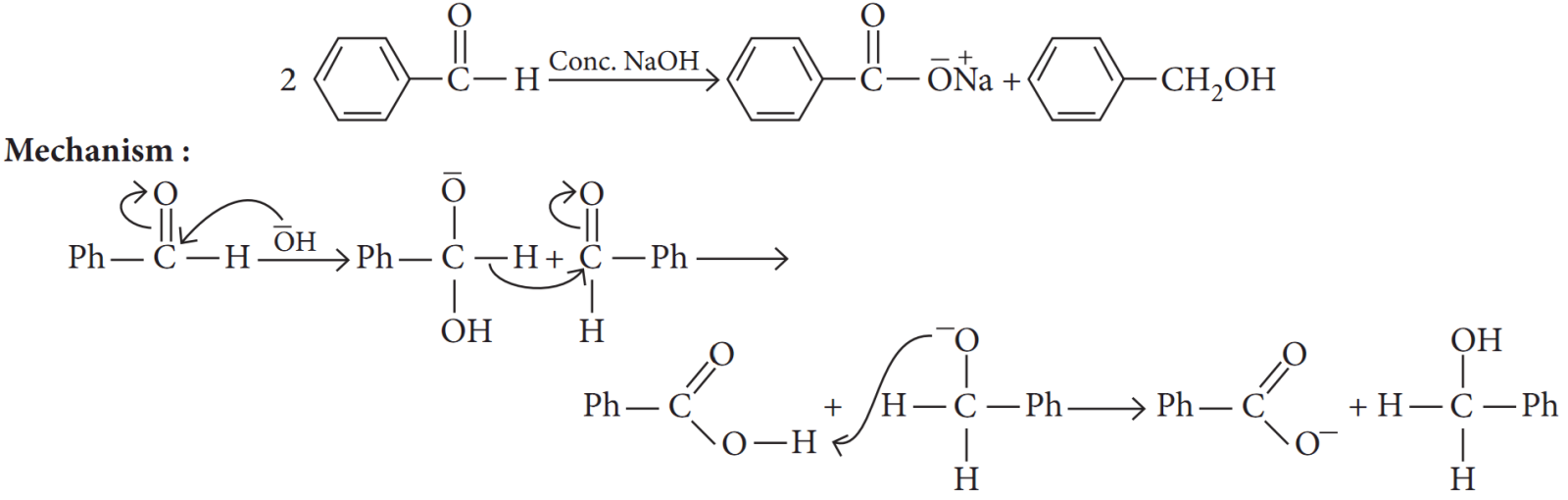
When an aldehyde with no et $-$ hydrogen reacts with concentrated aqueous $\ce{NaOH},$ half the aldehyde is converted to carboxylic acid salt and other half is converted to an alcohol. In other words, half of the reactant is oxidized and other half is reduced. This reaction is known as Cannizzaro reaction.

The following questions are multiple choice questions. Choose the most appropriate answer:
  1. A mixture of benzaldehyde and formaldehyde on heating with aqueous $\ce{NaOH}$ solution gives:
  1. Benzyl alcohol and sodium formate.
  2. Sodium benzoate and methyl alcohol.
  3. Sodium benzoate and sodium formate.
  4. Benzyl alcohol and methyl alcohol.
  1. Which of the following compounds will undergo Cannizzaro reaction?
  1. $\ce{CH_3CHO}$
  2. $\ce{CH_3COCH_3}$
  3. $\ce{C_6H_5CHO}$
  4. $\ce{C_6H_5CH_2CHO}$
  1. Trichloroacetaldehyde is subjected to Cannizzaro's reaction by using $\ce{NaOH}$. The mixture of the products contains sodium trichloroacetate ion and another compound. The other compounds is:
  1. $2, 2, 2-$ trichloroethanol.
  2. Trichloromethanol.
  3. $2, 2, 2-$ trichloropropanol.
  4. Chloroform.
  1. In Cannizzaro reaction given below:
$2\text{PhCHO}\xrightarrow{\stackrel{-}{\hbox{ OH}}}\text{PhCH}_2+\text{OH}+\text{PhCO}_2^-$ the slowest step is:
  1. The attack $^-OH$ at the carboxyl group.
  2. The transfer of hydride to the carbonyl group.
  3. The abstraction of proton from the carboxylic group.
  4. The deprotonation of $\ce{PhCH_2OH}.$
  1. Which of the following reaction will not result in the formation of carbon $-$ carbon bonds?
  1. Cannizzaro reaction.
  2. Wurtz reaction.
  3. Reimer $-$Tiemann reaction.
  4. Friedel $-$ Crafts' acylation.