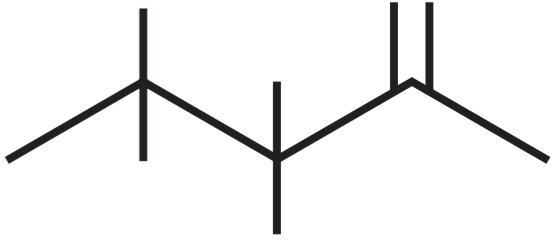
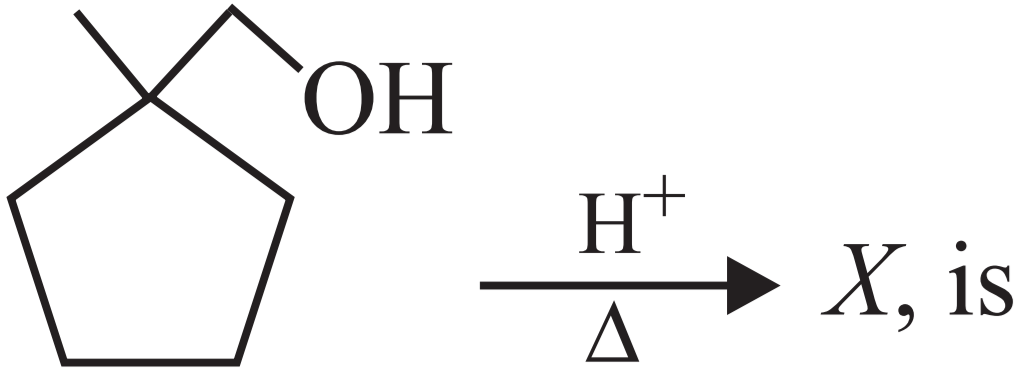
Question
Read the passage given below and answer the following questions:

For understanding the structure and bonding in transition metal complexes, the magnetic properties are very helpful. Low spin complexes are generally diamagnetic because of pairing of electrons, whereas high spin complexes are usually paramagnetic because of presence of unpaired electrons. Larger the number of unpaired electrons, stronger will be the paramagnetism. However magnetic behaviour of a complex can be confirmed from magnetic moment measurement. Magnetic moment $\mu=\sqrt{\text{n(n+2)}}\text{B.M.}$ where n = number of unpaired electrons. Greater the number of unpaired electrons, more will be the magnetic moment.

In these questions (Q. No. i-iv), a statement of assertion followed by a statement ofreason is given. Choose the correct answer out of the following choices.

  1. Assertion and reason both are correct statements and reason is correct explanation for assertion.
  2. Assertion and reason both are correct statements but reason is not correct explanation for assertion.
  3. Assertion is correct statement but reason is wrong statement.
  4. Assertion is wrong statement but reason is correct statement.
The following questions are multiple choice questions. Choose the most appropriate answer:

  1. Assertion: Both [Cr(H2O)6]2+ and [Fe(H2O)6]2+ have same magnetic moment.

Reason: Number of unpaired electrons in Cr2+ and Fe2+ are same.

  1. Assertion: [Fe(H2O)5NO]SO4 is paramagnetic.

Reason: The Fe in [Fe(H2O)5NO]SO4 has three unpaired electrons.

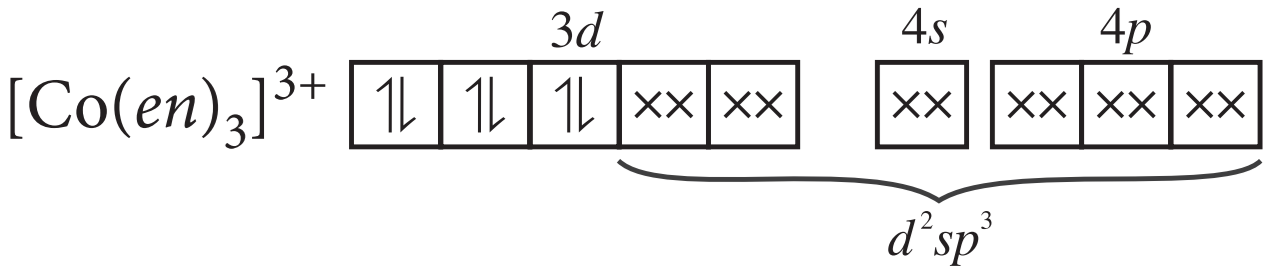
  1. Assertion: [Co(en)3]3+ is paramagnetic.

Reason: It is an inner orbital complex.

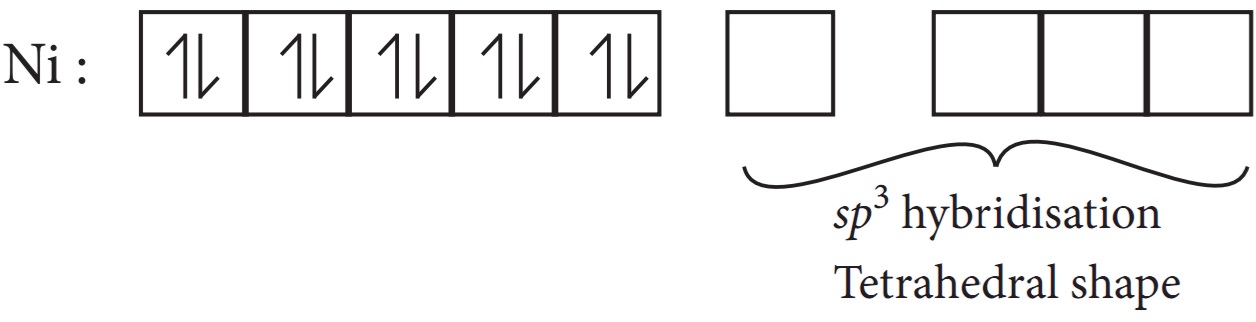
  1. Assertion: [Ni(CO)4] is diamagnetic and tetrahedral in shape.

Reason: [Ni(CO)4] contains no unpaired electrons and involves dsp2 hybridisation.

  1. Assertion: [Ni(CN)4]2- is diamagnetic complex.

Reason: It involves dsp2 hybridisation and there is no unpaired electron.
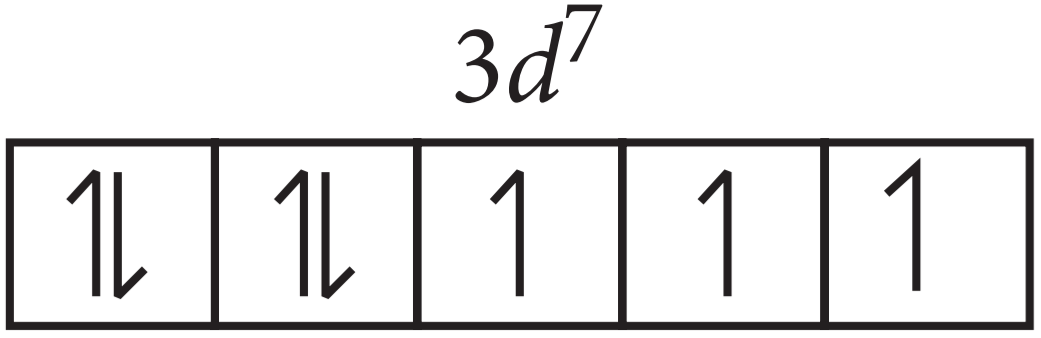
Need a full question paper?

Generate a complete, print-ready paper with questions like this in minutes — across 16+ boards, with answer keys.

Start Generating Free

Similar questions

The electrochemical cell shown below is concentration cell.

M|M2+ (saturated solution of a sparingly soluble salt, MX2) || M2+ (0.001 mol dm-3) |M The emfof the cell depends on the difference in concentrations of M2+ ions at the two electrodes. The emf of the cell at 298 K is 0.059V.

The following questions are multiple choice questions. Choose the most appropriate answer:

  1. The solubility product (Ksp' mol3 dm-9) of MX2 at 298 K based on the information available for the given concentration cell is $(\text{take }2.303 \times \text{R}\times \frac{298}{\text{F}} = 0.059)$
  1. 2 × 10-15
  2. 4 × 10-15
  3. 3 × 10-12
  4. 1 × 10-12
  1. The value of $\triangle\text{G}$ (in kJ mol-1) for the given cell is (take 1 F = 96500 C mol-1)

  1. 3.7
  2. -3.7
  3. 10.5
  4. -11.4
  1. The equilibrium constant for the foUowing reaction is:

$\text{Fe}^{2+}+\text{Ce}^{4+}\rightleftharpoons\text{Ce}^{3+}+\text{Fe}^{3+}$

(Given, $\text{E}^\circ_\frac{\text{Ce}^{4+}}{\text{Ce}^{3+}}=1.44\text{V}$ and $\text{E}^\circ_\frac{\text{Fe}^{3+}}{\text{Fe}^{2+}}=0.68\text{V}$)

  1. 7.6 × 10¹²
  2. 6.5 × 1010
  3. 5.2 × 109
  4. 3.4 × 1012
  1. The solubility product of a saturated solution of Ag2CrO4 in water at 298 K if the emf of the cell

Ag|Ag+ (satd. Ag2CrO4 soln) || Ag+ (0.1 M) | Ag

is 0.164V at 298 K, is:

  1. 3.359 × 10⁻¹² mol3 L-3
  2. 2.287 × 10⁻¹² mol3 L-3
  3. 1.158 × 10⁻¹² mol3 L-3
  4. 4.135 × 10⁻¹² mol3 L-3
  1. To calculate the emf of the cell, which of the foUowing options is correct?
  1. emf = Ecathode - Eanode
  2. emf = Eanode - Ecathode
  3. emf = Eanode + Ecathode
  4. None of these.
Read the passage given below and answer the following questions:

Williamson's synthesis is used for the preparation of symmetrical as well as unsymmerical ether. It is SN2 reaction mechanism. In Williamson's synthesis, 1º alkyl halide are used for preparation of ethers because 2º and 3º alkyl halide give alkene. Ethers are cleaved by hydrogen halides to alcohol and alkyl halide where alkyl halide is corresponding to that alkyl which has less number of carbon atom (it is because of less steric hindrance). In polar media unsymmetrical ether like tertiary butyl ethyl ether gives ethyl alcohol and tertiary butyl halide as reaction proceeds via carbocation.

In these questions (Q. No. i-iv), a statement of assertion followed by a statement of reason is given. Choose the correct answer out of the following choices.

  1. Assertion and reason both are correct statements and reason is correct explanation for assertion.
  2. Assertion and reason both are correct statements but reason is not correct explanation for assertion.
  3. Assertion is correct statement but reason is wrong statement.
  4. Assertion is wrong statement but reason is correct statement.
  1. Assertion: Rate of reaction of alkyl halide in Williamson's synthesis reaction is 1ºRX > 2ºRX > 3ºRX.

Reason: It is a type of bimolecular substitution reaction (SN2).

  1. Assertion: T-Butyl methyl ether is not prepared by the reaction of t-butyl bromide with sodium methoxide.

Reason: Sodium methoxide is a weak nucleophile.

  1. Assertion: Williamson's synthesis method cannot be used for preparing diphenyl ether.

Reason: Aryl halides do not undergo nucleophilic substitution easily.

  1. Assertion: When isopropyl bromide is treated with sodium isopropoxide, di-isopropyl ether is obtained as a major product.

Reason: With secondary alkyl halides, both substitution and elimination occur.

  1. Assertion: Both symmetrical and unsymmetrical ethers can be prepared by Williamson's synthesis.

Reason: Williamson's synthesis is an example of nucleophilic substitution reaction.

Two types of conductors are generally used, metallic and electrolytic. Free electrons are the current carrier in metallic and in electrolytic conductors, free ions. Specific conductance or conductivity of an electrolytic solution is given by

$\text{K}=\text{C}\times\frac{\text{l}}{\text{A}}$

where, $\text{C}\times\frac{1}{\text{R}}$ and $\frac{\text{l}}{\text{A}}=\text{G}^\star$ (cell constant)

Molar conductance $(\wedge_\text{m})$ and equivalent conductance $(\wedge_\text{e})$ of an electrolyte solution are calculated as

$\wedge_\text{m}=\frac{\text{K}\times1000}{\text{M}}$ or $\wedge_\text{e}=\frac{\text{K}\times1000}{\text{N}}$

where, M = molarity of solution and N is normality of solution. Molar conductance of strong electrolyte depends on the concentration.

$\wedge_\text{m}=\wedge^\circ_{\text{m}^-}\text{b}\sqrt{\text{C}}$

$\wedge^\circ_\text{m}=$ molar conductance at infinite dilution, b = constant, C = cone.of solution

In these questions (Q. No. i-iv), a statement of assertion followed by a statement of reason is given. Choose the correct answer out of the following choices.

  1. Assertion and reason both are correct statements and reason is correct explanation for assertion.
  2. Assertion and reason both are correct statements but reason is not correct explanation for assertion.
  3. Assertion is correct statement but reason is wrong statement.
  4. Assertion is wrong statement but reason is correct statement.
  1. Assertion: The molar conductivity of strong electrolyte decreases with increase in concentration.

Reason: At high concentration, migration ofions is slow.

  1. Assertion: The molar conductance of weak electrolyte at infinite dilution is equal to the sum of molar conductance of cations and anions.

Reason: Kohlrausch's law is applicable for strong electrolytes.

  1. Assertion: Equivalent conductance of all electrolytes increases with increasing concentration.

Reason: More number ofions are available per gram equivalent at higher concentration.

  1. Assertion: Specific conductance decreases with dilution whereas equivalent conductance increases.

Reason: On dilution, number of ions per millilitre decreases but total number ofions increases considerably.

  1. Assertion: The ratio of specific conductivity to the observed conductance does not depend upon the concentration of the solution taken in the conductivity cell.

Reason: Specific conductivity decreases with dilution whereas observed conductance increases with dilution.

Read the passage given below and answer the following questions:

Aldehydes and ketones are reduced to primary and secondary alcohols respectively by NaBH4 or LiAlH4 as well as catalytic hydrogenation. The carbonyl group of aldehydes and ketones is reduced to  group on treatment with Zn-Hg and cone. HCl (Clemmensen reduction) or with hydrazine followed by NaOH or KOH in highly boiling solvent such as ethylene glycol (Wolff-Kishner reduction).Aldehydes differ from ketones in their oxidation reactions. Aldehydes are easily oxidised to carboxylic acids on treatment with HNO3, KMnO4, K2Cr2O7 etc. Even mild oxidising agents mainlyTollens' reagent and Fehling's solution also oxidise aldehydes. Ketones are generally oxidised under vigorous conditions i.e., strong oxidising agents and at elevated temperatures, to give mixture of carboxylic acids having lesser number of C-atoms than the parent ketone.
The following questions are multiple choice questions. Choose the most appropriate answer:

  1. Which of the following cannot be made by reduction of ketone or aldehyde with NaBH4 in methanol?
  1. 1-Butanol
  2. 2-Butanol
  3. 2-Methyl-1-propanol
  4. 2-Methyl-2-propanol
  1. The carbonyl compound producing an optically active product by reaction with LiAlH4 is:
  1. Propanone
  2. Butanone
  3. 3-pentanone
  4. Benzophenone
  1. A substance C4H10O (X) yields on oxidation a compound C4H8O which gives an oxime and a positive iodoform test. The substance X on treatment with cone. H2SO4 gives C4H8. The structure of the compound (X) is:
  1. CH3CH2CH2CH2OH
  2. CH3CH(OH)CH2CH3
  3. (CH3)3COH
  4. CH3CH- O - CH2CH3
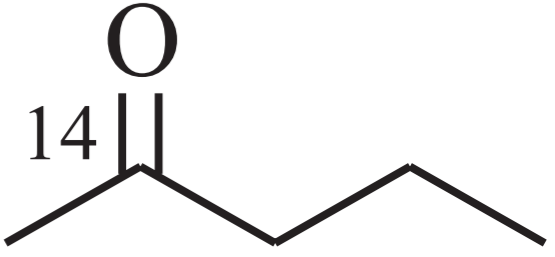
  1. In the oxidation of  by acidified K2Cr2O7, the products are:
  1. $\ \ \ \ \ \ \ \ \ \ \ \ \ \ \ \ \text{O}\\\ \ \ \ \ \ \ \ \ \ \ \ \ \ \ \ ||\\\text{CH}_3-\ ^\text{14}\text{C}-\text{OH}$ and $\text{CH}_3\text{CH}_2\text{COOH}$

  2. $\ \ \ \ \ \ \ \ \ \ \ \ \ \ \ \ \ \ \ \ \ \ \ \ \ \ \ \ \ \ \ \ \ \ \ \ \text{O}\\ \ \ \ \ \ \ \ \ \ \ \ \ \ \ \ \ \ \ \ \ \ \ \ \ \ \ \ \ \ \ \ \ \ \ \ \ \ ||\\\text{CH}_3(\text{CH}_2)_2\text{COOH}-\text{C}-\text{OH}$ and $ \ \ \ \ \ \ \ 14\\\text{CH}_3\text{CH}_2\text{COOH}$

  3. $\ \ \ \ \ \ \ \ \ \ \ \ \ \ \ \ \ \ \ \ \ \ \ \ \ \ \ \ \ \ \ \ \ \ \ \ \ \ \ \ \ \ 14\\\text{CH}_3\text{CH}_2\text{CH}_2\text{COOH}+\text{HCOOH}$

  4. None of these.

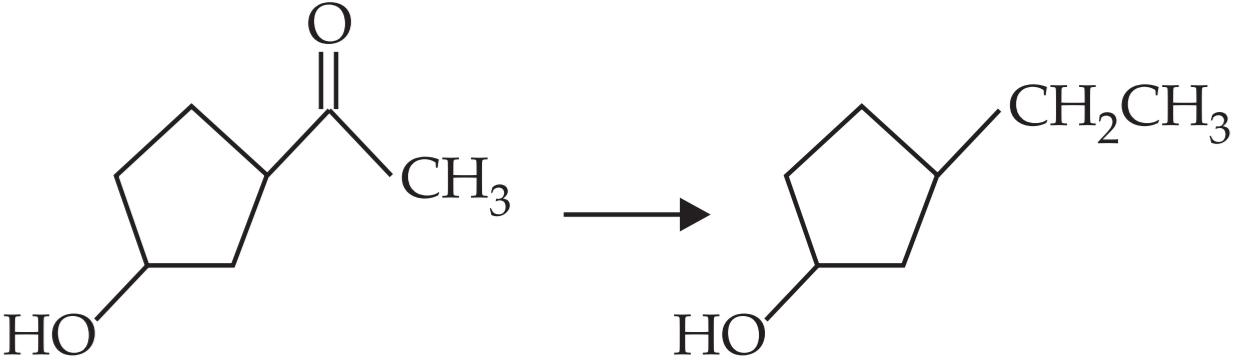
  1. The appropriate reagent for the following transformation is:

  1. $\text{Na}_2\text{NH}_2,^-\text{OH}$

  2. $\text{NaBH}_4$

  3. $\frac{\text{H}_2}{\text{Ni}}$

  4. $\text{AICl}_3$

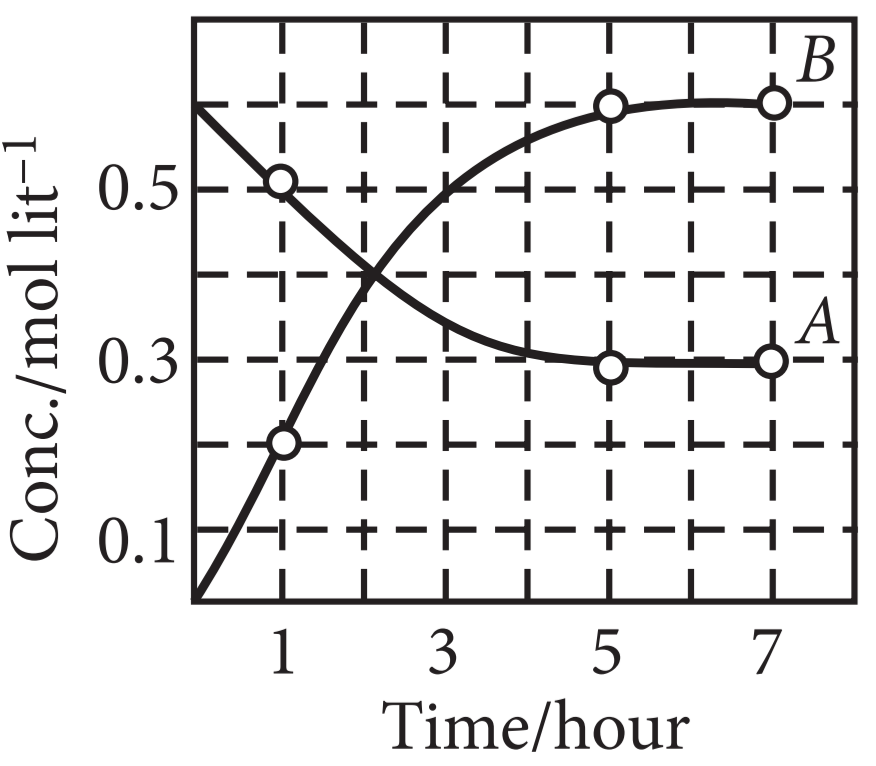
The progress of the reaction, $\text{A}\rightleftharpoons\text{nB}$ with time is represented in the following figure:

The following questions are multiple choice questions. Choose the most appropriate answer:
  1. What is the value of n?
  1. 1
  2. 2
  3. 3
  4. 4
  1. Find the value of the equilibrium constant.
  1. 0.6M
  2. 1.2M
  3. 0.3M
  4. 2.4M
  1. The initial rate of conversion of A will be:
  1. 0.1 mol L-1hr-1
  2. 0.2 mol L-1hr-1
  3. 0.4 mol L-1hr-1
  4. 0.8 mol L-1hr-1
  1. For the reaction, if $\frac{\text{d}[\text{B}]}{\text{dt}}=2\times10^{-4},$ value of $-\frac{\text{d}[\text{A}]}{\text{dt}}$ will be:
  1. 2 × 10-4
  2. 10-4
  3. 4 × 10-4
  4. 0.5 × 10⁻⁴
  1. Which factor has no effect on rate of reaction?
  1. Temperature.
  2. Nature of reactant.
  3. Concentration of reactant.
  4. Molecularity.
Explain the structure of nucleic acid compounds.
Read the passage given below and answer the following questions:
To explain bonding in coordination compounds various theories were proposed. One of the important theory was valence bond theory. According to that, the central metal ion in the complex makes available a number of empty orbitals for the formation of coordination bonds with suitable ligands. The appropriate atomic orbitals of the metal hybridise to give a set of equivalent orbitals of definite geometry.
The d-orbitals involved in the hybridisation may be either inner d-orbitals i.e., (n - 1)d or outer d-orbitals i.e., nd. For example, Co3+ forms both inner orbital and outer orbital complexes, with ammonia it forms [Co(NH3)6]3+ and with fluorine it forms [CoF6]3- complex ion.
The following questions are multiple choice questions. Choose the most appropriate answer:
  1. Which of the following is not true for [CoF6]3-?
  1. It is paramagnetic.
  2. It has coordination number of 6.
  3. It is outer orbital complex.
  4. It involves d2sp3 hybridisation.
  1. [Cr(H2O)6]Cl3 (at. no. of Cr = 24) has a magnetic moment of 3.83B.M. The correct distribution of 3d-electrons in the central metal of the complex is:
  1. $3\text{d}^1_\text{xy},3\text{d}^1_{\text{x}^2-\text{y}^2},3\text{d}^1_\text{yz}$
  2. $3\text{d}^1_\text{xy},3\text{d}^1_{\text{yz}},3\text{d}^1_\text{zx}$
  3. $3\text{d}^1_\text{xy},3\text{d}^1_{\text{zy}},3\text{d}^1_{\text{z}^2}$
  4. $3\text{d}^1_{\text{x}^2-\text{y}^2},3\text{d}^1_{\text{z}^2},3\text{d}^1_\text{xz}$
  1. Which of the following is true for [Co(NH3)6]3+?
  1. It is an octahedral, di magnetic and outer orbital complex.
  2. It is an octahedral, paramagnetic and outer orbital complex.
  3. It is an octahedral, paramagnetic and inner orbital complex.
  4. It is an octahedral, di magnetic and inner orbital complex.
  1. The paramagnetism of [CoF6]3- is due to.
  1. 3 electrons.
  2. 4 electrons.
  3. 2 electrons.
  4. 1 electron.
  1. Which of the following is an inner orbital or low spin complex?
  1. [Ni(H2O)6]3+
  2. [FeF6]3-
  3. [Co(CN)6]3-
  4. [NiCl4]2-
Read the passage given below and answer the following questions:

Proteins are high molecular mass complex biomolecules of amino acids. The important proteins required for our body are enzymes, hormones, antibodies, transport proteins, structural proteins, contractile proteins etc. Except for glycine, all $\alpha$-amino acids have chiral carbon atom and most of them have L-configuration. The amino acids exists as dipolar ion called zwitter ion, in which a proton goes from the carboxyl group to the amino group. A large number of $\alpha$-amino acids are joined by peptide bonds forming polypeptides. The peptides having very large molecular mass (more than 10,000) are called proteins. The structure of proteins is described as primary structure giving sequence of linking of amino acids; secondary structure giving manner in which polypeptide chains are arranged and folded; tertiary structure giving folding, coiling or bonding polypeptide chains producing three dimensional structures and quaternary structure giving arrangement of sub-units in an aggregate protein molecule.

A statement of assertion followed by a statement of reason is given. Choose the correct answer out of the following choices.

  1. Assertion and reason both are correct statements and reason is correct explanation for assertion.
  2. Assertion and reason both are correct statements but reason is not correct explanation for assertion.
  3. Assertion is correct statement but reason is wrong statement.
  4. Assertion is wrong statement but reason is correct statement.
  1. Assertion: Except glycine, all naturally occurring CL-amino acids are optically active.

Reason: All naturally occurring CL-amino acids, except glycine, has at least one asymmetric carbon.

  1. Assertion: All amino acids are optically active.

Reason: Amino acids contain asymmetric carbon atoms.

  1. Assertion: In $\alpha$-helix structure, intramolecular H-bonding takes place whereas in $\beta$-pleated structure, intermolecular H-bonding takes place.

Reason: An egg contains a soluble globular protein called albumin which is present in the white part.

  1. Assertion: Secondary structure of protein refers to regular folding patterns of continuos portions of the polypeptide chain.

Reason: Out of 20 amino acids, only 12 amino acids can be synthesised by human body.

  1. Assertion: The helical structure of protein is stabilised by intramolecular hydrogen bond between -NH and carbonyl oxygen.

Reason: Sanger's reagent is used for the identification of N-tenninal amino acid of peptide chain.

Read the passage given below and answer the following questions:

Dehydration of alcohols can lead to the formation of either alkenes or ethers. This dehydration can be carried out either with protonic acids such as cone.H2SO4, H3PO4 or catalysts such as anhydrous ZnCl2 or Al2O3. When primary alcohols are heated with cone. H2SOat 433-44 K, they undergo intramolecular dehydration to form alkenes. Secondary and tertiary alcohols undergo dehydration under milder conditions. The ease of dehydration of alcohols follows the order: 3º > 2º > 1º.

The dehydration of alcohols always occurs in accordance with the Saytzeff's rule. Primary alcohols when heated with protic acid at 413K, gives dialkyl ether.

$\text{CH}_3\text{CH}_2\text{OH}\xrightarrow[433.433\text{K}]{\text{conc. H}_2\text{SO}_4}\text{CH}_2=\text{CH}_2+\text{H}_2\text{O}$

$2\text{CH}_3\text{CH}_2\text{OH}\xrightarrow[433\text{K}]{\text{conc. H}_2\text{SO}_4}\text{CH}_3\text{CH}_2-\text{O}-\text{CH}_2\text{CH}_3+\text{H}_2\text{O}$

The following questions are multiple choice questions. Choose the most appropriate answer:

  1. Which one of the following alcohols undergoes acid-catalysed dehydration to alkenes most readily?
  1. (CH3)2CHCH2OH

  2. (CH3)3COH

  3. CH3CHOHCH3

  4. CH3CH2CH2OH

  1. Dehydration of alcohol is an example of which type of reaction?
  1. Substitution.
  2. Elimination.
  3. Addition.
  4. Rearrangment.
  1. The alcohol which does not give a stable compound on dehydration is:
  1. Ethyl alcohol.
  2. Methyl alcohol.
  3. N-propyl alcohol.
  4. N-butyl alcohol.
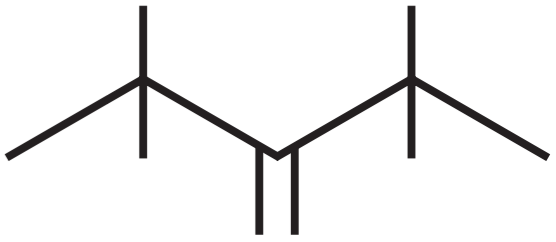
  1.  The most stable product (s) is/ are:

  1.  

  1.  

  1. Both (a) and (b)
  2. None of these.
  1. The product of the reaction 

All chemical reactions involve interaction of atoms and molecules. A large number of atoms/molecules are present in a few gram of any chemical compound varying with their atomic/ molecular masses. To handle such large number conveniently, the mole concept was introduced. All electrochemical cell reactions are also based on mole concept. For example, a 4.0 molar aqueous solution of NaCl is prepared and 500mL of this solution is electrolysed. This leads to the evolution of chlorine gas at one of the electrode. The amount of products formed can be calculated by using mole concept.
The following questions are multiple choice questions. Choose the most appropriate answer:
  1. The total number of moles of chlorine gas evolved is:
  1. 0.5
  2. 1.0
  3. 1.5
  4. 1.9
  1. If cathode is a Hg electrode, then the maximum weight of amalgam formed from this solution is:
  1. 300g
  2. 446g
  3. 396g
  4. 296g
  1. The total charge (coulomb) required for complete electrolysis is:
  1. 186000
  2. 24125
  3. 48296
  4. 193000
  1. In the electrolysis, the number of moles of electrons involved are:
  1. 2
  2. 1
  3. 3
  4. 4
  1. In electrolysis of aqueous NaCl solution when Pt electrode is taken, then which gas is liberated at cathode?
  1. H2gas
  2. Cl2gas
  3. O2gas
  4. None of these.