Question
Read the passage given below and answer the following questions:

Williamson's synthesis is used for the preparation of symmetrical as well as unsymmerical ether. It is SN2 reaction mechanism. In Williamson's synthesis, 1º alkyl halide are used for preparation of ethers because 2º and 3º alkyl halide give alkene. Ethers are cleaved by hydrogen halides to alcohol and alkyl halide where alkyl halide is corresponding to that alkyl which has less number of carbon atom (it is because of less steric hindrance). In polar media unsymmetrical ether like tertiary butyl ethyl ether gives ethyl alcohol and tertiary butyl halide as reaction proceeds via carbocation.

In these questions (Q. No. i-iv), a statement of assertion followed by a statement of reason is given. Choose the correct answer out of the following choices.

  1. Assertion and reason both are correct statements and reason is correct explanation for assertion.
  2. Assertion and reason both are correct statements but reason is not correct explanation for assertion.
  3. Assertion is correct statement but reason is wrong statement.
  4. Assertion is wrong statement but reason is correct statement.
  1. Assertion: Rate of reaction of alkyl halide in Williamson's synthesis reaction is 1ºRX > 2ºRX > 3ºRX.

Reason: It is a type of bimolecular substitution reaction (SN2).

  1. Assertion: T-Butyl methyl ether is not prepared by the reaction of t-butyl bromide with sodium methoxide.

Reason: Sodium methoxide is a weak nucleophile.

  1. Assertion: Williamson's synthesis method cannot be used for preparing diphenyl ether.

Reason: Aryl halides do not undergo nucleophilic substitution easily.

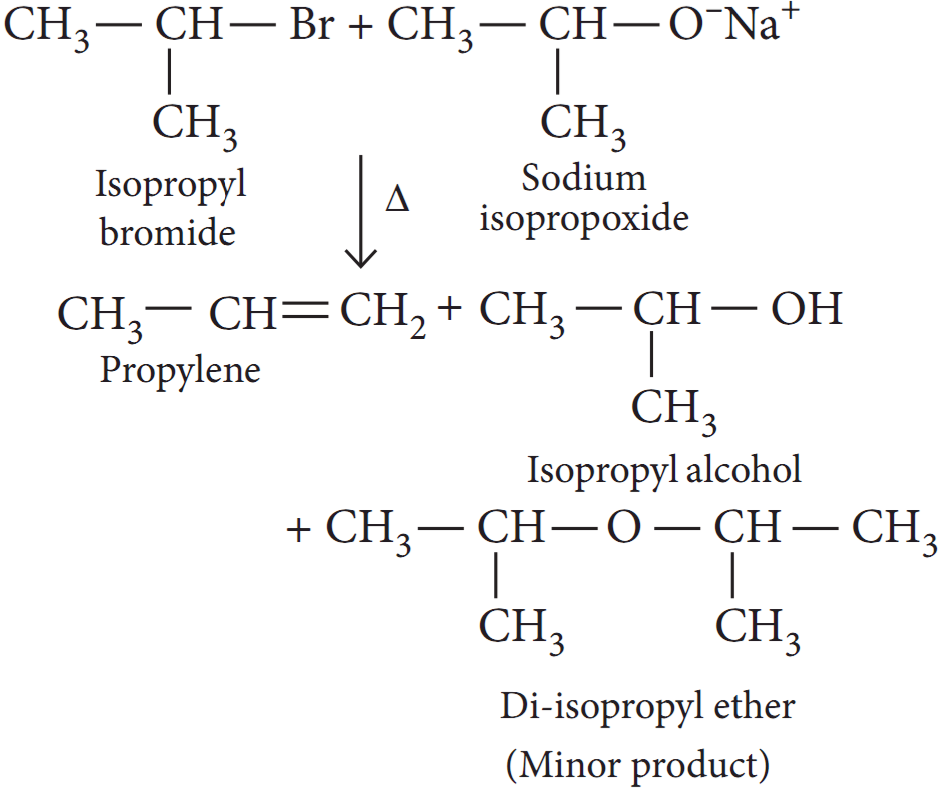
  1. Assertion: When isopropyl bromide is treated with sodium isopropoxide, di-isopropyl ether is obtained as a major product.

Reason: With secondary alkyl halides, both substitution and elimination occur.

  1. Assertion: Both symmetrical and unsymmetrical ethers can be prepared by Williamson's synthesis.

Reason: Williamson's synthesis is an example of nucleophilic substitution reaction.
Answer

  1. (a) Assertion and reason both are correct statements and reason is correct explanation for assertion.

Explanation:

Williamson's synthesis occurs by SN2 mechanism and primary alkyl halides are most reactive in SN2 reactions.

  1. (c) Assertion is correct statement but reason is wrong statement.

​​​​​​​​​​​​​​Explanation:

Sodium methoxide is a strong nucleophile. ln presence of a strong base, i.e., sodium methoxide, t-butyl bromide undergoes dehyrohalogenation to form isobutylene.

  1. (a) Assertion and reason both are correct statements and reason is correct explanation for assertion.

​​​​​​​​​​​​​​​​​​​​​Explanation:

Diary! ethers cannot be prepared by Williamson's synthesis since aryl halides do not undergo nucleophilic substitution easily.

  1. (d) Assertion is wrong statement but reason is correct statement.

​​​​​​​​​​​​​​​​​​​​​Explanation:

Since secondary and tertiary alkyl halides prefer to undergo elimination rather th an substitution, therefore, even symmetrical ethers containing secondary and tertiary alkyl groups cannot be prepared in good yields by Williamson synthesis.

  1. (b) Assertion and reason both are correct statements but reason is not correct explanation for assertion.

​​​​​​​​​​​​​​​​​​​​​​​​​​​​Explanation:

Depending upon whether the alkyl halide and the alkoxide ion carry the same or different alkyl groups, both symmetrical and unsymmetrical ethers can be prepared by Williamsons synthesis.


Need a full question paper?

Generate a complete, print-ready paper with questions like this in minutes — across 16+ boards, with answer keys.

Start Generating Free

Similar questions

Read the passage given below and answer the following questions:

A primary alkyl halide (A) C4H9Br reacted with akoholic KOH to give compound (B). Compound (B) is reacted with HBr to give compound (C) which is an isomer of (A). When (A) reacted with sodium metal, it gave a compound (D) C8H18 that is different than the compound obtained when n-butyl bromide reacted with sodium metal.

The following questions are multiple choice questions. Choose the most appropriate answer:

  1. Compound (A) is:
  1. CH3CH2CH2CH2Br

  2. $\text{CH}_3\text{CH}-\text{CH}_2\text{Br}\\\ \ \ \ \ \ \ \ \ |\\\ \ \ \ \ \ \ \ \text{CH}_3$

  3. $\ \ \ \ \ \ \ \ \ \ \ \ \ \ \text{CH}_3\\\ \ \ \ \ \ \ \ \ \ \ \ \ \ \ |\\\text{CH}_3-\text{C}-\text{Br} \\\ \ \ \ \ \ \ \ \ \ \ \ \ \ \ \ |\\\ \ \ \ \ \ \ \ \ \ \ \ \ \ \ \text{CH}_3$

  4. CH3CH2CH2Br

  1. Which type of isomerism is present in compound (A) and (C)?
  1. Positional
  2. Functional
  3. Chain
  4. Both (a) and (c)
  1. Identify compound (B).
  1. $\text{CH}_3-\text{C}=\text{CH}_2 \ \ \\ \ \ \ \ \ \ \ \ \ \ \ \ \ \mid \\ \ \ \ \ \ \ \ \ \ \ \ \text{CH}_3$
  2. CH3 – CH = CH – CH3
  3. CH3 – CH2 – CH = CH2
  4. None of these.
  1. IUPAC name of compound (D) is:
  1. N - octane
  2. 2, 5 - dimethylhexane
  3. 2 - methylheptane
  4. 3, 4 - dimethyl hexane.
  1. When compoound (C) is treated with ale. KOH and then treated with presence of peroxide, the compound obtained is:
  1. $\ \ \ \ \ \ \ \ \ \ \ \ \ \ \text{CH}_3\\\ \ \ \ \ \ \ \ \ \ \ \ \ \ \ |\\\text{CH}_3-\text{C}-\text{Br} \\\ \ \ \ \ \ \ \ \ \ \ \ \ \ \ \ |\\\ \ \ \ \ \ \ \ \ \ \ \ \ \ \ \text{CH}_3$

  2. $\ \ \ \ \ \ \ \ \ \ \ \ \ \ \text{CH}_3\\\ \ \ \ \ \ \ \ \ \ \ \ \ \ \ |\\\text{CH}_3-\text{CH}-\text{CH}_2-\text{Br}$

  3. $\text{CH}_3\text{CH}_2\text{CH}_2\text{CH}_2\text{Br}$

  4. $$$\text{CH}_3\text{CH}_2\text{CH}_2\text{CH}-\text{Br}\\\ \ \ \ \ \ \ \ \ \ \ \ \ \ \ \ \ \ \ \ \ \ \ \ \ |\\\ \ \ \ \ \ \ \ \ \ \ \ \ \ \ \ \ \ \ \ \ \ \ \ \text{CH}_3$

Read the passage given below and answer the following questions:
A mixture of two aromatic compounds (A) and (B) was separated by dissolving in chloroform followed by extraction with aqueous KOH solution. The organic layer containing compound (A), when heated with alcoholic solution of KOH produce C7H5N (C) associated with unpleasant odour.
The following questions are multiple choice questions. Choose the most appropriate answer:
  1. What is A?
  1. C6H5NH2
  2. C6H5CH3
  3. C6H5CH3
  4. None of these.
  1. The reaction of (A) with alcoholic solution of KOH to produce (C) of unpleasant odour is called:
  1. Sandmeyer reaction.
  2. Carbylamine reaction.
  3. Ullmann reaction.
  4. Reimer-Tiemann reaction..
  1. The alkaline aqueous layer (B) when heated with chloroform and then acidified give a mixture of isomeric compounds of molecular formula C7H6O2. (B) is:
  1. C6H5CHO
  2. C6H5COOH
  3. C6H5CH3
  4. C6H5OH
  1. In the chemical reaction, CH3CH2NH2 + CHCl3 + 3KOH → (A)+ (B) + 3H2O,
  1. C2H5NC and KCl
  2. C2H5CN and KCl
  3. CH3CH2CONH2 and KCl
  4. C2H5NC and K2CO3
  1. Direct nitration of an aromatic compound (A) is not feasible because:
  1. The reaction cannot be stopped at the mononitration stage.
  2. A mixture of o, m and p-nitroaniline is always obtained.
  3. Nitric acid oxidises most of the aromatic compound to give oxidation products along with only a small amount of nitrated products.
  4. All of the above.
A reaction is said to be of the first order if the rate of the reaction depends upon one concentration term only. For a first order reaction of the type A → Products, the rate of the reaction is given as: rate = k[A]. The differential rate law is given as: $\frac{\text{dA}}{\text{dt}}=-\text{k}[\text{A}].$ The integrated rate law is: In $\frac{[\text{A}]}{[\text{A}]_0}=-\text{kt},$ [A] is the concentration of reactant left at time t and [A]0 is the initial concentration of the reactant, k is the rate constant.
The following questions are multiple choice questions. Choose the most appropriate answer:
  1. The unit of rate constant for a first order reaction is:
  1. S-1
  2. mol L-1 s-1
  3. L mol-1 s-1
  4. L2 mol-2 s-1
  1. Half-life period of a first order reaction is 10min. Starting with initial concentration 12M, the rate after 20min is:
  1. 0.693 × 3M min-1
  2. 0.0693 × 4M min-1
  3. 0.0693 × M min-1
  4. 0.0693 × 3M min-1
  1. 50% of a first order reaction is complete in 23 minutes. Calculate the ti me required to complete 90% of the reaction.
  1. 70.4 minutes.
  2. 76.4 minutes.
  3. 38.7 minutes.
  4. 35.2 minutes.
  1. For a first order reaction, (A) → products, the concentration of A changes from 0.1M to 0.025M in 40 minutes. The rate of reaction when the concentration of A is 0.01M, is:
  1. 3.47 × 10⁻⁴ M/ min
  2. 3.47 × 10⁻⁵ M/ min
  3. 1.73 × 10⁻⁴ M/ min
  4. 1.73 × 10⁻⁵ M/ min
  1. The half-life period ofa 1st order reaction is 60 minutes. What percentage will be left over after 240 minutes?
  1. 6.25%
  2. 4.25%
  3. 5%
  4. 6%
Read the passage given below and answer the following questions:
Valence bond theory considers the bonding between the metal ion and the ligands as purely covalent. On the other hand, crystal field theory considers the metal-ligand bond to be ionic arising from electrostatic interaction between the metal ion and the ligands. In coordination compounds, the interaction between the ligand and the metal ion causes the five d-orbitals to split-up. This is called crystal field splitting and the energy difference between the two sets of energy level is called crystal field splitting energy. The crystal field splitting energy $(\Delta_0)$ depends upon the nature of the ligand. The actual configuration of complexes is divided by the relative values of $\Delta_0$ and P (pairing energy).
If $\Delta_0<\text{P},$ then complex will be high spin.
If $\Delta_0>\text{P},$ then complex will be low spin
The following questions are multiple choice questions. Choose the most appropriate answer:
  1. Which of the following ligand has lowest $\Delta_0$ value?
  1. CN-
  2. CO
  3. F-
  4. NH3
  1. The crystal field splitting energy for octahedral $(\Delta_0)$ and tetrahedral $(\Delta_t)$ complex is related as:
  1. $\Delta_\text{t}=\frac{1}{2}\Delta_0$
  2. $\Delta_\text{t}=\frac{4}{9}\Delta_0$
  3. $\Delta_\text{t}=\frac{3}{5}\Delta_0$
  4. $\Delta_\text{t}=\frac{2}{5}\Delta_0$
  1. On the basis of crystal field theory, the electronic configuration of d4 in two situations : (i) t.0 > P and (ii) t.0
  (i) (ii)
(a) $\text{t}^4_{2\text{g}}\text{e}^0_\text{g}$ $\text{t}^3_{2\text{g}}\text{e}^1_\text{g}$
(b) $\text{t}^3_{2\text{g}}\text{e}^1_\text{g}$ $\text{t}^4_{2\text{g}}\text{e}^0_\text{g}$
(c) $\text{t}^3_{2\text{g}}\text{e}^1_\text{g}$ $\text{t}^3_{2\text{g}}\text{e}^1_\text{g}$
(d) $\text{t}^4_{2\text{g}}\text{e}^0_\text{g}$ $\text{t}^4_{2\text{g}}\text{e}^0_\text{g}$
  1. Using crystal field theory, calculate magnetic moment of central metal ion of [FeF6]4-.
  1. 1.79B.M.
  2. 2.83B.M.
  3. 3.85B.M.
  4. 4.9B.M.
  1. Electronic configuration of d-orbitals in [Ti(H2O)6]3+ ion in an octahedral crystal field is:
  1. $\text{t}^1_{2\text{g}}\text{e}^0_\text{g}$
  2. $\text{t}^2_{2\text{g}}\text{e}^0_\text{g}$
  3. $\text{t}^0_{2\text{g}}\text{e}^1_\text{g}$
  4. $\text{t}^1_{2\text{g}}\text{e}^1_\text{g}$
The concentration of potassium ions inside a biological cell is at least twenty times higher than the outside. The resulting potential difference across the cell is important in several processes such as transmission of nerve impulses and maintaining the ion balance. A simple model for such a concentration cell involving a metal M is,
M(s) | M+(aq.; 0.05 molar) || M+(aq; 1 molar) | M(s)
The following questions are multiple choice questions. Choose the most appropriate answer:
  1. For the above cell,
  1. $\text{E}_\text{cell}<0;\Delta\text{G}>0$
  2. $\text{E}_\text{cell}>0;\Delta\text{G}<0$
  3. $\text{E}_\text{cell}<0;\Delta\text{G}^\circ>0$
  4. $\text{E}_\text{cell}>0;\Delta\text{G}^\circ<0$
  1. If the 0.05 molar solution of M+ is replaced by a 0.0025 molar M+ solution, then the magnitude of the cell potential would be:
  1. 130mV
  2. 185mV
  3. 154mV
  4. 600mV
  1. The value of equilibrium constant for a feasible cell reaction is:
  1. < 1
  2. = 1
  3. > 1
  4. Zero
  1. What is the emf of the cell when the cell reaction attains equilibrium?
  1. 1
  2. 0
  3. > 1
  4. < 1
  1. The potential of an electrode change with change in:
  1. Concentration ofions in solution.
  2. Position of electrodes.
  3. Voltage of the cell.
  4. All of these.

Read the passage given below and answer the following questions:

Although chlorobenzene is inert to nucleophilic substitution, however it gives quantitative yield of phenol when heated with aq. Na OH at high temperature and under high pressure. As far as electrophilic substitution in phenol is concemed the — OH group is an activating group, hence, its presence enhances the electrophilic substitution at o - and p - positions.

The following questions are multiple choice questions. Choose the most appropriate answer:

  1. Conversion of chlorobenzene into phenol involves:
  1. Modified SN1 mechanism.
  2. Modified SN2 mechanism.
  3. Both (a) and (b).
  4. Elimination-addition mechanism.
  1. Phenol undergoes electrophilic substitution more readily than benzene because:
  1. The intermediate carbocation is a resonance hybrid of more resonating structures than that from benzene.
  2. The intermediate is more stable as it has positive charge on oxygen, which can be better accommodated than on carbon.
  3. In one of the canonical structures, every atom (except hydrogen) has complete octet.
  4. The — OH group is o, p-directing which like all other o, p - directing group, is activating.
  1. Phenol on treatment with excess of cone. HNO3 gives:
  1. O - nitrophenol.
  2. P - nitrophenol.
  3. O - and p - nitrophenol.
  4. 2, 4, 6 - trinitrophenol.
  1. Phenol is heated with a solution of mixture of KBr and KBrO3. The major product obtained in the above reaction is:
  1. 2 - bromophenol.
  2. 3 - bromophenol.
  3. 4 - bromophenol.
  4. 2, 4, 6 - tribromophenol.
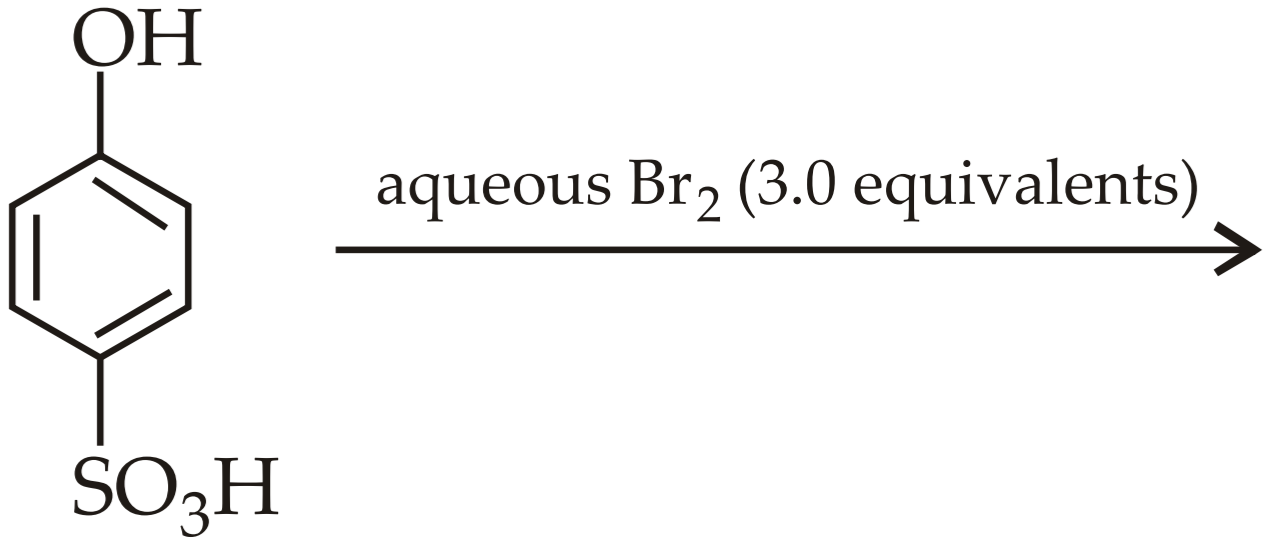
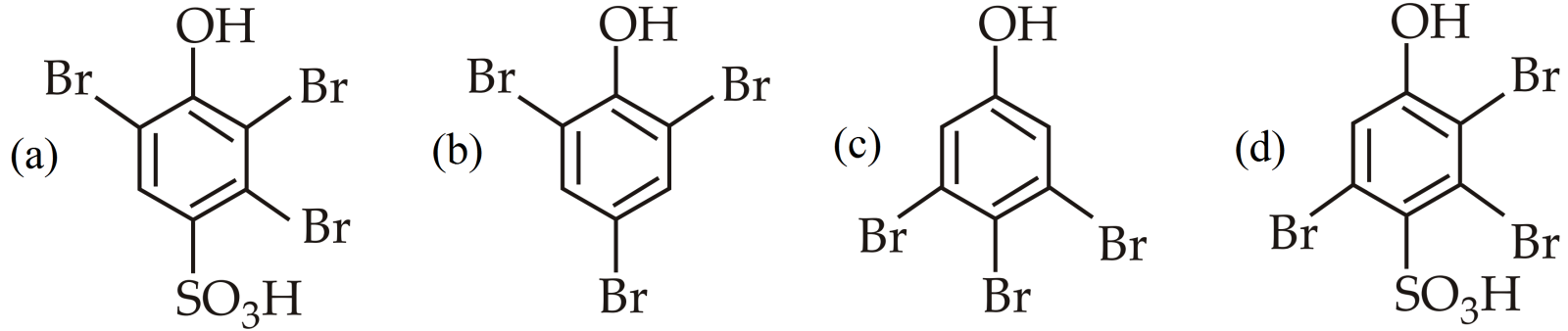
  1. The major product of the following reaction is:

Read the passage given below and answer the following questions:

Lucas test is a test to differentiate between primary, secondary and tertiary alcohols. This test consists of treating an alcohol with Lucas' reagent, and turbidity, due to the formation of insoluble alkyl chloride, is observed. Lucas test is based on the difference in reacting of three classes of alcohols with hydrogen chloride via SN1 reaction. The different reactivity reflects the differing ease of formation of the corresponding carbocations.

In these questions (Q. No. i-iv), a statement of assertion followed by a statement ofreason is given. Choose the correct answer out of the following choices.

  1. Assertion and reason both are correct statements and reason is correct explanation for assertion.
  2. Assertion and reason both are correct statements but reason is not correct explanation for assertion.
  3. Assertion is correct statement but reason is wrong statement.
  4. Assertion is wrong statement but reason is correct statement.
  1. Assertion: Equimolar mixture of cone. HCI and anhydrous ZnCl2 is called Lucas' reagent.

Reason: Lucas' reagent can be used to distinguish between methanol and ethanol.

  1. Assertion: 2-Methyl-2-butanol gives no turbidity with Lucas' reagent at room temperature.

Reason: It is a 3º alcohol.

  1. Assertion: Tertiary alcohols react fastest with Lucas' reagent by SN1 mechanism.

Reason: 3º carbocation is most stable.

  1. Assertion: Amongst the compounds, H2C = CHCH2OH (I), C6H5OH (II), CH3CH2CH2OH (III) and (CH3)3COH (IV), only (IV) reacts with Lucas' reagent at room temperature.

Reason: Tertiary alcohol gives turbidity immediately with Lucas' reagent.

  1. Assertion: Lucas test can be used to distinguish between 1-propanol and 2-propanol.

Reason: Lucas test is based upon the difference in reactivity of primary, secondary and tertiary alcohols with cone. HCI and anhyd. ZnCl2.

Nemst equation relates the reduction potential of an electrochemical reaction to the standard potential and activities of the chemical species undergoing oxidation and reduction.

Let us consider the reaction, $\text{M}^{\text{n+}}_{(\text{aq})}\xrightarrow{\ \ \ \ \ \ \ \ }\text{nM}_\text{(s)}$

For this reaction, the electrode potential measured with respect to standard hydrogen electrode can be given as

$\text{E}_{\Big(\frac{\text{M}^{\text{n+}}}{\text{M}}\Big)}=\text{E}^\circ_{\Big(\frac{\text{M}^\text{n+}}{\text{M}}\Big)}-\frac{\text{RT}}{\text{nF}}\text{ln}\frac{[\text{M}]}{[\text{M}^{\text{n}+}]}$

In these questions (Q. No. i-iv), a statement of assertion followed by a statement ofreason is given. Choose the correct answer out of the following choices.

  1. Assertion and reason both are correct statements and reason is correct explanation for assertion.
  2. Assertion and reason both are correct statements but reason is not correct explanation for assertion.
  3. Assertion is correct statement but reason is wrong statement.
  4. Assertion is wrong statement but reason is correct statement.
  1. Assertion: For concentration cell, $\text{Zn}_{(\text{s})}|\text{ Zn}^{2+}_{\text{(aq)}}||\text{ Zn}^{2+}_{(\text{aq})}|\text{ Zn}\\\ \ \ \ \ \ \ \ \ \ \ \ \text{C}_1\ \ \ \ \ \ \ \ \text{C}_2$

For spontaneous cell reaction, C1 < C2

Reason: For concentration cell, $\text{E}_\text{cell}=\frac{\text{RT}}{\text{nF}}\log\frac{\text{C}_2}{\text{C}_1}$

For spontaneous reaction, $\text{E}_\text{cell}=+\text{ve}\Rightarrow\text{C}_2>\text{C}_1$

  1. Assertion: For the cell reaction, $\text{Zn}_{(\text{s})}+\text{Cu}^{2+}_{(\text{aq})}\xrightarrow{\ \ \ \ \ }\text{Zn}^{2+}_{(\text{aq})}+\text{Cu}_{(\text{s})}$ voltmeter gives zero reading at equilibrium.

Reason: At the equilibrium, there is no change in concentration of Cu2+ and Zn2+ ions.

  1. Assertion: The Nernst equation gives the concentration dependence of emf of the cell.

Reason: In a cell, current flows from cathode to anode.

  1. Assertion: Increase in the concentration of copper half cell in a cell, increases the emfofthe cell.

Reason: $\text{E}_\text{cell}=\text{E}^\circ_\text{cell}+\frac{0.059}{2}\log\frac{[\text{Cu}^{2+}]}{[\text{Zn}^{2+}]}$

  1. Assertion: Electrode potential for the electrode $\frac{\text{Mn}^+}{\text{Mn}}$ with concentration is given by the expression under STP conditions.

$\text{E}=\text{E}^\circ+\frac{0.059}{\text{n}}\log[\text{Mn}^{+}]$

Reason: STP conditions require the temperature to be 273K.

For a first order reaction, A → Products, $\text{k}=\frac{2.303}{\text{t}}\log\frac{\text{a}}{\text{a}-\text{x}},$ where a is the initial concentration of A and (a - x) is the concentration of A after time t. k is rate constant. Its value is constant at constant temperature for a reaction. The time in which half of the reactant is consumed is called half-life period. Half-life period of a first order reaction is constant. Its value is independent of initial concentration or any other external conditions.

In these questions (Q. No. i-iv), a statement of assertion followed by a statement ofreason is given. Choose the correct answer out of the following choices.

  1. Assertion and reason both are correct statements and reason is correct explanation for assertion.
  2. Assertion and reason both are correct statements but reason is not correct explanation for assertion.
  3. Assertion is correct statement but reason is wrong statement.
  4. Assertion is wrong statement but reason is correct statement.
  1. Assertion: Rate of reaction doubles when concentration of reactant is doubled if it is a first order reaction.

Reason: Rate constant also doubles.

  1. Assertion: For the first order reaction, half-life period is expressed as $\text{t}_\frac{1}{2}=\frac{2.303}{\text{k}}\log2.$

Reason: The half-life time of a first order reaction is not always constant and it depends upon the initial concentration of reactants.

  1. Reason: The half-life time of a first order reaction is not always constant and it depends upon the initial concentration of reactants.

Reason: Acid only acts as a catalyst whereas alkali acts as one of the reactants.

  1. Assertion: For a first order reaction, the concentration of the reactant decreases exponentially with time.

Reason: Rate of reaction at any time depends upon the concentration of the reactant at that time.

  1. Assertion: Half-life period for a first order reaction is independent of initial concentration of the reactant.

Reason: For a first order reaction, $\text{t}_\frac{1}{2}=\frac{0.693}{\text{k}},$ where k is rate constant.