Question
Read the passage given below and answer the following questions from $1$ to $5$. When an object moves along a straight line with uniform acceleration, it is possible to relate its velocity, acceleration during motion and the distance covered by it in a certain time interval by a set of equations known as the equations of motion. For convenience, a set of three such equations are given below: $v = u + at $$\text{s}=\text{ut}+\frac{1}{2}\text{at}^2$ $2a s = v^2 – u^2$ Where u is the initial velocity of the object which moves with uniform acceleration a for Time $t, v$ is the final velocity and s is the distance travelled by the object in time.
  1. equation of motions are applicable to motion with
  1. uniform acceleration
  2. non uniform acceleration
  3. constant velocity
  4. none of these
  1. There are $4$ equation of motion. True or false?
  1. True
  2. False
  1. The brakes applied to a car produce an acceleration of $10\ m/s^2$​​​​​​​ in the opposite direction to the motion. If the car takes $1\ s$ to stop after the application of brakes, calculate the distance traveled during this time by car.
  1. An object is dropped from a tower falls with a constant acceleration of $10\ m/s2$. Find its speed $10\ s$ after it was dropped.
  1. A bullet hits a Sand box with a velocity of $10\ m/s$ and penetrates it up to a distance of $5\ cm$. Find the deceleration of the bullet in the sand box
Answer

  1. (a) uniform acceleration
  2. (b) False
  3. Here in this problem,
$v = 0$
$a = -10 m/s2$ (as acceleration is retarding)
$t = 1\ sec.$
To find: distance travelled
Solution: using kinematic equation
$v = u + at$
$0= u + -10 \times 1$
$u = 10\ m/s$
Therefore distance is given by
$\text{S}=\text{ut}+\frac{1}{2}\text{at}^2$
$\text{S}=10\times1-\Big(\frac{1}{2}\Big)\times10\times1^2$
$s = 5m$
  1. Here in this problem,
$u = 0$
$a = 10 m/s^2​​​​​​​$​​​​​​​(as acceleration is in the direction of gravity)
$t = 10\ sec$.
To find: final velocity after 10 second
Solution: using kinematic equation
$v = u + at$
$v = 0 + 10 \times 10$
$v = 100 m/s$​​​​​​​
  1. Here in this problem,
$v = 0$(as bullet is going to stop)
$u = 10 m/s$
$s = 5m$.
To find: deceleration of the bullet
Solution: using kinematic equation
$2a s = v^2 – u^2$
$2 \times a \times 5 = 0^2- 10^2$
$10a = -100$
$\text{A}=\frac{100}{10}$
$a = -10m/s^2$. Negative sign indicates that it is deceleration.

Need a full question paper?

Generate a complete, print-ready paper with questions like this in minutes — across 16+ boards, with answer keys.

Start Generating Free

Similar questions

The cathode of a diode valve is replaced by another cathode of double the surface area. Keeping the voltage and temperature conditions the same, will the place current decrease, increase or remain the same?
Read the passage given below and answer the following questions from (i) to (v). Boyle’s law is a gas law which states that the pressure exerted by a gas (of a given mass, kept at a constant temperature) is inversely proportional to the volume occupied by it. In other words, the pressure and volume of a gas are inversely proportional to each other as long as the temperature and the quantity of gas are kept constant. For a gas, the relationship between volume and pressure (at constant mass and temperature) can be expressed mathematically as follows.$\text{P}\infty(\frac{1}{\text{V}})$ Where P is the pressure exerted by the gas and V is the volume occupied by it. This proportionality can be converted into an equation by adding a constant, k.
Charles law states that the volume of an ideal gas is directly proportional to the absolute temperature at constant pressure. The law also states that the Kelvin temperature and the volume will be in direct proportion when the pressure exerted on a sample of a dry gas is held constant. Charles law and Boyle’s law applied to low density gas only. The total pressure of a mixture of ideal gases is the sum of partial pressures. This is Dalton’s law of partial pressures.
  1. Boyle’s law is obeyed by high as well as low density gases. True or False?
  1. True
  2. False
  1. Charles law is states that volume of an ideal gas is directly proportional to temperature at constant
  1. Temperature
  2. Pressure
  3. Volume
  4. None of these
  1. State Daltons law of partial pressures
  2. State Boyle’s law
  3. State Charles law
A kid of mass M stands at the edge of a platform of radius R which can be freely rotated about its axis. The moment of inertia of the platform is I. The system is at rest when a friend throws a ball of mass m and the kid catches it. If the velocity of the ball is v horizontally along the tangent to the edge of the platform when it was caught by the kid, find the angular speed of the platform after the event.
Calculate the amplification factor of a triode valve that has plate resistance of $2\text{k}\Omega$ and transconductance of 2 millimho.
Read the passage given below and answer the following questions from (i) to (v). Dimensional analysis and its applications The expression which shows how and which of the base quantities represent the dimensions of a physical quantity is called the dimensional formula of the given physical quantity. The recognition of concepts of dimensions, which guide the description of physical behaviour is of basic importance as only those physical quantities can be added or
subtracted which have the same dimensions. A thorough understanding of dimensional analysis helps us in deducing certain relations among different physical quantities and checking the derivation, accuracy and dimensional consistency or homogeneity of various mathematical expressions. When magnitudes of two or more physical quantities are multiplied, their units should be treated in the same manner as ordinary algebraic symbols. We can cancel identical units in the numerator and denominator. The same is true for dimensions of a physical quantity. Similarly, physical quantities represented by symbols on both sides of a mathematical equation must have the same dimensions.
  1. Statement I The method of dimensions analysis cannot validate the exact relationship between physical quantities in any equation.
Statement II It does not distinguish between the physical quantities having same dimensions.
Which of the following statement(s) is/are correct?
  1. Only I
  2. I and II
  3. Only II
  4. None of these
  1. The quantity having same dimension as that of Planck’s constant is
  1. Work
  2. Linear momentum
  3. Angular momentum
  4. Impulse
  1. If speed v, acceleration A and force F, are considered as fundamental units, the dimension of Young’s modulus will be:
  1. $[v^{-4} A^{-2} F]$
  2. $[v^{-2} A^2 F^2]$
  3. $[v^{-2} A^2F^{-2}]$
  4. $[v^{-4} A^2 F^1]$
  1. Given that, the amplitude of the scattered light is:
  1. Directly proportional to amplitude of incident light
  2. Directly proportional to the volume of the scattering dust particle
  3. Inversely proportional to its distance from the scattering particle and
  4. Dependent upon the wavelength l of the light.
Then, the relation of intensity of scattered light with the wavelength is:
  1. $\frac{1}{\lambda^2}$
  2. $\frac{1}{\lambda^4}$
  3. $\frac{1}{\lambda^6}$
  4. $\frac{1}{\lambda^7}$
  1. Find the value of power of 60 J/min on a system that has 100g, 100cm and 1min as the base units.
  1. $2.16 \times 10^4$ units
  2. $2.16 \times 10^6$​​​​​​​ units
  3. $3 \times 10^4$​​​​​​​ units
  4. $4 \times 10^7​​​​​​​$​​​​​​​ units
On a winter day, the outside temperature is 0°C and relative humidity 40%. The air from outside comes into a room and is heated to 20°C. What is the relative humidity in the room? The saturation vapour pressure at 0°C is 4.6mm of mercury and at 20°C it is 18mm of mercury.
The power delivered in the plate circular of a diode is 1.0W when the plate voltage is 36V. Find the power delivered if the plate voltage is increased to 49V. Assume Langmuir-Child equation to hold.
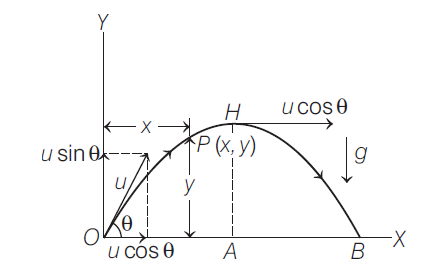
Read the passage given below and answer the following questions from 1 to 5. Projectile motion is a form of motion in which an object or particle is thrown with some initial velocity near the earth’s surface and it moves along a curved path under the action of gravity alone. The path followed by a projectile is called its trajectory, which is shown below. When a projectile is projected obliquely, then its trajectory is as shown in the figure below. Here velocity u is resolved into two components, we get (a) u cosθ along OX and (b) u sinθ along OY.
  1. The example of such type of motion is:
  1. Motion of car on a banked road.
  2. Motion of boat in sea.
  3. A javelin thrown by an athlete.
  4. Motion of ball thrown vertically upward.
  1. The acceleration of the object in horizontal direction is:
  1. Constant
  2. Decreasing
  3. Increasing
  4. Zero
  1. The vertical component of velocity at point H is:
  1. Maximum
  2. Zero
  3. Double to that at O
  4. Equal to horizontal component
  1. A cricket ball is thrown at a speed of 28m/s in a direction 30° with the horizontal. The time taken by the ball to return to the same level will be:
  1. 2.0s
  2. 3.0s
  3. 4.0s
  4. 2.9s
  1. In above case, the distance from the thrower to the point where the ball returns to the same level will be:
  1. 39m
  2. 69m
  3. 68m
  4. 72m
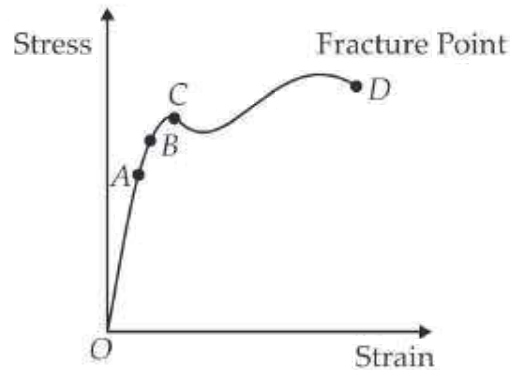
Read the passage given below and answer the following questions from 1 to 5. Stress-Strain Curve The graph shown below shows qualitatively the relation between the stress and the strain as the deformation gradually increases. Within Hooke’s limit for a certain region stress and strain relation is linear. Beyond that up to a certain value of strain the body is still elastic and if deforming forces are removed the body recovers its original shape.
  1. If deforming forces are removed up to which point the curve will be retraced?
  1. Upto OA only
  2. Upto OB
  3. Upto C
  4. Never retraced its path
  1. In the above question, during loading and unloading the force exerted by the material are conservative up to:
  1. OA only
  2. OB only
  3. OC only
  4. OD only
  1. During unloading beyond B, say C, the length at zero stress in now equal to:
  1. Less than original length
  2. Greater than original length
  3. Original length
  4. Can’t be predicted
  1. The breaking stress for a wire of unit cross - section is called:
  1. Yield point
  2. Elastic fatigue
  3. Tensile strength
  4. Young’s modulus
  1. Substances which can be stretched to cause large strains are called:
  1. Isomers
  2. Plastomers
  3. Elastomers
  4. Polymers
The dimensions $\text{ML}^{-1}\text{T}^{-2}$ may correspond to:
  1. Work done by a force.
  2. Linear momentum.
  3. Pressure.
  4. Energy per unit volume.