Question
The dimensions $\text{ML}^{-1}\text{T}^{-2}$ may correspond to:
  1. Work done by a force.
  2. Linear momentum.
  3. Pressure.
  4. Energy per unit volume.

Answer

  1. Pressure.
  2. Energy per unit volume.
Explantion:

$\text{[Work done] = [ML}^2\text{ T}^{-2}]$

$\text{[Linear momentum] = [MLT}^{-1}]$

$\text{[Pressure] = [ML}^{-1}\text{T}^{-2}]$

$\text{[Energy per unit volume] = [ML}^{-1}\text{T}^{-2}]$

From the above, we can see that pressure and energy per unit volume have the same dimension, i.e., $\text{ML}^{-1}\text{T}^{-2}.$

Need a full question paper?

Generate a complete, print-ready paper with questions like this in minutes — across 16+ boards, with answer keys.
Start Generating Free

Similar questions

A magnetic dipole of magnetic moment $0.72\sqrt{2}\text{ A-m}^2$ -is placed horizontally with the north pole pointing towards east. Find the position of the neutral point if the horizontal component of the earth's magnetic field is $18\mu\text{T.}$
Show that the magnetic field at a point due to a magnetic dipole is perpendicular to the magnetic axis if the line joining the point with the centre of the dipole makes an angle of $\tan^{-1}(\sqrt{2})$ with the magnetic axis.
A bar magnet takes $\frac{\pi}{10}$ second to complete one oscillation in an oscillation magnetometer. The moment of inertia of the magnet about the axis of rotation is $1.2 \times 10^{-4} \mathrm{~kg}-\mathrm{m}^2$ and the earth's horizontal magnetic field is $30\mu \text{T}.$ Find the magnetic moment of the magnet.
The magnetic field at a point, 10cm away from a magnetic dipole, is found to be $2.0 \times 10^{-4} \mathrm{~T}$. find the magnetic moment of the dipole if the point is.
  1. In end-on position of the dipole.
  2. In broadside-onposition of the dipole.
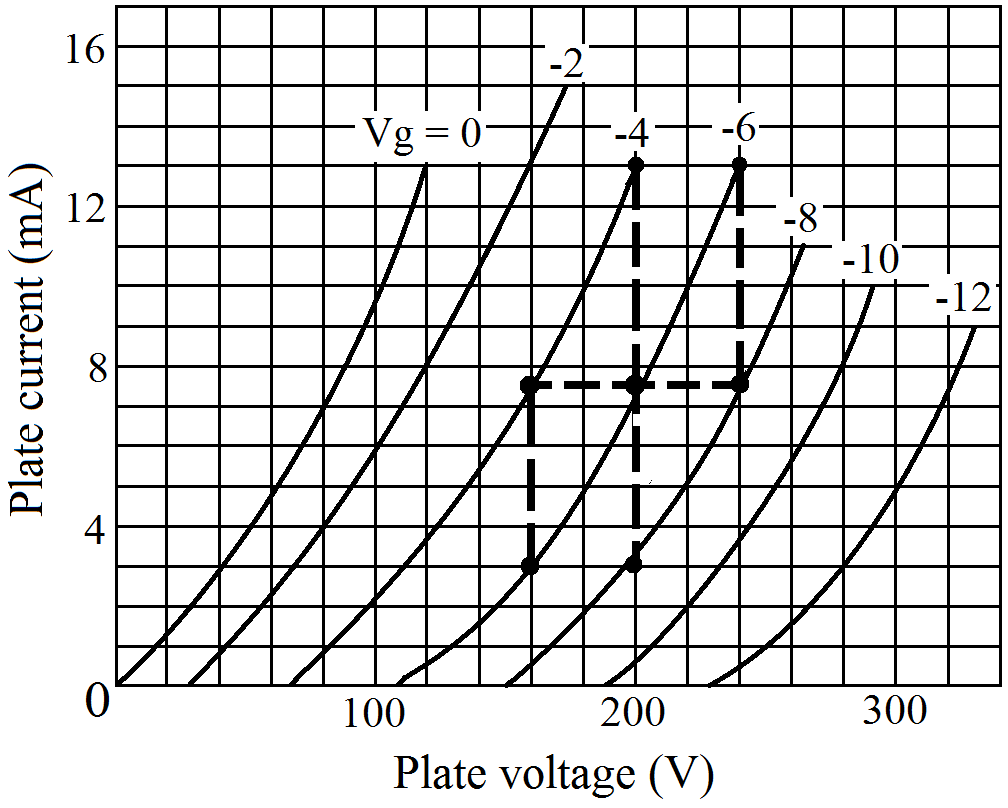
Find the values of $\text{r}_\text{p},\ \mu$ and $\text{g}_\text{m}$ of a triode operating at plate voltage 200V and grid voltage -6. The plate characteristics are shown in the figure.
Read the passage given below and answer the following questions from 1 to 5.Following are properties of vectors
a) Two vectors A and B are said to be equal if, and only if, they have the same magnitude and the same direction.
b) Multiplying a vector A with a positive number λ gives a vector whose magnitude is changed by the factor λ but the direction is the same as that of A:
$|\ \lambda\text{ A }|=\lambda\text{ A }|$
c) The null vector also results when we multiply a vector A by the number zero. Properties of 0 are
A + 0 = A
λ 0 = 0
0 A = 0
d) Subtraction of vectors can be defined in terms of addition of vectors. We define the difference of two vectors A and B as the sum of two vectors A and –B :
A – B = A + (–B).
  1. Two vectors A and B are said to be equal if:
  1. they have the same magnitude
  2. they have the same direction
  3. they have the same magnitude and the same direction
  4. None of these
  1. Multiplying a vector A with a positive number will impact:
  1. Change in magnitude
  2. Change in direction
  3. Change in both magnitude and the same direction
  4. None of these
  1. What is null vector?
  1. How we can perform subtraction of two vectors?
  1. Enlist any 4 properties of vectors.
Read the passage given below and answer the following questions from 1 to 5. The product of force and time which is the change in momentum of the body remains a measurable quantity. This product is called impulse Impulse = Force × time duration = Change in momentum Large force acting for a short time to produce a finite change in momentum is called an impulsive force. The third law of motion states that when one object exerts a force on another object, the second object instantaneously exerts a force back on the first. These two forces are always equal in magnitude but opposite in direction. These forces act on different objects and never on the same object. The two opposing forces are also known as action and reaction forces. Answer the following questions. The second and third laws of motion lead to an important consequence: the law of conservation of momentum. Take a familiar example. A bullet is fired from a gun. If the force on the bullet by the gun is F, the force on the gun by the bullet is – F, according to the third law. The two forces act for a common interval of time $\triangle\text{t}$ According to the second law,$\text{F}\triangle\text{t}$ is the change in momentum of the bullet and $-\text{F}\triangle\text{t}$ is the change in momentum of the gun. Since initially, both are at rest, the change in momentum equals the final momentum for each. Thus if pb is the momentum of the bullet after firing and pg is the recoil momentum of the gun, pg = – pb i.e. pb + pg = 0 That is, the total momentum of the (bullet + gun) system is conserved. Thus in an isolated system (i.e. a system with no external force), mutual forces between pairs of particles in the system can cause momentum change in individual particles, but since the mutual forces for each pair are equal and opposite, the momentum changes cancel in pairs and the total momentum remains unchanged. This fact is known as the law of conservation of momentum. The total momentum of an isolated system of interacting particles is conserved.
  1. Action reaction forces acts on bodies in order that:
  1. Action acts first then reaction force comes.
  2. Reaction acts first then action force comes.
  3. Both action reaction act at same time.
  4. None of the above.
  1. Which of the following is correct about action reaction forces?
  1. They act on different objects.
  2. They are equal in magnitude and opposite in direction.
  3. Both forces acted on different object simultaneously
  4. All the above.
  1. State Newton’s third law of motion.
  1. Define impulse. Give its formula.
  1. State law of conservation of momentum.
A bar magnet has a length of 8cm. The magnetic field at a point at a distance 3cm from the centre in the broadside-on position is found to be $4\times10^{-6}T$. Find the pole strength of the magnet.
Read the passage given below and answer the following questions from 1 to 5. Power is defined as the time rate at which work is done or energy is transferred. The average power of a force is defined as the ratio of the work, W, to the total time t taken $P_{av}= W/t$ The instantaneous power is defined as the limiting value of the average power as time interval approaches zero. P = dw/dt The work dW done by a force F for a displacement dr is dW = F.dr. The instantaneous power can also be expressed as P = F.dr/dt P = F.v Where v is the instantaneous velocity when the force is F. Power, like work and energy, is a scalar quantity. Its dimensions are $[ML^2 T^{-3}]$. In the SI, its unit is called a watt (W). The watt is $1 J s^{-1}$. The unit of power is named after James Watt, one of the innovators of the steam engine in the eighteenth century. There is another unit of power, namely the horse-power (hp) 1 hp = 746W This unit is still used to describe the output of automobiles, motorbikes.
  1. The time rate at which work is done or energy is transferred is called as:
  1. Energy
  2. Force
  3. Power
  4. None of these
  1. Limiting value of power as time interval approaches zero is called as:
  1. Average power
  2. Instantaneous power
  3. Both a and b
  4. None of these
  1. Power is directly proportional to:
  1. Force
  2. Velocity
  3. Both
  4. None of these
  1. Define instantaneous power. Give its SI unit and dimensions.
  1. 1 horse power is equal to how many watt?
Read the passage given below and answer the following questions from 1 to 5. The proportional region within the elastic limit of the stress-strain curve is of great importance for structural and manufacturing engineering designs. The ratio of stress and strain, called modulus of elasticity, is found to be a characteristic of the material. Experimental observation show that for a given material, the magnitude of the strain produced is same whether the stress is tensile or compressive. The ratio of tensile (or compressive) stress $(\sigma)$ to the longitudinal strain $(\in)$ is defined as Young’s modulus and is denoted by the symbol Y. $\text{Y}=\frac{\sigma}{\in}$ Since strain is a dimensionless quantity, the unit of Young’s modulus is the same as that of stress i.e., $N-m^{-2}$ or Pascal (Pa). As steel has more modulus of elasticity than copper brass and aluminum hence steel is preferred in heavy-duty machines and in structural designs. Wood, bone, concrete and glass have rather small Young’s moduli. Answer the following.
  1. If stress strain changes then young’s modulus is:
  1. Also changes.
  2. Remains constant.
  3. Either changes or remains constant depends on amount of stress and strain.
  4. None of these.
  1. SI unit of young’s modulus is:
  1. $N-m^{-2}​​​​​​​$
  2. Pascal (Pa).
  3. $N-m^{-2}​​​​​​​$​​​​​​​ or Pascal (Pa).
  4. None of these
  1. Which of the following is more elastic
  1. Aluminum
  2. Steel
  3. Wood
  4. Glass
  1. Defines young’s modulus. Give its SI unit and dimensions.
  1. Why steel is more preferred in heavy industries than copper and brass?