Question
Read the passage given below and answer the following questions from 1 to 5.
When an object moves along a straight line with uniform acceleration, it is possible to relate its velocity, acceleration during motion and the distance covered by it in a certain time interval by a set of equations known as the equations of motion. For convenience, a set of three such equations are given below:
v = u + at
$\text{s}=\text{ut}+\frac{1}{2}\text{at}^2$
 2a s = v2 – u2
Where u is the initial velocity of the object which moves with uniform acceleration a for Time t, v is the final velocity and s is the distance travelled by the object in time.
  1. equation of motions are applicable to motion with
  1. uniform acceleration
  2. non uniform acceleration
  3. constant velocity
  4. none of these
  1. There are 4 equation of motion. True or false?
  1. True
  2. False
  1. The brakes applied to a car produce an acceleration of 10 m/s2 in the opposite direction to the motion. If the car takes 1 s to stop after the application of brakes, calculate the distance traveled during this time by car.
  1. An object is dropped from a tower falls with a constant acceleration of 10 m/s2. Find its speed 10 s after it was dropped.
  1. A bullet hits a Sand box with a velocity of 10 m/s and penetrates it up to a distance of 5 cm. Find the deceleration of the bullet in the sand box
Answer

  1. (a) uniform acceleration
  2. (b) False
  3. Here in this problem,

v = 0

a = -10 m/s2 (as acceleration is retarding)

t = 1 sec.

To find: distance travelled

Solution: using kinematic equation

v = u + at

0=  u + -10 × 1

u = 10 m/s

Therefore distance is given by

$\text{S}=\text{ut}+\frac{1}{2}\text{at}^2$

$\text{S}=10\times1-\Big(\frac{1}{2}\Big)\times10\times1^2$

s = 5m

  1. Here in this problem,

u = 0

a = 10 m/s2(as acceleration is in the direction of gravity)

t = 10 sec.

To find: final velocity after 10 second

Solution: using kinematic equation

v = u + at

v = 0 + 10 × 10

v = 100 m/s

  1. Here in this problem,

v = 0(as bullet is going to stop)

u = 10 m/s

s = 5m.

To find: deceleration of the bullet

Solution: using kinematic equation

2a s = v2 – u2

2 × a × 5 = 0- 102

10a = -100

$\text{A}=\frac{100}{10}$

a = -10m/s2. Negative sign indicates that it is deceleration.

Need a full question paper?

Generate a complete, print-ready paper with questions like this in minutes — across 16+ boards, with answer keys.

Start Generating Free

Similar questions

A physical quantity is measured and the result is expressed as nu where u is the unit used and n is the numerical value. If the result is expressed in various units then:

  1. $\text{n}\propto\text{size of u}$

  2. $\text{n}\propto\text{u}^2$

  3. $\text{n}\propto\sqrt{\text{u}}$

  4. $\text{n}\propto\frac{1}{\text{u}}$

A metallic loop is placed in a nonuniform magnetic field. Will an emf be induced in the loop?
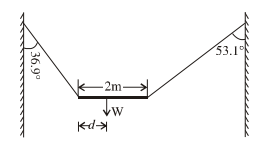
A non-uniform bar of weight W is suspended at rest by two strings of negligible weight as shown in Fig. The angles made by the strings with the vertical are 36.9º and 53.1º respectively. The bar is 2 m long. Calculate the distance d of the centre of gravity of the bar from its left end.
Image
A steel wire of length 4.7 m and cross-sectional area $3.0 \times 10^{-5} m^2$ stretches by the same amount as a copper wire of length 3.5 m and cross-sectional area of $4.0 \times 10^{-5} m^2$ under a given load. What is the ratio of the Young's modulus of steel to that of copper?
Compare the bulk modulus of water from the following data : Initial volume $=100.0$ litre, Pressure increase $=100.0 atm\left(1 atm=1.013 \times 10^5\right.$ Pa ), Final volume $=100.5$ litre. Compare the bulk modulus of water with that of air (at constant temperature). Explain in simple terms why the ratio is so large.
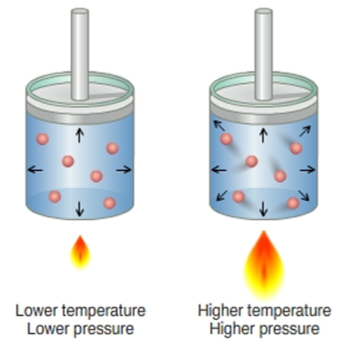
In a gas the particles are always in a state of random motion, all the particles move at different speed constantly colliding and changing their speed and direction, as speed increases it will result in an increase in its kinetic energy.
Image
1. If the temperature of the gas increases from 300 K to 600 K then the average kinetic energy becomes:
(a) same    (b) becomes double    (c) becomes half    (d) become triple
2. What is the average velocity of the molecules of an ideal gas?
(a) Infinite    (b) Same    (c) Increase    (d) Zero
3. Cooking gas containers are kept in a lorry moving with uniform speed. The temperature of the gas molecules inside will ___________.
(a) decrease    (b) Rises    (c) increase    (d) remains same
4. Find the ratio of average kinetic energy per molecule of Oxygen and Hydrogen:
(a) $1: 1$    (b) $4: 1$    (c) $1: 2$    (d) $1: 4$
OR
The velocities of the three molecules are $3 v , 4 v$, and 5 v . calculate their root mean square velocity?
(a) 4.0 v   (b) 4.02 v    (c) 4.08 v    (d) 4.04 v
A van is standing on a frictionless portion of a horizontal road. To start the engine, the vehicle must be set in motion in the forward direction. How can the persons sitting inside the van do it without coming out and pushing from behind?
The power delivered in the plate circular of a diode is 1.0W when the plate voltage is 36V. Find the power delivered if the plate voltage is increased to 49V. Assume Langmuir-Child equation to hold.
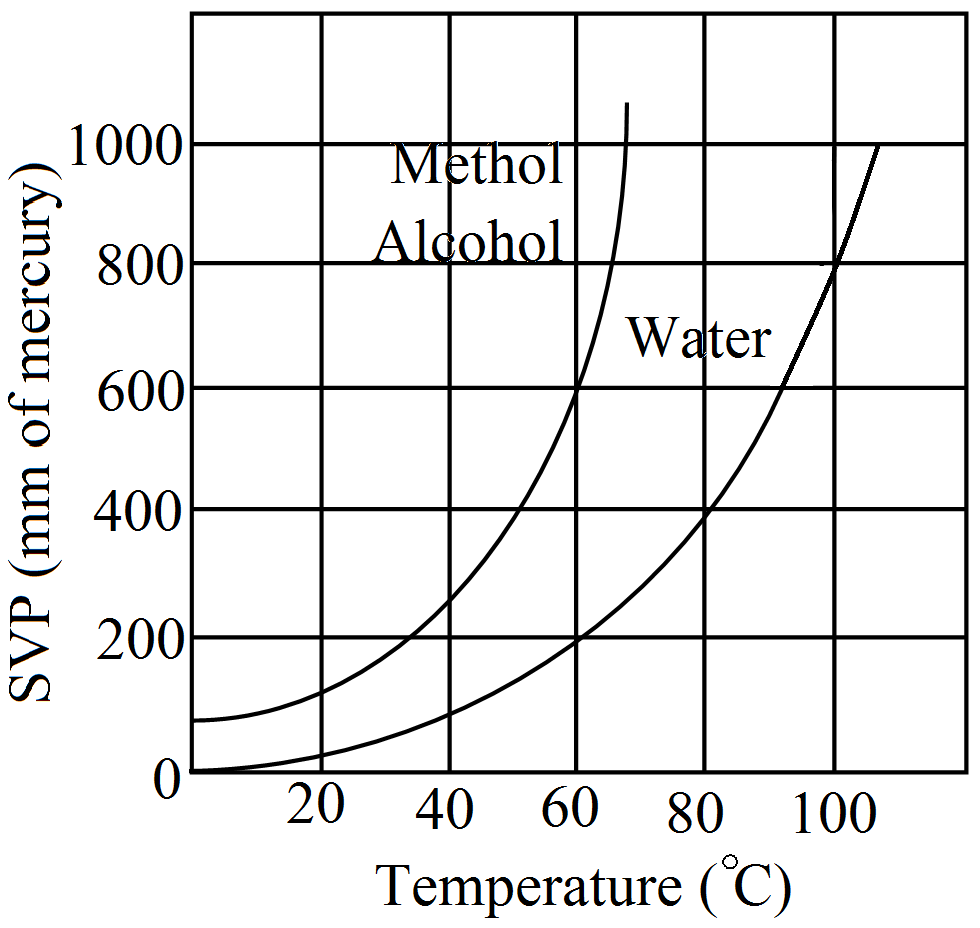
The human body has an average temperature of 98°F. Assume that the vapour pressure of the blood in the veins behaves like that of pure water. Find the minimum atmospheric pressure which is necessary to prevent the blood from boiling. Use figure. of the text for the vapour pressures.


In a TV picture tube electrons are ejected from the cathode with negligible speed and reach a velocity of 5 × 10⁶m/s in travelling one centimeter. Assuming straight line motion, find the constant force exerted on the electron. The mass of the electron is 9.1 × 10⁻³¹kg.