Question
Read the passage given below and answer the following questions from (i) to (v). Vectors
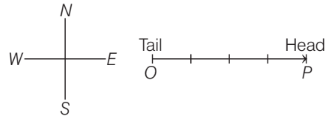
Vectors are the physical quantities which have both magnitudes and directions and obey the triangle/parallelogram laws of addition and subtraction. It is specified by giving its magnitude by a number and its direction. e.g. Displacement, acceleration, velocity, momentum, force, etc. A vector is represented by a bold face type and also by an arrow placed over a letter, i.e. F, a, b or $\overrightarrow{\text{F}},\overrightarrow{\text{a}},\overrightarrow{\text{b}}.$ The length of the line gives the magnitude and the arrowhead gives the direction. The point P is called head or terminal point and pointO is called tail or initial point of the vector OP.
  1. Amongst the following quantities, which is not a vector quantity?
  1. Force
  2. Acceleration
  3. Temperature
  4. Velocity
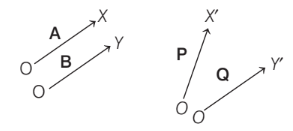
  1. Set of vectors A and B, P and Q are as shown below

Length of A and B is equal, similarly length of P and Q is equal. Then, the vectors which are equal, are:
  1. A and P
  2. P and Q
  3. A and B
  4. B and Q
  1. $\mid\lambda\text{A}\mid=\lambda\mid\text{A}\mid,$ if:
  1. $\lambda>0$
  2. $\lambda,<0$
  3. $\lambda,=0$
  4. $\lambda,\neq0$
  1. Among the following properties regarding null vector which is incorrect?
  1. A + 0 = A
  2. $\lambda0=\lambda$
  3. 0A = 0
  4. A - A = 0
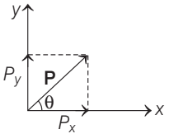
  1. The x and y components of a position vector P have numerical values 5 and 6, respectively. Direction and magnitude of vector P are:
  1. $\tan^{-1}\big(\frac{6}{5}\big)\text{and}\sqrt{61}$
  2. $\tan^{-1}\big(\frac{5}{6}\big)\text{and}\sqrt{61}$
  3. 60° and 8
  4. 30° and 9

Answer

  1. (c) Temperature
Explanation:
Temperature is not a vector quantity because it has magnitude only.
However, force, acceleration and velocity have both a magnitude and a direction.
So, these are vectors in nature.
  1. (c) A and B
Explanation:
Two vectors are said to be equal, if and only if they have the same magnitude and direction.
Among the given vectors A and B are equal vectors as they have same magnitude (length) and direction.
However, P and Q are not equal even though they are of same magnitude because their directions are different.
  1. (c) $\lambda>0$
Explanation:
$\mid\lambda\text{A}\mid=\lambda\mid\text{A}\mid,$ if $\lambda>0$ as multiplication of vector A with a positive number $\lambda$ gives a
vector whose magnitude is changed by the factor $\lambda$ but the direction is same as that of A.
  1. (b) $\lambda0=\lambda$
Explanation:
Null vector 0 is a vector, whose magnitude iszero and its direction cannot be specified.
So, it means, $\mid0\mid=0.$
Thus, $\lambda0=0.$
Hence, property given in option (b) is incorrect.
  1. (c) 60° and 8
Explanation:
Let P be as shown in the figure, then according to the given information

Px = 5, Py = 6
$\therefore\mid\text{P}\mid=\sqrt{\text{P}_\text{x}^2+\text{P}_\text{y}^2}$
$=\sqrt{25+336}$
$\Rightarrow\mid\text{P}\mid=\sqrt{61}$ and $\tan\theta=\frac{\text{P}_\text{y}}{\text{P}_\text{x}}=\frac{6}{5}$
$\Rightarrow\theta=\tan^{-1}\big(\frac{6}{5}\big)$

Need a full question paper?

Generate a complete, print-ready paper with questions like this in minutes — across 16+ boards, with answer keys.

Start Generating Free

Similar questions

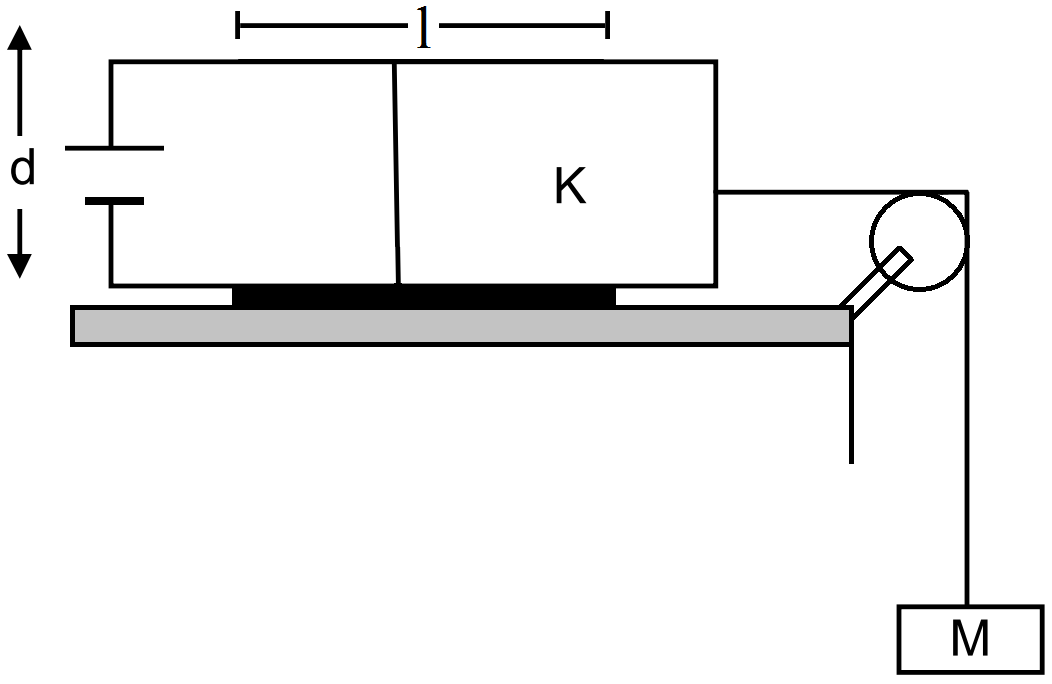
Consider the situation shown in figure. The width of each plate is b. The capacitor plates are rigidly clamped in the laboratory and connected to a battery of emf $\in.$ All surfaces are frictionless. Calculate the value of M for which the dielectric slab will stay in equilibrium.
50cc of oxygen is collected in an inverted gas jar over water. The atmospheric pressure is 99.4kPa and the room temperature is 27°C. The water level in the jar is same as the level outside. The saturation vapour pressure at 27°C is 3.4kPa. Calculate the number of moles of oxygen collected in the jar.
Read the passage given below and answer the following questions from 1 to 5. The cross product of two vectors is given by Vector C = A × B. The magnitude of the vector defined from cross product of two vectors is equal to product of magnitudes of the vectors and sine of angle between the vectors. Direction of the vectors is given by right hand corkscrew rule and is perpendicular to the plane containing the vectors. $\therefore\mid\text{vector}\text{C}\mid=\text{AB}\sin\theta$ and $ \text{Vector}\ \text{C}=\text{AB}\sinθ\text{n}$ Where, cap n is the unit vector perpendicular to the plane containing the vectors A and B. Following are properties of vector product
  1. Cross product does not obey commutative law. But its magnitude obeys commutative low.
  2. $\overrightarrow{\text{A}}\times\overrightarrow{\text{B}}\neq\overrightarrow{\text{B}}\times\overrightarrow{\text{A}}\Rightarrow(\overrightarrow{\text{A}}\times\overrightarrow{\text{B}})$
$=-(\overrightarrow{\text{B}}\times\overrightarrow{\text{A}}),\mid\overrightarrow{\text{A}}\times\overrightarrow{\text{B}}\mid=\mid\overrightarrow{\text{B}}\times\overrightarrow{\text{A}}\mid$
  1. It obeys distributive law
$\overrightarrow{\text{A}}\times(\overrightarrow{\text{B}}\times\overrightarrow{\text{C}})=\overrightarrow{\text{A}}\times\overrightarrow{\text{B}}+\overrightarrow{\text{A}}\times\overrightarrow{\text{C}}$
  1. The magnitude cross product of two vectors which are parallel is zero. Since θ = 0;
$\text{vector}\mid\text{A}\times\text{B}\mid=\text{AB}\sin\theta\circ= 0$
  1. For perpendicular vectors, $ \theta=90\circ,\text{vector}\mid\text{A}\times\text{B}\mid=\text{AB}\sin90\circ\mid\text{cap}\ \text{n}\mid=\text{AB}$
î x î = ĵ x ĵ = ƙ x ƙ = 0
î x ĵ = ƙ; ĵ x ƙ = î; ƙ x î = ĵ
ĵ x î = – (î x ĵ) = – ƙ; ƙ x ĵ = – (ĵ x ƙ) = – î ; î x ƙ = – (ƙ x î) = – ĵ
  1. The expression for a × b can be put in a determinant form which is easy to remember
$\overrightarrow{\text{a}}\times\overrightarrow{\text{b}}=\begin{vmatrix}\overrightarrow{\text{i}}&\overrightarrow{\text{j}}&\overrightarrow{\text{k}} \\\text{a}_{\text{x}} & \text{a}_{\text{y}}&\text{a}_{\text{z}}\\ \text{b}_{\text{x}} &\text{b}_{\text{y}}&\text{b}_\text{z}\end{vmatrix}$
Answer the following questions from above case study.
  1. If θ is angle between two vectors then resultant vector is maximum when θ is:
  1. 0
  2. 90
  3. 180
  4. None of these
  1. Cross product is operation performed between:
  1. Two scalar numbers
  2. One scalar other vector
  3. 2 vectors
  4. None of these
  1. Define cross product of two vectors:
  1. State right hand screw rule for finding out direction of resultant after cross product of two vectors.
  1. Give properties of cross product of parallel vector.
A collision experiment is done on a horizontal table kept in an elevator. Do you expect a change in the results if the elevator is accelerated up or down because of the noninertial character of the frame?
Read the passage given below and answer the following questions from 1 to 5.
Beats is an interesting phenomenon arising from interference of waves. When two harmonic Sound waves of slightly different frequencies and comparable amplitude are heard at the same time, we hear a sound of similar frequency (the average of two close frequencies), but we hear something else also. We hear audibly distinct waxing and waning of the intensity of the sound, with a frequency equal to the difference in the two close frequencies. Beat frequency is given by
$u = u_1 - u_2$
Artists use this phenomenon often while tuning their instruments with each other. They go on tuning until their sensitive ears do not detect any beats.
Doppler Effect is a wave phenomenon, it holds not only for sound waves but also for electromagnetic waves. However, here we shall consider only sound waves. Doppler Effect is defined as increase or decrease in frequency of sound due to relative motion between source of sound and observer. Frequency increases when source and observer comes towards each other and frequency decreases when source and observer go away from each other .For sound the observed frequency n is given in terms of the source frequency $v_0$ by
$\text{u}=\text{v}_0\frac{\text{v}+\text{v}_0}{\text{v}+\text{vs}}$
Here v is the speed of sound through the medium, is the velocity of observer relative to the medium, and is the source velocity relative to the medium. In using this formula, velocities in the direction OS should be treated as positive and those opposite to it should be taken to be negative. The change in frequency caused by a moving object due to Doppler Effect is used to measure their velocities in diverse areas such as military, medical science, astrophysics, etc. It is also used by police to check over-speeding of vehicles. A sound wave or electromagnetic wave of known frequency is sent towards a moving object. Some part of the wave is reflected from the object and its frequency is detected by the monitoring station. This change in frequency is called Doppler shift. It is used at airports to guide aircraft, and in the military to detect enemy aircraft. Astrophysicists use it to measure the velocities of stars. Doctors use it to study heart beats and blood flow in different parts of the body. Here they use ultrasonic waves, and in common practice, it is called sonography. Ultrasonic waves enter the body of the person, some of them are reflected back, and give information about motion of blood and pulsation of heart valves, as well as pulsation of the heart of the foetus. In the case of heart, the picture generated is called echocardiogram. Answer the following
  1. Beats are heard after superposition of two waves with beat frequency.
  1. $υ = υ_1 - υ_2$
  2. $υ = υ_1 + υ_2$
  3. $υ = (υ_1 - υ_2)/_2$
  4. None of these
  1. When source and observer comes towards each other then frequency heard will.
  1. Increase
  2. Decrease
  3. Remains same
  4. None of these
  1. Define beats.
  1. Define Doppler effect in sound.
  1. Note on applications of Doppler Effect in sound.
Which of the following is true for a cathode ray?
  1. It travels in a straight line.
  2. It emits an X-ray when it strikes a metal.
  3. It is an electromagnetic wave.
  4. It is not deflected by a magnetic field.
You are waiting for a train on a railway platform. Your three year old niece is standing on your iron trunk containing the luggage. Why does the trunk not recoil as she jumps off on the platform?
Calculate the amplification factor of a triode valve that has plate resistance of $2\text{k}\Omega$ and transconductance of 2 millimho.
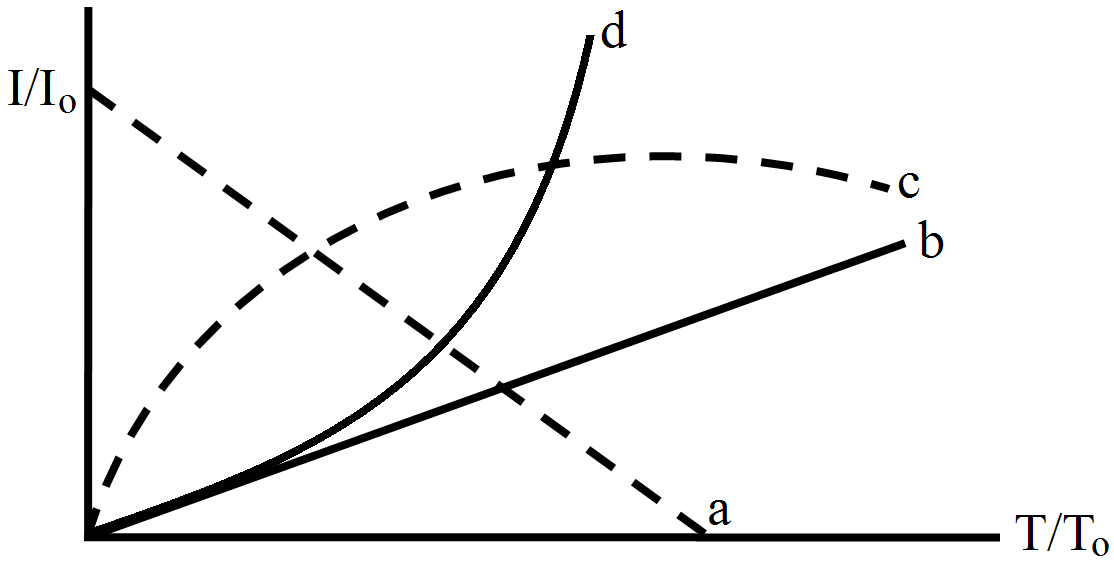
Let $\text{i}_0$ be the thermionic current from a metal surface when the absolute temperature of the surface is $\text{T}_0$. The temperature is slowly increased and the thermionic current is measured as a function of temperature. Which of the following plots may represent the variation in $\Big(\frac{\text{i}}{\text{i}_0}\Big)$ against $\Big(\frac{\text{T}}{\text{T}_0}\Big)?$
The weight Mg of an extended body is generally shown in a diagram to act through the centre of mass. Does it mean that the earth does not attract other particles?