Question
A collision experiment is done on a horizontal table kept in an elevator. Do you expect a change in the results if the elevator is accelerated up or down because of the noninertial character of the frame?

Answer

Velocity and mass are only two components that affect collision between two bodies so in this change in acceleration due to gravity will not affect the collision between two bodies. (if kept horizontally)

Need a full question paper?

Generate a complete, print-ready paper with questions like this in minutes — across 16+ boards, with answer keys.
Start Generating Free

Similar questions

Read the passage given below and answer the following questions from (i) to (v).
A motion that repeats itself at regular intervals of time is called periodic motion. Very often, the body undergoing periodic motion has an equilibrium position somewhere inside its path. When the body is at this position no net external force acts on it. Therefore, if it is left there at rest, it remains there forever. If the body is given a small displacement from the position, a force comes into play which tries to bring the body back to the equilibrium point, giving rise to oscillations or vibrations. Every oscillatory motion is periodic, but every periodic motion need not be oscillatory. Circular motion is a periodic motion, but it is not oscillatory. The smallest interval of time after which the motion is repeated is called its period. Let us denote the period by the symbol T. Its SI unit is second. The reciprocal of T gives the number of repetitions that occur per unit time. This quantity is called the frequency of the periodic motion. It is represented by the symbol n. The relation between n and T is $\text{n}=\frac{1}{\text{T}}$. The unit of n is thus $s^{-1}$​​​​​​​. After the discoverer of radio waves, Heinrich Rudolph Hertz (1857–1894), a special name has been given to the unit of frequency. It is called hertz (abbreviated as Hz). Answer the following.
  1. Every oscillatory motion is periodic motion true or false?
  1. True
  2. False
  1. Circular motion is
  1. Oscillatory motion
  2. Periodic motion
  3. Rotational motion
  4. None of these
  1. Define period. Give its SI unit and dimensions
  2. Define frequency of periodic motion. How it is related to time period
  3. What is oscillatory motion
Read the passage given below and answer the following questions from (i) to (v). Vectors
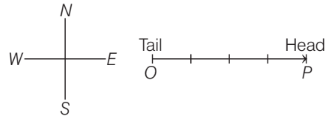
Vectors are the physical quantities which have both magnitudes and directions and obey the triangle/parallelogram laws of addition and subtraction. It is specified by giving its magnitude by a number and its direction. e.g. Displacement, acceleration, velocity, momentum, force, etc. A vector is represented by a bold face type and also by an arrow placed over a letter, i.e. F, a, b or $\overrightarrow{\text{F}},\overrightarrow{\text{a}},\overrightarrow{\text{b}}.$ The length of the line gives the magnitude and the arrowhead gives the direction. The point P is called head or terminal point and pointO is called tail or initial point of the vector OP.
  1. Amongst the following quantities, which is not a vector quantity?
  1. Force
  2. Acceleration
  3. Temperature
  4. Velocity
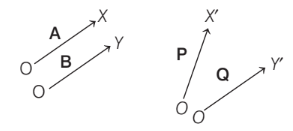
  1. Set of vectors A and B, P and Q are as shown below

Length of A and B is equal, similarly length of P and Q is equal. Then, the vectors which are equal, are:
  1. A and P
  2. P and Q
  3. A and B
  4. B and Q
  1. $\mid\lambda\text{A}\mid=\lambda\mid\text{A}\mid,$ if:
  1. $\lambda>0$
  2. $\lambda,<0$
  3. $\lambda,=0$
  4. $\lambda,\neq0$
  1. Among the following properties regarding null vector which is incorrect?
  1. A + 0 = A
  2. $\lambda0=\lambda$
  3. 0A = 0
  4. A - A = 0
  1. The x and y components of a position vector P have numerical values 5 and 6, respectively. Direction and magnitude of vector P are:
  1. $\tan^{-1}\big(\frac{6}{5}\big)\text{and}\sqrt{61}$
  2. $\tan^{-1}\big(\frac{5}{6}\big)\text{and}\sqrt{61}$
  3. 60° and 8
  4. 30° and 9
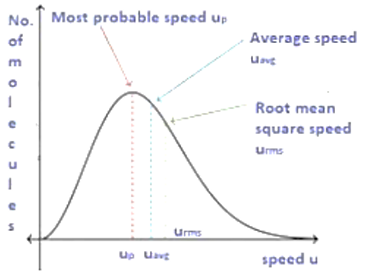
Root mean square velocity (RMS value)is the square root of the mean of squares of the velocity of individual gas molecules and the Average velocity is the arithmetic mean of the velocities of different molecules of a gas at a given temperature.
Image
1. Moon has no atmosphere because:
(a) the escape velocity of the moon’s surface is more than the r.m.s velocity of all molecules
(b) it is far away from the surface of the earth
(c) the r.m.s. velocity of all the gas molecules is more than the escape velocity of the moon’s surface
(d) its surface temperature is $10^{\circ} C$
2. For an ideal gas, $\frac{C_P}{C_V}$ is
(a) $\leq 1$    (b) none of these    (c) $>1$    (d) $<1$
3. The root means square velocity of hydrogen is $\sqrt{5}$ times that of nitrogen. If $T$ is the temperature of the gas then:
(a) $T\left(H_2\right)=T\left(N_2\right)$    (b) $T \left( H _2\right)< T \left( N _2\right)$
(c) $T \left( H _2\right) \neq T \left( N _2\right)$    (d) $T \left( H _2\right)> T \left( N _2\right)$
4. Suppose the temperature of the gas is tripled and $N _2$ molecules dissociate into an atom. Then what will be the rms speed of atom:
(a) $v_0 \sqrt{2}$    (b) $v_0 \sqrt{6}$    (c) $v_0 \sqrt{3}$    (d) $v_0$
OR
The velocities of the molecules are $v , 2 v , 3 v , 4 v \& 5 v$. The RMS speed will be:
(a) 11 v    (b) $v (12)^{11}$   (c) v    (d) $v (11)^{12}$
A magnetic dipole of magnetic moment $1.44A-m^2$ is placed horizontally with the north pole pointing towards north. Find the position of the neutral point if the horizontal component of the earth's magnetic field is $18 \mu\text{T}.$
Calculate the amplification factor of a triode valve that has plate resistance of $2\text{k}\Omega$ and transconductance of 2 millimho.
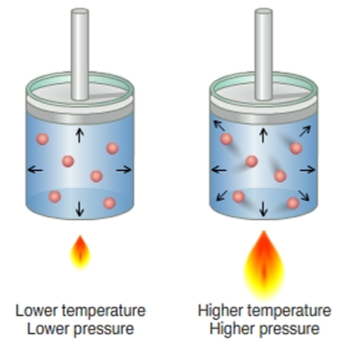
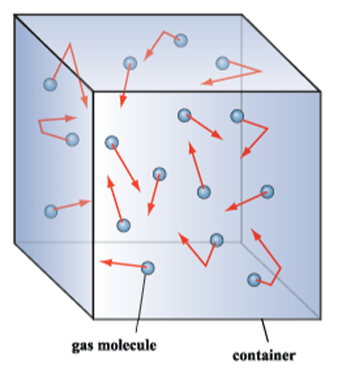
In a gas the particles are always in a state of random motion, all the particles move at different speed constantly colliding and changing their speed and direction, as speed increases it will result in an increase in its kinetic energy.
Image
1. If the temperature of the gas increases from 300 K to 600 K then the average kinetic energy becomes:
(a) same    (b) becomes double    (c) becomes half    (d) become triple
2. What is the average velocity of the molecules of an ideal gas?
(a) Infinite    (b) Same    (c) Increase    (d) Zero
3. Cooking gas containers are kept in a lorry moving with uniform speed. The temperature of the gas molecules inside will ___________.
(a) decrease    (b) Rises    (c) increase    (d) remains same
4. Find the ratio of average kinetic energy per molecule of Oxygen and Hydrogen:
(a) $1: 1$    (b) $4: 1$    (c) $1: 2$    (d) $1: 4$
OR
The velocities of the three molecules are $3 v , 4 v$, and 5 v . calculate their root mean square velocity?
(a) 4.0 v   (b) 4.02 v    (c) 4.08 v    (d) 4.04 v
You are holding a cage containing a bird. Do you have to make less effort if the bird flies from its position in the cage and manages to stay in the middle without touching the walls of the cage? Does it make a difference whether the cage is completely closed or it has rods to let air pass?
If the temperature of a tungsten filament is raised from 2000K to 2010K, by what factor does the emission current change? Work function of tungsten is 4.5eV.
A bar magnet takes $\frac{\pi}{10}$ second to complete one oscillation in an oscillation magnetometer. The moment of inertia of the magnet about the axis of rotation is $1.2 \times 10^{-4} \mathrm{~kg}-\mathrm{m}^2$ and the earth's horizontal magnetic field is $30\mu \text{T}.$ Find the magnetic moment of the magnet.