Question
Read the passage given below and answer the following questions:

Proteins are high molecular mass complex biomolecules of amino acids. The important proteins required for our body are enzymes, hormones, antibodies, transport proteins, structural proteins, contractile proteins etc. Except for glycine, all $\alpha$-amino acids have chiral carbon atom and most of them have L-configuration. The amino acids exists as dipolar ion called zwitter ion, in which a proton goes from the carboxyl group to the amino group. A large number of $\alpha$-amino acids are joined by peptide bonds forming polypeptides. The peptides having very large molecular mass (more than 10,000) are called proteins. The structure of proteins is described as primary structure giving sequence of linking of amino acids; secondary structure giving manner in which polypeptide chains are arranged and folded; tertiary structure giving folding, coiling or bonding polypeptide chains producing three dimensional structures and quaternary structure giving arrangement of sub-units in an aggregate protein molecule.

A statement of assertion followed by a statement of reason is given. Choose the correct answer out of the following choices.

  1. Assertion and reason both are correct statements and reason is correct explanation for assertion.
  2. Assertion and reason both are correct statements but reason is not correct explanation for assertion.
  3. Assertion is correct statement but reason is wrong statement.
  4. Assertion is wrong statement but reason is correct statement.
  1. Assertion: Except glycine, all naturally occurring CL-amino acids are optically active.

Reason: All naturally occurring CL-amino acids, except glycine, has at least one asymmetric carbon.

  1. Assertion: All amino acids are optically active.

Reason: Amino acids contain asymmetric carbon atoms.

  1. Assertion: In $\alpha$-helix structure, intramolecular H-bonding takes place whereas in $\beta$-pleated structure, intermolecular H-bonding takes place.

Reason: An egg contains a soluble globular protein called albumin which is present in the white part.

  1. Assertion: Secondary structure of protein refers to regular folding patterns of continuos portions of the polypeptide chain.

Reason: Out of 20 amino acids, only 12 amino acids can be synthesised by human body.

  1. Assertion: The helical structure of protein is stabilised by intramolecular hydrogen bond between -NH and carbonyl oxygen.

Reason: Sanger's reagent is used for the identification of N-tenninal amino acid of peptide chain.
Answer

  1.  (a) Assertion and reason both are correct statements and reason is correct explanation for assertion.
  1. (d) Assertion is wrong statement but reason is correct statement.

Explanation:

All amino acids except glycine are optically active because they contain, asymmetric carbon atom. They exist in both D and L-forms. Most naturally occurring amino acids have L-configuration.

  1. (b) Assertion and reason both are correct statements but reason is not correct explanation for assertion.

Explanation:

In $\alpha$-helix structure, the formation of hydrogen bonds takes place between -CO- and -NH groups, whereas in $\beta$-pleated structure, hydrogen bonds are formed between amide groups of two different chains.

  1. (c) Assertion is correct statement but reason is wrong statement.

Explanation:

Out of 20 amino acids, only 10 amino acids can be synthesised by human body.

  1.  (b) Assertion and reason both are correct statements but reason is not correct explanation for assertion. 

Need a full question paper?

Generate a complete, print-ready paper with questions like this in minutes — across 16+ boards, with answer keys.

Start Generating Free

Similar questions

Read the passage given below and answer the following questions
Few colligative properties are:
  1. Relative lowering of vapour pressure: depends only on molar concentration of solute (mole fraction) and independent of its nature.
  2. Depression in freezing point: it is proportional to the molal concentration of solution.
  3. Elevation of boiling point: it is proportional to the molal concentration of solute.
  4. Osmotic pressure: it is proportional to the molar concentration of solute
A solution of glucose is prepared with 0.052 g at glucose in 80.2 g of water.(KJ = 1.86K kg mol-1 and Kb = 5.2K kg mol-1)
The following questions are multiple choice questions. Choose the most appropriate answer:
  1. Molality of the given solution is.
  1. 0.0052m
  2. 0.0036m
  3. 0.0006m
  4. 1.29m
  1. Boiling point for the solution will be.
  1. 373.05K
  2. 373.15K
  3. 373.02K
  4. 373.02K
  1. The depression in freezing point of solution will be.
  1. 0.0187K
  2. 0.035K
  3. 0.082K
  4. 0.067K
  1. Mole fraction of glucose in the given solution is.
  1. 6.28 × 10⁻⁵
  2. 6.28 × 10⁻⁴
  3. 0.00625
  4. 0.00028
  1. If same amount of sucrose (C12 H22 O11) is taken instead of glucose, then.
  1. Elevation in boiling point will be higher.
  2. Depression in freezing point will be higher.
  3. Depression in freezing point will be lower.
  4. Both (a) and (b).
What is the most suitable pKa value of the substituted propylamine formed with substituent "X" with electronegativity 3.0
(i)10.67 (ii)10.08 (iii) 10.15 (iv)11.10

Read the passage given below and answer the following questions:

A primary alkyl halide (A) C4H9Br reacted with akoholic KOH to give compound (B). Compound (B) is reacted with HBr to give compound (C) which is an isomer of (A). When (A) reacted with sodium metal, it gave a compound (D) C8H18 that is different than the compound obtained when n-butyl bromide reacted with sodium metal.

The following questions are multiple choice questions. Choose the most appropriate answer:

  1. Compound (A) is:
  1. CH3CH2CH2CH2Br

  2. $\text{CH}_3\text{CH}-\text{CH}_2\text{Br}\\\ \ \ \ \ \ \ \ \ |\\\ \ \ \ \ \ \ \ \text{CH}_3$

  3. $\ \ \ \ \ \ \ \ \ \ \ \ \ \ \text{CH}_3\\\ \ \ \ \ \ \ \ \ \ \ \ \ \ \ |\\\text{CH}_3-\text{C}-\text{Br} \\\ \ \ \ \ \ \ \ \ \ \ \ \ \ \ \ |\\\ \ \ \ \ \ \ \ \ \ \ \ \ \ \ \text{CH}_3$

  4. CH3CH2CH2Br

  1. Which type of isomerism is present in compound (A) and (C)?
  1. Positional
  2. Functional
  3. Chain
  4. Both (a) and (c)
  1. Identify compound (B).
  1. $\text{CH}_3-\text{C}=\text{CH}_2 \ \ \\ \ \ \ \ \ \ \ \ \ \ \ \ \ \mid \\ \ \ \ \ \ \ \ \ \ \ \ \text{CH}_3$
  2. CH3 – CH = CH – CH3
  3. CH3 – CH2 – CH = CH2
  4. None of these.
  1. IUPAC name of compound (D) is:
  1. N - octane
  2. 2, 5 - dimethylhexane
  3. 2 - methylheptane
  4. 3, 4 - dimethyl hexane.
  1. When compoound (C) is treated with ale. KOH and then treated with presence of peroxide, the compound obtained is:
  1. $\ \ \ \ \ \ \ \ \ \ \ \ \ \ \text{CH}_3\\\ \ \ \ \ \ \ \ \ \ \ \ \ \ \ |\\\text{CH}_3-\text{C}-\text{Br} \\\ \ \ \ \ \ \ \ \ \ \ \ \ \ \ \ |\\\ \ \ \ \ \ \ \ \ \ \ \ \ \ \ \text{CH}_3$

  2. $\ \ \ \ \ \ \ \ \ \ \ \ \ \ \text{CH}_3\\\ \ \ \ \ \ \ \ \ \ \ \ \ \ \ |\\\text{CH}_3-\text{CH}-\text{CH}_2-\text{Br}$

  3. $\text{CH}_3\text{CH}_2\text{CH}_2\text{CH}_2\text{Br}$

  4. $$$\text{CH}_3\text{CH}_2\text{CH}_2\text{CH}-\text{Br}\\\ \ \ \ \ \ \ \ \ \ \ \ \ \ \ \ \ \ \ \ \ \ \ \ \ |\\\ \ \ \ \ \ \ \ \ \ \ \ \ \ \ \ \ \ \ \ \ \ \ \ \text{CH}_3$

Read the passage given below and answer the following questions:

Amines are basic in nature. The basic strength of amines can be expressed by their dissociation constant, Kb or pKb.

$\text{RNH}_2+\text{H}_2\text{O}\rightleftharpoons\text{RNH}^+_3+\text{OH}^-$

$\text{k}_\text{b}=\frac{[\text{RNH}^+_3][\text{OH}^-]}{[\text{RNH}_2]}\text{and}\text{ pk}_\text{b}=-\log\text{k}_\text{b}$

Greater the Kb value or smaller the pKb value, more is the basic strength of a mine. Aryl amines such as aniline are less basic than aliphatic amines due to the involvement of lone pair of electrons on N-atom with the resonance in benzene. In derivatives of aniline, the electron releasing groups increase the basic strength while electron withdrawing groups decrease the basic strength. The base weakening effect of electron withdrawing group and base strengthening effect of electron releasing group is more marked at p-position than at m-position. a-Substituted aniline is less basic than aniline due to ortho effect and is probable due to combination of electronic and steric effect.

The following questions are multiple choice questions. Choose the most appropriate answer:

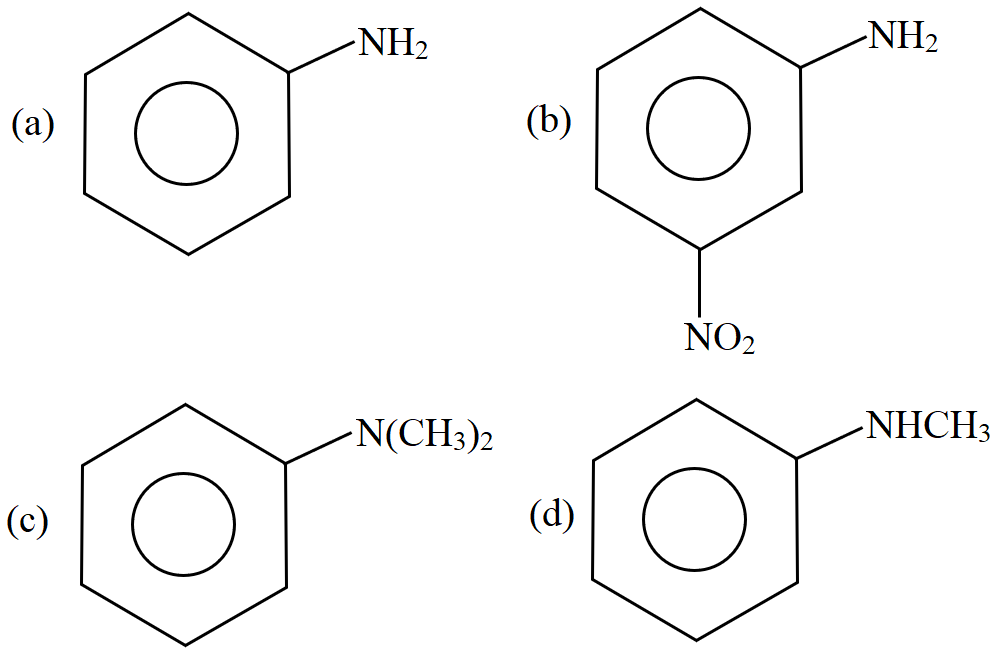
  1. Which of the following has lowest pKb value?

  1. The strongest base among the following is:
  1. C6H5NH2

  2. p-NO2 - C6H4NH2

  3. m-NO2 - C6H4NH2

  4. C6H5CH2NH2

  1. Maximum pKb value of:
  1.  

  1.  

  1. (CH3CH2)2NH

  2. (CH3)2NH

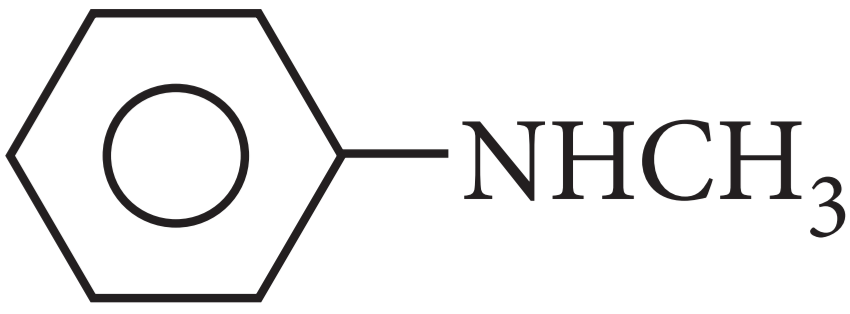
  1.  The order of basic strength among the following amines in benzene solution is:
  1. Methylamine is more basic than NH3.
  2. Amines form hydrogen bonds.
  3. Ethylamine has higher boiling point than propane.
  4. Dimethylamine is less basic than methylamine.
  1. CH3CH2NH2 contains a basic -NH2 group, but CH3CONH2 does not because:
  1. Acetamide is amphoteric in character.
  2. In ethylamine the electron pair on N-atom is delocalised by resonance.
  3. In ethylamine there is no resonance while in acetamide the lone pair of electrons on N-atom is delocalised and is less available for protonation.
  4. None of these.
For the reaction : $2\text{NO}_\text{(g)}+\text{Cl}_{2\text{(g)}}\rightarrow2\text{NOCl}_\text{(g)},$ the following data were collected. All the measurements were taken at 263K.
Experiment No.
Initial [NO] (M)
Initial [Cl2] (M)
Initial rate of disapp. of Cl2 (M/ min)
1.
0.15
0.15
0.60
2.
0.15
0.30
1.20
3.
0.30
0.15
2.40
4.
0.25
0.25
?
The following questions are multiple choice questions. Choose the most appropriate answer:
  1. The molecularity of the reaction is:
  1. 1
  2. 2
  3. 3
  4. 4
  1. The expression for rate law is:
  1. $\text{r}=\text{k}[\text{NO}][\text{Cl}_2]$
  2. $\text{r}=\text{k}[\text{NO}]^2[\text{Cl}_2]$
  3. $\text{r}=\text{k}[\text{NO}][\text{Cl}_2]^2$
  4. $\text{r}=\text{k}[\text{NO}]^2[\text{Cl}_2]^2$
  1. The overall order of the reaction is:
  1. 2
  2. 0
  3. 1
  4. 3
  1. The value of rate constant is:
  1. 150.32 M-2 min-1
  2. 200.08 M-1 min-1
  3. 177.77 M-2 min-1
  4. 155.75 M-1 min-1
  1. The initial rate of disappearance of Cl2 in experiment 4 is:
  1. 1.75M min-1
  2. 3.23M min-1
  3. 2.25M min-1
  4. 2.77M min-1
Explain the structure of nucleic acid compounds.
Read the passage given below and answer the following questions:

Glucose is known as dextrose because it occurs in nature as the optically active dextrorotatory isomer. lt is essential constituent of human blood. The blood normally contains 65 to 110mg of glucose per 100mL (hence named Blood sugar). The level may be much higher in diabetic persons. The urine of diabetic persons also contain considerable amount of glucose. ln combined form, it occurs in cane sugar and polysaccharides such as starch and cellulose.

Glucose has an aldehyde group (-CHO), one primary alcoholic group (-CH2OH) and four secondary alcoholic groups (-CHOH) in their structure. Due to the presence five hydroxyl groups (-OH). glucose undergoes acetylation. Glucose also undergoes oxidation with mild oxidising agents like bromine water as well as with strong oxidising agents like nitric acid. Since glucose is readily oxidised, it acts as a strong reducing agent and reduces Tollen's reagent and Fehling solution. Glucose exists in two crystalline forms: $\alpha$-D-glucose and $\beta$-D-glucose. If either of the two forms is dissolved in water and allowed to stand, the specific rotation of the solution changes gradually, until a constant value is obtained. This change is called mutarotation.

A statement of assertion followed by a statement of reason is given. Choose the correct answer out of the following choices.

  1. Assertion and reason both are correct statements and reason is correct explanation for assertion.
  2. Assertion and reason both are correct statements but reason is not correct explanation for assertion.
  3. Assertion is correct statement but reason is wrong statement.
  4. Assertion is wrong statement but reason is correct statement.
  1. Assertion: A diabetic person carries a packet of glucose with him always.

Reason: Glucose increases the blood sugar level almost instantaneously.

  1. Assertion: On oxidation with nitric acid, glucose as well as gluconic acid both yield saccharic acid.

Reason: The pentaacetate of glucose does not react with hydroxylamine indicating the absence of free -CHO group.

  1. Assertion: Glucose reacts with acetyl chloride to form pentaacetyl glucose.

Reason: The formation of pentaacetyl derivative confirms the presence of five -OH groups in glucose.

  1. Assertion: A certain compound gives negative test with ninhydrin and positive test with Benedict's solution, the compound is an amino acid.

Reason: Glucose is a monosaccharide.

  1. Assertion: The rapid interconversion of $\alpha$-D-glucose and $\beta$-D-glucose in solution is known as racemisation.

Reason: Hydrolysis reaction will take place when a mineral acid is treated with sugar.

Read the passage given below and answer the following questions:

Dehydration of alcohols can lead to the formation of either alkenes or ethers. This dehydration can be carried out either with protonic acids such as cone.H2SO4, H3PO4 or catalysts such as anhydrous ZnCl2 or Al2O3. When primary alcohols are heated with cone. H2SOat 433-44 K, they undergo intramolecular dehydration to form alkenes. Secondary and tertiary alcohols undergo dehydration under milder conditions. The ease of dehydration of alcohols follows the order: 3º > 2º > 1º.

The dehydration of alcohols always occurs in accordance with the Saytzeff's rule. Primary alcohols when heated with protic acid at 413K, gives dialkyl ether.

$\text{CH}_3\text{CH}_2\text{OH}\xrightarrow[433.433\text{K}]{\text{conc. H}_2\text{SO}_4}\text{CH}_2=\text{CH}_2+\text{H}_2\text{O}$

$2\text{CH}_3\text{CH}_2\text{OH}\xrightarrow[433\text{K}]{\text{conc. H}_2\text{SO}_4}\text{CH}_3\text{CH}_2-\text{O}-\text{CH}_2\text{CH}_3+\text{H}_2\text{O}$

The following questions are multiple choice questions. Choose the most appropriate answer:

  1. Which one of the following alcohols undergoes acid-catalysed dehydration to alkenes most readily?
  1. (CH3)2CHCH2OH

  2. (CH3)3COH

  3. CH3CHOHCH3

  4. CH3CH2CH2OH

  1. Dehydration of alcohol is an example of which type of reaction?
  1. Substitution.
  2. Elimination.
  3. Addition.
  4. Rearrangment.
  1. The alcohol which does not give a stable compound on dehydration is:
  1. Ethyl alcohol.
  2. Methyl alcohol.
  3. N-propyl alcohol.
  4. N-butyl alcohol.
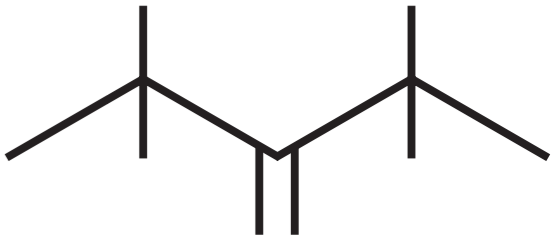
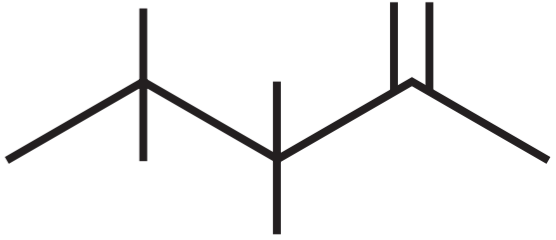
  1.  The most stable product (s) is/ are:

  1.  

  1.  

  1. Both (a) and (b)
  2. None of these.
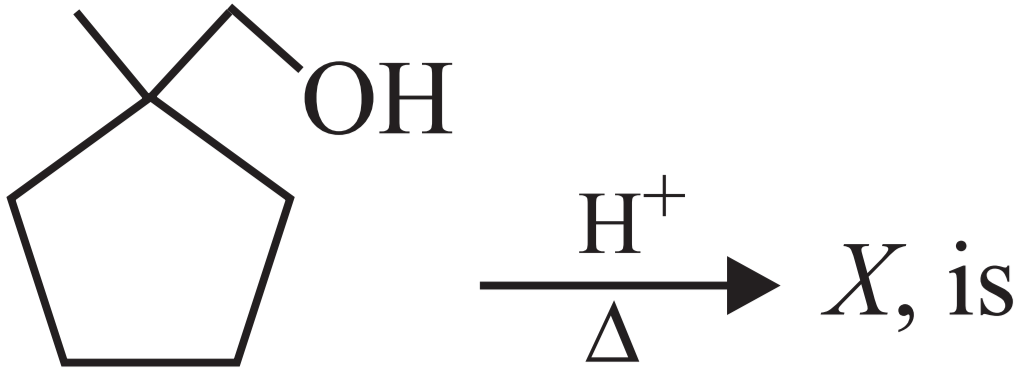
  1. The product of the reaction 

Read the passage given below and answer the following questions:

Lucas test is a test to differentiate between primary, secondary and tertiary alcohols. This test consists of treating an alcohol with Lucas' reagent, and turbidity, due to the formation of insoluble alkyl chloride, is observed. Lucas test is based on the difference in reacting of three classes of alcohols with hydrogen chloride via SN1 reaction. The different reactivity reflects the differing ease of formation of the corresponding carbocations.

In these questions (Q. No. i-iv), a statement of assertion followed by a statement ofreason is given. Choose the correct answer out of the following choices.

  1. Assertion and reason both are correct statements and reason is correct explanation for assertion.
  2. Assertion and reason both are correct statements but reason is not correct explanation for assertion.
  3. Assertion is correct statement but reason is wrong statement.
  4. Assertion is wrong statement but reason is correct statement.
  1. Assertion: Equimolar mixture of cone. HCI and anhydrous ZnCl2 is called Lucas' reagent.

Reason: Lucas' reagent can be used to distinguish between methanol and ethanol.

  1. Assertion: 2-Methyl-2-butanol gives no turbidity with Lucas' reagent at room temperature.

Reason: It is a 3º alcohol.

  1. Assertion: Tertiary alcohols react fastest with Lucas' reagent by SN1 mechanism.

Reason: 3º carbocation is most stable.

  1. Assertion: Amongst the compounds, H2C = CHCH2OH (I), C6H5OH (II), CH3CH2CH2OH (III) and (CH3)3COH (IV), only (IV) reacts with Lucas' reagent at room temperature.

Reason: Tertiary alcohol gives turbidity immediately with Lucas' reagent.

  1. Assertion: Lucas test can be used to distinguish between 1-propanol and 2-propanol.

Reason: Lucas test is based upon the difference in reactivity of primary, secondary and tertiary alcohols with cone. HCI and anhyd. ZnCl2.