Question
Read the passage given below and answer the following questions
Few colligative properties are:
  1. Relative lowering of vapour pressure: depends only on molar concentration of solute (mole fraction) and independent of its nature.
  2. Depression in freezing point: it is proportional to the molal concentration of solution.
  3. Elevation of boiling point: it is proportional to the molal concentration of solute.
  4. Osmotic pressure: it is proportional to the molar concentration of solute
A solution of glucose is prepared with 0.052 g at glucose in 80.2 g of water.(KJ = 1.86K kg mol-1 and Kb = 5.2K kg mol-1)
The following questions are multiple choice questions. Choose the most appropriate answer:
  1. Molality of the given solution is.
  1. 0.0052m
  2. 0.0036m
  3. 0.0006m
  4. 1.29m
  1. Boiling point for the solution will be.
  1. 373.05K
  2. 373.15K
  3. 373.02K
  4. 373.02K
  1. The depression in freezing point of solution will be.
  1. 0.0187K
  2. 0.035K
  3. 0.082K
  4. 0.067K
  1. Mole fraction of glucose in the given solution is.
  1. 6.28 × 10⁻⁵
  2. 6.28 × 10⁻⁴
  3. 0.00625
  4. 0.00028
  1. If same amount of sucrose (C12 H22 O11) is taken instead of glucose, then.
  1. Elevation in boiling point will be higher.
  2. Depression in freezing point will be higher.
  3. Depression in freezing point will be lower.
  4. Both (a) and (b).

Answer

  1. (b) 0.0036m

Explanation:

$\text{m}=\frac{0.052}{180}\times\frac{1000}{80.2}=0.0036$

  1. (c) 373.02K

Explanation:

$\Delta\text{T}_\text{b}=\text{k}_\text{b}\times\text{m}=5.2\times0.0036=0.0187\ \text{K}$

Tb = 373 + 0.0187 = 373.0187 K $\approx$ 373.02 K

  1. (d) 0.067 K

Explanation:

$\Delta\text{T}_\text{f}=\text{k}_\text{f}\times\text{m}=1.86\times0.0036=0.067\ \text{K}$

  1. (a) 6.28 × 10⁻⁵

Explanation:

Moles of water $\frac{80.2}{18}=4.455$

Mole fraction of glucose $=\frac{0.00028}{4.45+0.00028}=6.28\times10^{-5}$'

  1. (c) Depression in freezing point will be lower.

Explanation:

Depression in freezing point or elevation in boiling point is proportional to molarity, which is proportional to number of moles. For same amount, higher the molar mass of solute, lower will be number of moles. Hence, lower will be the colligative property.

Need a full question paper?

Generate a complete, print-ready paper with questions like this in minutes — across 16+ boards, with answer keys.

Start Generating Free

Similar questions

Read the passage given below and answer the following questions:

Ligands are atoms or ions which can donate electrons to the central atoms. Ligands can be monodentate, bidentate or polydentate as well. Few ligands can coordinate with the central atom through more than one site, these are called ambidentate ligands. When a di- or polydentate ligand uses its two or more donor atoms to bind a single metal ion, it is said to be a chelating ligand.

In these questions (Q. No. i-iv), a statement of assertion followed by a statement ofreason is given. Choose the correct answer out of the following choices.

  1. Assertion and reason both are correct statements and reason is correct explanation for assertion.
  2. Assertion and reason both are correct statements but reason is not correct explanation for assertion.
  3. Assertion is correct statement but reason is wrong statement.
  4. Assertion is wrong statement but reason is correct statement.
The following questions are multiple choice questions. Choose the most appropriate answer:

  1. Assertion: Glycinate ion is an example of monodentate ligand.

Reason: Glycinate contains N and O as donor atoms.

  1. Assertion: EDTA forms complex with divalent metals of 3d-series in the ratio of 1 : 1.

Reason: EDTA has 4 - COOH groups.

  1. Assertion: Oxalate ion is a bidentate ligan.

Reason: Oxalate ion has two donor atoms.

  1. Assertion: A chelating ligand must possess two or more lone pairs at such a distance that it may form suitable strain free 5 and 6 membered rings with the metal ion.

Reason: H2N - NH2 is a chelating ligand.

  1. Assertion: In Zeise's salt coordination number of Pt is five.

Reason: Ethene is a monodentate ligand.

What change in the concentration of H₂ will triple the rate of reaction?
(c). Suppose a reaction between A and B, was experimentally found to be first order with respect to both A and B. So the rate equation is:
Rate = k[A][B]
Which of these two mechanisms is consistent with this experimental finding? Why?
Mechanism 1
A → C + D (slow)
B+C → E (fast)
Mechanism 2
A+B →C + D (slow)
C → E (fast)
Read the passage given below and answer the following questions:

Carbohydrates are polyhydroxy aldehydes and ketones and those compounds which on hydrolysis give such compounds are also carbohydrates. The carbohydrates which are not hydrolysed are called monosaccharides. Monosaccharides with aldehydic group are called aldose and those which free ketonic groups are called ketose. Carbohydrates are optically active. Number of optical isomers = 2n

Where n = numberofasymmetric carbons. Carbohydrates are mainlysynthesised by plants during photosynthesis. The monosaccharides give the characteristic reactions of alcohols and carbonyl group (aldehydes and ketones). It has been found that these monosaccharides exist in the form of cyclic structures. In cyctization, the -OH groups (generally C5 or C4 in aldohexoses and C5 or C6 in ketohexoses) combine with the aldehyde or keto group. As a result, cyclic structures of five or six membered rings containing one oxygen atom are formed, e.g., glucose forms a ring structure. Glucose contains one aldehyde group, one IO alcoholic group and four 2° alcoholic groups in its open chain structure.

The following questions are multiple choice questions. Choose the most appropriate answer:

  1. First member of ketos sugar is:
  1. Ketotriose.
  2. Ketotetrose.
  3. Ketopentose.
  4. Ketohexose.
  1. In CH2OHCHOHCHOHCHOHCHOHCHO, the number of optical isomers will be:
  1. 16
  2. 8
  3. 32
  4. 4
  1. Some statements are given below:
  1. Glucose is aldohexose.
  2. Naturally occurring glucose is dextrorotatory.
  3. Glucose contains three chiral centres.
  4. Glucose contains one 1° alcoholic group and four 2° alcoholic groups.

Among the above, correct statements are:

  1. 1 and 2 only
  2. 3 and 4 only
  3. 1, 2 and 4 only
  4. 1, 2, 3 and 4
  1. Two hexoses fonn the same osazone, find the correct statement about these hexoses.
  1. Both of them must be aldoses.
  2. They are epimers at C-3.
  3. The carbon atoms I and 2 in both have the same configuration.
  4. The carbon atoms 3, 4 and 5 in both have the same configuration.
  1. Which of the following reactions of glucose can be explained only by its cyclic structure?
  1. Glucose forms cyanohydrin with HCN.
  2. Glucose reacts with hydroxylamine to form an oxime.
  3. Pentaacetate of glucose does not react with hydroxylamine.
  4. Glucose is oxidised by nitric acid to gluconic acid.
Read the passage given below and answer the following questions:

Amines are produced when an alcoholic solution of ammonia and an alkyl or a benzyl halide is heated in a sealed tube at 373K. This reaction is called ammonolysis and usually gives a mixture of primary, secondary and tertiary amines along with some quarternary ammonium salts. This reaction is an example of nucleophilic substitution reaction in which ammonia acts as a nucleophile due to the presence of a lone pair of electrons on the nitrogen atom. However this method cannot be used for the preparation of aryl amines. One of the most convenient methods for the preparation of aryl amines is reduction of nitro compounds. Aryl amines can also be prepared by reduction of nitrites or Gabriel phthalimide synthesis.

A statement of assertion followed by a statement of reason is given. Choose the correct answer out of the following choices.

  1. Assertion and reason both are correct statements and reason is correct explanation for assertion.
  2. Assertion and reason both are correct statements but reason is not correct explanation for assertion.
  3. Assertion is correct statement but reason is wrong statement.
  4. Assertion is wrong statement but reason is correct statement.
  1. Assertion: Ammonolysis of alkyl halides only produces 2° amines.

Reason: Ammonolysis of alkyl halides involves the reaction between alkyl halides and alcoholic ammonia.

  1. Assertion: Gabriel-phthalimide reaction can be used to prepare both aryl and alkyl primary amines.

Reason: Aryl halides are more reactive alkyl halides towards nucleophilic substitution reactions.

  1. Assertion: Anunonolysis method cannot be used for the preparation of aryl amines.

Reason: Aryl halides are much less reactive than alkyl halides towards nucleophilic substitution reaction.

  1. Assertion: Ammonolysis can be used to prepare pure primary amines.

Reason: Ammonolysis of haloalkanes lead to multiple ammonium salts.

  1. Assertion: Aromatic 1º amines can not be prepared by Gabriel phthalimide synthesis.

Reason: Aryl halides do not undergo nucleophilic substitution with anion formed by phthalimide.

Read the passage given below and answer the following questions:
A compound (X) containing C, H and O is unreactive towards sodium. It also does not react with Schiff s reagent. On refluxing with an excess of hydroiodic acid, (X) yields only one organic product ( Y). On hydrolysis, (Y) yields a new compound (Z) which can be converted into (Y) by reaction with red phosphorus and iodine. The compound (Z) on oxidation with potassium permanganate gives a carboxylic acid. The equivalent weight of this acid is 60.
The following questions are multiple choice questions. Choose the most appropriate answer:
  1. The compound (X) is an:
  1. Acid.
  2. Aldehyde.
  3. Alcohol.
  4. Ether.
  1. The IUPAC name of the acid formed is:
  1. Methanoic acid.
  2. Ethanoic acid.
  3. Propanoic acid.
  4. Butanoic acid.
  1. Compound (Y) is:
  1. Ethyl iodide.
  2. Methyl iodide.
  3. Propyl iodide.
  4. Mixture of (a) and (b).
  1. Compound (Z) is:
  1. Methanol.
  2. Ethanol.
  3. Propanol.
  4. Butanol.
  1. Compound (X) on treatment with excess of Cl2 in presence of tight gives:
  1. $\propto-$ Chlorodiethyl ether.
  2. $\propto,\propto'-$ Dichlorodiethyl ether.
  3. Perchlorodiethyl ether.
  4. None of these.
Read the passage given below and answer the following questions:
Valence bond theory considers the bonding between the metal ion and the ligands as purely covalent. On the other hand, crystal field theory considers the metal-ligand bond to be ionic arising from electrostatic interaction between the metal ion and the ligands. In coordination compounds, the interaction between the ligand and the metal ion causes the five d-orbitals to split-up. This is called crystal field splitting and the energy difference between the two sets of energy level is called crystal field splitting energy. The crystal field splitting energy $(\Delta_0)$ depends upon the nature of the ligand. The actual configuration of complexes is divided by the relative values of $\Delta_0$ and P (pairing energy).
If $\Delta_0<\text{P},$ then complex will be high spin.
If $\Delta_0>\text{P},$ then complex will be low spin
The following questions are multiple choice questions. Choose the most appropriate answer:
  1. Which of the following ligand has lowest $\Delta_0$ value?
  1. CN-
  2. CO
  3. F-
  4. NH3
  1. The crystal field splitting energy for octahedral $(\Delta_0)$ and tetrahedral $(\Delta_t)$ complex is related as:
  1. $\Delta_\text{t}=\frac{1}{2}\Delta_0$
  2. $\Delta_\text{t}=\frac{4}{9}\Delta_0$
  3. $\Delta_\text{t}=\frac{3}{5}\Delta_0$
  4. $\Delta_\text{t}=\frac{2}{5}\Delta_0$
  1. On the basis of crystal field theory, the electronic configuration of d4 in two situations : (i) t.0 > P and (ii) t.0
  (i) (ii)
(a) $\text{t}^4_{2\text{g}}\text{e}^0_\text{g}$ $\text{t}^3_{2\text{g}}\text{e}^1_\text{g}$
(b) $\text{t}^3_{2\text{g}}\text{e}^1_\text{g}$ $\text{t}^4_{2\text{g}}\text{e}^0_\text{g}$
(c) $\text{t}^3_{2\text{g}}\text{e}^1_\text{g}$ $\text{t}^3_{2\text{g}}\text{e}^1_\text{g}$
(d) $\text{t}^4_{2\text{g}}\text{e}^0_\text{g}$ $\text{t}^4_{2\text{g}}\text{e}^0_\text{g}$
  1. Using crystal field theory, calculate magnetic moment of central metal ion of [FeF6]4-.
  1. 1.79B.M.
  2. 2.83B.M.
  3. 3.85B.M.
  4. 4.9B.M.
  1. Electronic configuration of d-orbitals in [Ti(H2O)6]3+ ion in an octahedral crystal field is:
  1. $\text{t}^1_{2\text{g}}\text{e}^0_\text{g}$
  2. $\text{t}^2_{2\text{g}}\text{e}^0_\text{g}$
  3. $\text{t}^0_{2\text{g}}\text{e}^1_\text{g}$
  4. $\text{t}^1_{2\text{g}}\text{e}^1_\text{g}$
Read the passage given below and answer the following questions:

The sequence of bases along the DNA and RNA chain establishes its primary structure which controls the specific properties of the nucleic acid. An RNA molecule is usually a single chain ofribose-containing nucleotide. On the basis of X-ray analysis of DNA, J.D., Watson and EH.C. crick (shared noble prize in 1962) proposed a three dimensional secondary structure for DNA. DNA molecule is a long and highly complex, spirally twisted, double helix, ladder like structure. The two polynucleotide chains or strands are linked up by hydrogen bonding between the nitrogeneous base molecules of their nucleotide monomers. Adenine (purine) always links with thymine (pyrimidine) with the help of two hydrogen bonds and guanine (purine) with cytosine (pyrimidine) with the help of three hydrogen bonds. Hence, the two strands extend in opposite directions, i.e., are antiparallel and complimentary.

  1. Assertion and reason both are correct statements and reason is correct explanation for assertion.
  2. Assertion and reason both are correct statements but reason is not correct explanation for assertion.
  3. Assertion is correct statement but reason is wrong statement.
  4. Assertion is wrong statement but reason is correct statement.
  1. Assertion: DNA molecules and RNA molecules are found in the nucleus of a cell.

Reason: There are two types of nitrogenous bases, purines and pyrimidines. Adenine (A) and guanine (G) are substituted purines; cytosine (C), thymine (T) and uracil (U) are substituted pyrimidines.

  1. Assertion: In both DNA and RNA, heterocyclic base and phosphate ester linkages are at C-1' and C-5' respectively of the sugar molecule.

Reason: Nucleotides and nucleosides mainly differ from each other in presence of phosphate units.

  1. Assertion: The backbone of RNA molecule is a linear chain consisting of an alternating units of a heterocylic base, D-ribose and a phosphate.

Reason: The segment of DNA which acts as the instruction manual for the synthesis of protein is ribose.

  1. Assertion: The double helical structure of DNA was proposed by Emil Fischer.

Reason: A nucleoside is an N-glycoside of heterocyclic base.

  1. Assertion: In DNA, the complementary bases are, adenine and guanine; thymine and cytosine.

Reason: The phenomenon of mutation is chemical change in DNA molecule.

ln a reaction, the rates of disappearance of different reactants or rates of formation of different products may not be equal but rate of reaction at any instant of time has the same value expressed in terms of any reactant or product. Further, the rate of reaction may not depend upon the stoichiometric coefficients of the balanced chemical equation. The exact powers of molar concentrations of reactants on which rate depends are found experimentally and expressed in terms of 'order of reaction'. Each reaction has a characteristic rate constant depends upon temperature. The units of the rate constant depend upon the order of reaction.
The following questions are multiple choice questions. Choose the most appropriate answer:
  1. The rate constant of a reaction is found to be 3 × 10-3 mol-2 L2 sec-1. The order of the reaction is:
  1. 0.5
  2. 2
  3. 3
  4. 1
  1. ln the reaction, A + 3B → 2C, the rate of formation of C is:
  1. The same as rate of consumption of A.
  2. The same as the rate of consumption of B.
  3. Twice the rate of consumption of A.
  4. $\frac{3}{2}$ times the rate of consumption of B.
  1. Rate of a reaction can be expressed by following rate expression, Rate = k[A]2 [B], if concentration of A is increased by 3 times and concentration of B is increased by 2 times, how many times rate of reaction increases?
  1. 9 times
  2. 27 times
  3. 18 times
  4. 8 times
  1. The rate of a certain reaction is given by, rate = k[H+]n.The rate increases 100 times when the pH changes from 3 to 1. The order (n) of the reaction is:
  1. 2
  2. 0
  3. 1
  4. 1.5
  1. ln a chemical reaction A + 2B → products, when concentration of A is doubled, rate of the reaction increases 4 times and when concentration of B alone is doubled rate continues to be the same. The order of the reaction is:
  1. 1
  2. 2
  3. 3
  4. 4
What is the most suitable pKa value of the substituted propylamine formed with substituent "X" with electronegativity 3.0
(i)10.67 (ii)10.08 (iii) 10.15 (iv)11.10

Read the passage given below and answer the following questions:

Aldehydes and ketones having acetyl group $\left(\begin{array}{c}\ \ \ \ \ \ \ \ \ \ \ \ \text{O}\\\ \ \ \ \ \ \ \ \ \ \ \ ||\\\ \ \ \text{CH}_3-\text{C}-\end{array}\right)$ are oxidised by sodium hypohalate (NaOX) or halogen and alkali (X2 + OH-) to corresponding sodium salt having one carbon atoms less than the carbonyl compound and give a haloform.

$\ \ \ \ \ \ \ \ \text{O}\\\ \ \ \ \ \ \ \ ||\\\text{R}-\text{C}-\text{CH}_3\xrightarrow[\text{orX}_2+\text{NaOH}]{\text{NaOX}}\\ \ \ \ \ \ \ \ \ \text{O}\\\ \ \ \ \ \ \ \ ||\\\text{R}-\text{C}-\stackrel{-}{\hbox{ O}}\stackrel{+}{\hbox{Na}}+\text{CHX}_3(\text{X = Cl, Br, I})$

Sodium hypoiodite (NaOl) when treated with compounds containing CH3CO-group gives yellow precipitate of iodoform. Haloform reaction does not affect a carbon-carbon double bond present in the compound.

The following questions are multiple choice questions. Choose the most appropriate answer:

  1. Which of the following compounds will give positive iodoform test?
  1. Isopropyl alcohol.
  2. Propionaldehyde.
  3. Ethylphenyl ketone.
  4. Benzyl alcohol.
  1. Which of the following compounds is not formed in iodoform reaction of acetone?
  1. CH3COCH2l
  2. lCH2COCH2l
  3. CH3COCHl2
  4. CH3COCl3
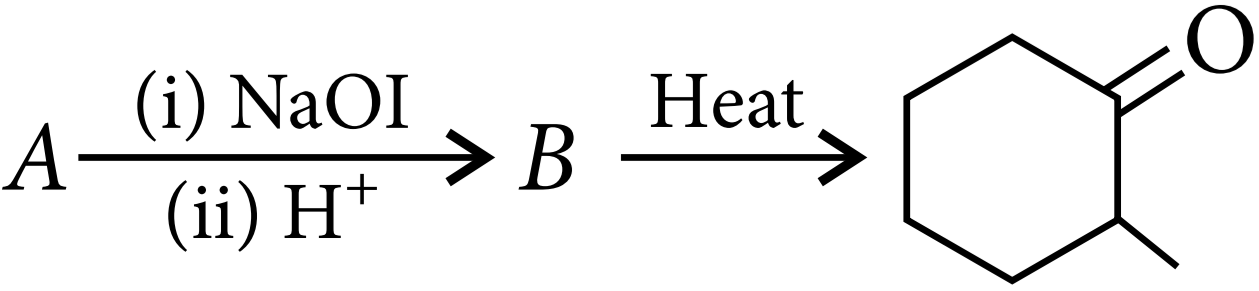
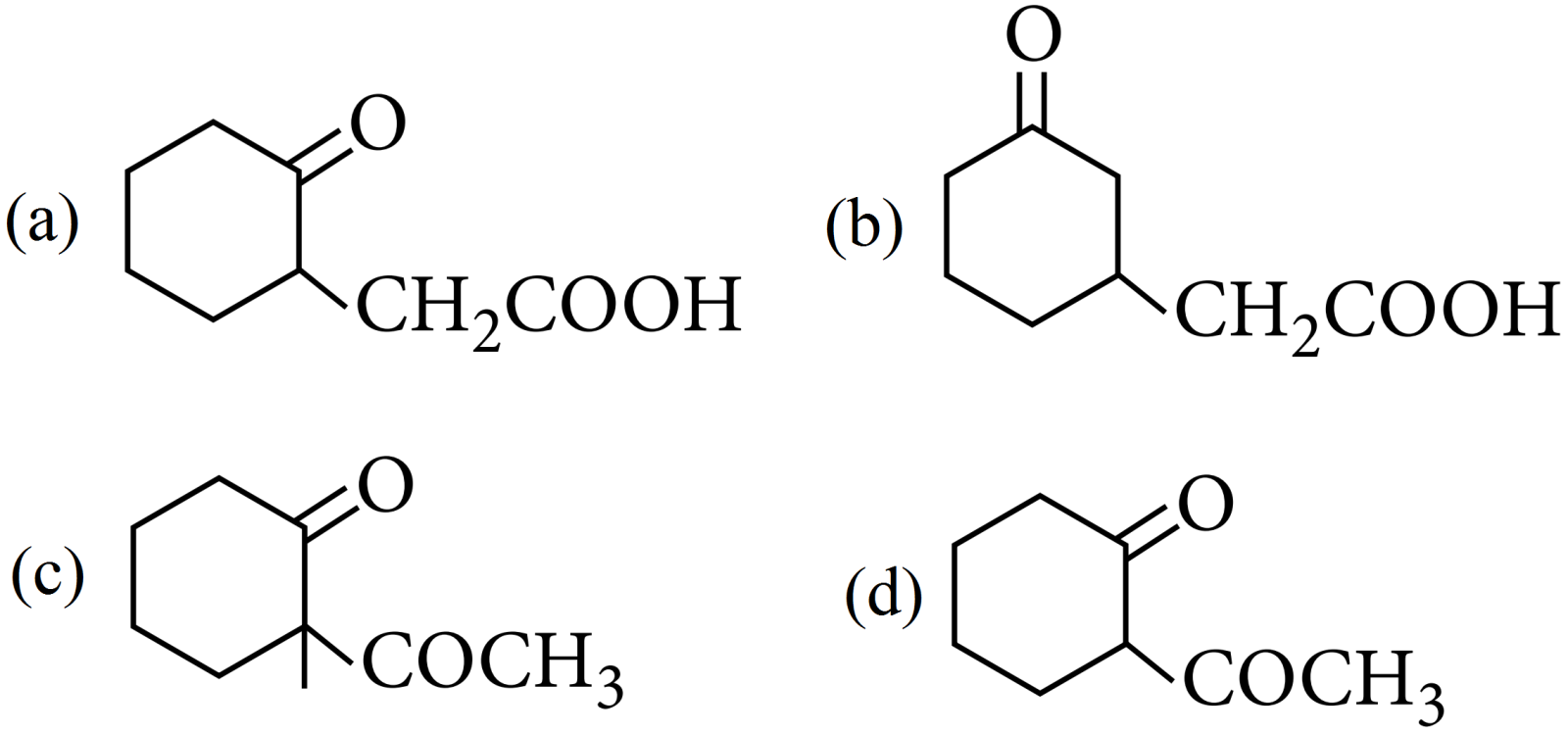
  1. For the given set of reactions,

starting compound A corresponds to:

  1. In the following reaction sequence, the correct structures of E, F and G are:

(* implies 13C labelled carbon)

  1. An organic compound 'A' has the molecular formula C3H6O. It undergoes iodoform test. When saturated with HCl it gives 'B' of molecular formula C9H14O. 'A' and 'B' respectively are:
  1. propanal and mesityl oxide.
  2. Propanone and mesityl oxide.
  3. propanone and 2,6-dimethyl-2,5-hepta-dien-4-one.
  4. propanone and propionaldehyde.