Question
Read the passage given below and answer the following questions :
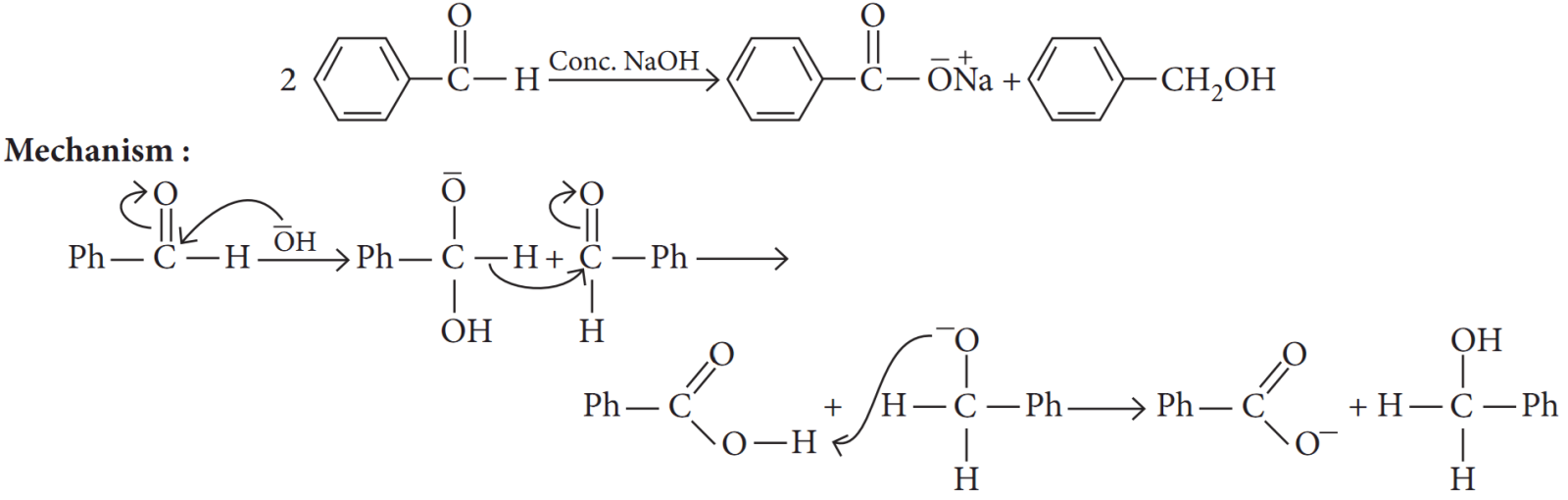
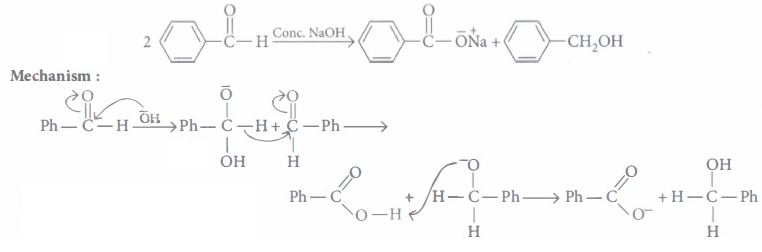
When an aldehyde with no a-hydrogen reacts with concentrated aqueous $NaOH$, half the aldehyde is converted to carboxylic acid salt and other half is converted to an alcohol. In other words, half of the reactant is oxidized
and other half is reduced. This reaction is known as Cannizzaro reaction
The following questions are multiple choice questions. Choose the most appropriate answer:
  1. A mixture of benzaldehyde and formaldehyde on heating with aqueous $NaOH$ solution gives:
  1. Benzyl alcohol and sodium formate.
  2. Sodium benzoate and methyl alcohol.
  3. Sodium benzoate and sodium formate.
  4. Benzyl alcohol and methyl alcohol.
  1. Which of the following compounds will undergo Cannizzaro reaction?
  1. $CH_3CHO$
  2. $CH_3COCH_3$
  3. $C_6H_5CHO$
  4. $C_6H_5CH_2CHO$
  1. Trichloroacetaldehyde is subjected to Cannizzaro's reaction by using $NaOH$. The mixture of the products contains sodium trichloroacetate ion and another compound. The other compounds is:
  1. 2, 2, 2-trichloroethanol
  2. Trichloromethanol
  3. 2, 2, 2-trichloropropanol
  4. Chloroform
  1. Which of the following reaction will not result in the formation of carbon-carbon bonds?
  1. Cannizzaro reaction
  2. Wurtz reaction
  3. Reimer- Tiemann reaction
  4. Friedel - Crafts acylation

Answer

  1. (a) Benzyl alcohol and sodium formate.
Explanation:

It is an example of cross Cannizzaro reaction where aromatic aldehyde gets reduced to alcohol and aliphatic aldehyde gets oxidised to its sodium salt (both aldehydes must not contain any αα-hydrogen).
CBSE 12th Chemistry Aldehydes , Ketones and Carboxylic Acids Case Study Questions With Solution 2021
  1. (c) $C_6H_5CHO$
  1. (a) 2, 2, 2-trichloroethanol
Explanation:

The Cannizzaro product of given reaction yields 2, 2, 2-trichloroethanol.
CBSE 12th Chemistry Aldehydes , Ketones and Carboxylic Acids Case Study Questions With Solution 2021
  1. (a) Cannizzaro reaction
Explanation:
C - C bond is not formed in Cannizzaro reaction while other reactions result in the formation of C - C bond.

Need a full question paper?

Generate a complete, print-ready paper with questions like this in minutes — across 16+ boards, with answer keys.

Start Generating Free

Similar questions

Read the passage given below and answer the following questions:
Noble gases are inert gases with general electronic configuration of $ns^2np^6$. These are monoatomic, colourless, odourless and tasteless gases. The first compound of noble gases was obtained by the reaction of Xe with $PtF_6.$ A large number of compounds of Xe and fluorine have been prepared till now. The structure of these compounds can be explained on the basis of VSEPR theory as well as concept of hybridisation. The compounds of krypton are fewer. Only the diftuoride of krypton $(KrF_2)$ has been studied in detail. Compounds of radon have not isolated but only identified by radio tracer technique. However, no true compounds of helium, neon or argon are yet known.
The following questions are multiple choice questions. Choose the most appropriate answer:
  1. The formula of the compound when $Xe$ and $PtF_6$ are mixed, is:
  1. $XeF_6$
  2. $XeF_4$
  3. $Xe_2PtF_6$
  4. $Xe^+[PtF_6]^-$
  1. The shape and hybridisation of some xenon oxy-fluoride and fluoride compounds are given below. Find the incorrect one.
  1. $XeOF_2 - T-$shape $- sy^3d$
  2. $XeOF_4 -$ square pyramidal $- sp^3d^2$
  3. $XeF_2 -$ linear $- sp^3d$
  4. $XeF_6 -$ square planar $- dsp^2$
  1. Which of the following is not formed by $Xe?$
  1. $XeF_5$
  2. $XeF$
  3. $XeF_3$
  4. All of these.
  1. The number oflone pairs and bond pairs of electrons around $Xe$ in $XeOF_4$ respectively are,
  1. $0$ and $5$
  2. $1$ and $5$
  3. $1$ and $4$
  4. $2$ and $3$
  1. Which of the following compounds has more than one lone pair of electrons around central atom?
  1. $XeO_3$
  2. $XeF_2$
  3. $XeOF_4$
  4. $XeO_2F_2$
Read the passage given below and answer the following questions:
Coordination compounds are formulated and named according to the IUPAC system.
Few rules for naming coordination compounds are:
  1. In ionic complex, the cation is named first and then the anion.
  2. In the coordination entity, the ligands are named first and then the central metal ion.
  3. When more than one type of ligands are present, they are named in alphabetical order of preference without any consideration of charge.
The following questions are multiple choice questions. Choose the most appropriate answer:
  1. The IUPAC name of the complex $[Pt(NH_3)_3Br(NO_2)Cl]Cl$ is:
  1. Triamminechlorobromonitroplatinum (IV) chloride.
  2. Triamminebromonitrochloroplatinum (IV) chloride.
  3. Triamminebromidochloridonitroplatinum (IV) chloride.
  4. Triamminenitrochlorobromoplatinum (IV) chloride.
  1. The IUPAC name of $[Ni(CO)_4]$ is:
  1. Tetracarbonylnickel (II).
  2. Tetracarbonylnickel (0).
  3. Tetracarbonylnickelate (II).
  4. Tetracarbonylnickelate (0).
  1. As per IUPAC nomenclature, the name of the complex $[Co(H_2O)_4(NH_3)_2]Cl_3$ is:
  1. Tetraaquadiamminecobalt (II) chloride.
  2. Tetraaquadiamminecobalt (III) chloride.
  3. Diamminetetraaquacobalt (II) chloride.
  4. Diamminetetraaquacobalt (III) chloride.
  1. Which of the following represents correct formula of dichloridobis(ethane -1, 2-diamine)cobalt (III) ion?
  1. $[CoCl_2(en)]^{2+}$
  2. $[CoCl_2(en)_2]^{2+}$
  3. $[CoCl_2(en)]^+$
  4. $[CoCl_2(en)_2]^+$
  1. Correct formula of pentaamminenitro$-O-$cobalt (III) sulphate is:
  1. $[Co(NO_2)(NH_3)_5]SO_4$
  2. $[Co(ONO)(NH_3)_5]SO_4$
  3. $[Co(NO_2)(NH_3)_4](SO_4)_2$
  4. $[Co(ONO)(NH_3)_4](SO_4)_2$
Read the passage given below and answer the following questions:
A chlorocompound $(A)$ on reduction with $Zn-Cu$ and ethanol gives the hydrocarbon $(B)$ with five carbon atoms. When $(A)$ is dissolved in dry ether and treated with sodium metal it gave $2, 2, 5, 5 -$ tetramethylhexane. The treatment of $(A)$ with alcoholic $KCN$ gives compound $( C).$
The following questions are multiple choice questions. Choose the most appropriate answer:
  1. The compound $(A)$ is:
  1. $1-$chloro$-2, 2-$dimethylpropane.
  2. $1-$chloro$-2, 2-$dimethyl butane.
  3. $1-$chloro$-2-$methyl butane.
  4. $2-$chloro$-2-$methyl butane.
  1. The reaction of $(C)$ with Na, $C_2H_5OH$ gives:
  1. $(CH_3)_3C CH_2CONH_2$
  2. $(CH_3)_3C NH_2$
  3. $(CH_3)_3C CH_2CH_2NH_2$
  4. $(CH_3)_2CHCH_2NH_2$
  1. The reaction of $(C)$ with Na, $C_2H_5OH$ is called:
  1. Gilman reaction.
  2. Mendius reaction.
  3. Grooves process.
  4. Swart's reaction.
  1. The reaction of $(A)$ with aq. $KOH$ will preferably favour:
  1. $S_N1$ mechanism.
  2. $S_N2$ mechanism.
  3. $E_1$ mechanism.
  4. $E_2$ mechanism.
  1. Compound $(B)$ is:
  1. $N-$pentane.
  2. $2, 2-$dimethylpropane.
  3. $2-$methylbutane.
  4. None of these.
Read the passage given below and answer the following questions:
If some solute is added to a solvent, the boiling point of solution increases. This is known as elevation in baiting point.
$\Delta\text{T}_\text{b}=\text{K}_\text{b}\text{m}$ where, $K_b =$ Molal elevation constant,
$\Delta\text{T}_\text{b}\propto\text{m}$
Hence, it is a colligative property,
Also, $\text{K}_\text{b}=\frac{\text{MRT}^2_\text{b}}{\Delta\text{Vap}\text{H}\times1000}$
where, $M =$ Molar mass of solvent,
$\Delta\text{vap}$ $H = $Enthalpy of vaporisation,
Molar mass can also be calculated using elevation in boiling point.
$\text{M}_\text{B}=\frac{\text{K}_\text{B}\times\text{W}_\text{B}\times1000}{\Delta\text{T}_\text{b}\times\text{W}_\text{A}}$
A statement of assertion followed by a statement of reason is given. Choose the correct answer out of the following choices.
  1. Assertion and reason both are correct statements and reason is correct explanation for assertion.
  2. Assertion and reason both are correct statements but reason is not correct explanation for assertion.
  3. Assertion is correct statement but reason is wrong statement.
  4. Assertion is wrong statement but reason is correct statement.
  1. Assertion: In a pressure cooker, the water is brought to boil. The cooker is then removed from the stove. Now on removing the lid of pressure cooker, the water starts boiling again.
Reason: The impurities in water bring down its boiling point.
  1. Assertion: On dissolving $3.24g$ of sulphur in $40g$ of benzene, boiling point of solution get higher than that of benzene by $0.081K$, then the formula of sulphur is $S_8. (K_b$ for benzene $= 2.53K\ kg\ mol^{-1})$
Reason: Molecular mass of sulphur comes out to be $253.$
  1. Assertion: When sugar is added to water, boiling point of water increases.
Reason: When a non-volatile solute is added to a solvent, elevation in boiling point is observed.
  1. Assertion: Cooking time in pressure cookers is reduced.
Reason: Boiling point inside the pressure cooker in raised.
  1. Assertion: Elevation in boiling point of two isotonic solutions is same.
Reason: Boiling point depends upon the concentration of the solute.
Read the passage given below and answer the following questions:
Werner, a Swiss chemist in $1892$ prepared and characterised a large number of coordination compounds and studied their physical and chemical behaviour. He proposed that, in coordination compounds, metals possess two types of valencies, viz. primary valencies, which are normally ionisable and secondary valencies which are non-ionisable. ln a series of compounds of cobalt (III) chloride with ammonia, it was found that some of the chloride ions could be precipitated as $AgCl$ on adding excess of $AgNO_3$ solution in cold, but some remained in solution. The number ofions furnished by a complex in a solution can be determined by precipitation reactions. The measurement of molar conductance of solutions of coordination compounds helps to estimate the number of ions furnished by the compound in solution.
In these questions (Q. No. i-iv), a statement of assertion followed by a statement ofreason is given. Choose the correct answer out of the following choices.
  1. Assertion and reason both are correct statements and reason is correct explanation for assertion.
  2. Assertion and reason both are correct statements but reason is not correct explanation for assertion.
  3. Assertion is correct statement but reason is wrong statement.
  4. Assertion is wrong statement but reason is correct statement.
The following questions are multiple choice questions. Choose the most appropriate answer:
  1. Assertion: The complex $[Co(NH_3)_3Cl_3]$ does not give precipitate with silver nitrate solution.
Reason: The given complex is non-ionisable.
  1. Assertion: The complex $[Co(NH_3)_4Cl_2]Cl$ gives precipitate corresponding to 2 mol of AgCl with $AgNO_3$ solution.
Reason: It ionises as $[Co(NH_3)_4Cl_2]^+ + Cl^-.$
  1. Assertion: $CoCl_3. 4NH_3$ gives 1 mol of AgCl on reacting with $AgNO_3$​​​​​​​, its secondary valency is 6.
Reason: Secondary valency corresponds to coordination number.
  1. Assertion: 1 mol of $[CrCl_2(H_2O)_4]Cl· 2H_2O$ will give 1 mol of AgCl on treating with $AgNO_3$​​​​​​​.
Reason: $Cl^-$ ions satisfying secondary valanceis will not be precipitated.
  1. Assertion: $CoCl_3. 3NH_3$ is not conducting while $CoCl_3. 5NH_3$​​​​​​​ is conducting.
Reason: The complex of $CoCl_3. 3NH_3$ is $[CoCl_3(NH_3)_3]$ while that of $CoCl_3· 5NH_3$ is $[CoCl(NH_3)_5]Cl_3$.
Read the passage given below and answer the following questions:
When an aldehyde with no et-hydrogen reacts with concentrated aqueous $NaOH$, half the aldehyde is converted to carboxylic acid salt and other half is converted to an alcohol. In other words, half of the reactant is oxidized and other half is reduced. This reaction is known as Cannizzaro reaction.

The following questions are multiple choice questions. Choose the most appropriate answer:
  1. A mixture of benzaldehyde and formaldehyde on heating with aqueous $NaOH$ solution gives:
  1. Benzyl alcohol and sodium formate.
  2. Sodium benzoate and methyl alcohol.
  3. Sodium benzoate and sodium formate.
  4. Benzyl alcohol and methyl alcohol.
  1. Which of the following compounds will undergo Cannizzaro reaction?
  1. $CH_3CHO$
  2. $CH_3COCH_3$
  3. $C_6H_5CHO$
  4. $C_6H_5CH_2CHO$
  1. Trichloroacetaldehyde is subjected to Cannizzaro's reaction by using NaOH. The mixture of the products contains sodium trichloroacetate ion and another compound. The other compounds is:
  1. 2, 2, 2-trichloroethanol.
  2. Trichloromethanol.
  3. 2, 2, 2-trichloropropanol.
  4. Chloroform.
  1. In Cannizzaro reaction given below:
$2\text{PhCHO}\xrightarrow{\stackrel{-}{\hbox{ OH}}}\text{PhCH}_2+\text{OH}+\text{PhCO}_2^-$ the slowest step is:
  1. The attack $^-OH$ at the carboxyl group.
  2. The transfer of hydride to the carbonyl group.
  3. The abstraction of proton from the carboxylic group.
  4. The deprotonation of $PhCH_2OH$.
  1. Which of the following reaction will not result in the formation of carbon-carbon bonds?
  1. Cannizzaro reaction.
  2. Wurtz reaction.
  3. Reimer-Tiemann reaction.
  4. Friedel-Crafts' acylation.
Read the passage given below and answer the following questions: Williamson's synthesis is used for the preparation of symmetrical as well as unsymmerical ether. It is $S_N2$ reaction mechanism. In Williamson's synthesis, $1º$ alkyl halide are used for preparation of ethers because $2º$ and $3º$ alkyl halide give alkene. Ethers are cleaved by hydrogen halides to alcohol and alkyl halide where alkyl halide is corresponding to that alkyl which has less number of carbon atom (it is because of less steric hindrance). In polar media unsymmetrical ether like tertiary butyl ethyl ether gives ethyl alcohol and tertiary butyl halide as reaction proceeds via carbocation. In these questions (Q. No. i-iv), a statement of assertion followed by a statement of reason is given. Choose the correct answer out of the following choices.
  1. Assertion and reason both are correct statements and reason is correct explanation for assertion.
  2. Assertion and reason both are correct statements but reason is not correct explanation for assertion.
  3. Assertion is correct statement but reason is wrong statement.
  4. Assertion is wrong statement but reason is correct statement.
  1. Assertion: Rate of reaction of alkyl halide in Williamson's synthesis reaction is 1ºRX > 2ºRX > 3ºRX.
Reason: It is a type of bimolecular substitution reaction $(S_N2)$.
  1. Assertion: T-Butyl methyl ether is not prepared by the reaction of t-butyl bromide with sodium methoxide.
Reason: Sodium methoxide is a weak nucleophile.
  1. Assertion: Williamson's synthesis method cannot be used for preparing diphenyl ether.
Reason: Aryl halides do not undergo nucleophilic substitution easily.
  1. Assertion: When isopropyl bromide is treated with sodium isopropoxide, di-isopropyl ether is obtained as a major product.
Reason: With secondary alkyl halides, both substitution and elimination occur.
  1. Assertion: Both symmetrical and unsymmetrical ethers can be prepared by Williamson's synthesis.
Reason: Williamson's synthesis is an example of nucleophilic substitution reaction.
Read the passage given below and answer the following questions:
The idealized ionic solid consists of two interpenetrating lattices of oppositely-charged point charges that are held in place by a balance of coulombic force of long range. But real ions occupy space, no such "perfect" ionic solid exists in nature. Chemists usually apply the term "ionic solid" to binary compounds of the metallic elements of groups $1 - 2$ with one of the halogen elements or oxygen. The most well known ionic solid is sodium chloride, also known by its geological names as rock-salt or halite. Structurally, each ion in sodium chloride is surrounded and held in tension by six neighbouring ions of opposite charge; this is known as $(6, 6)$ coordination. The resulting crystal lattice is of a type known as simple cubic. There are many other fundamental ionic structures (not all cubic) and these are: Zinc blende structure $(ZnS) $: having ccp arrangement of $S^2-$ and $Zn^{2+}$ in alternate tetrahedral voids; Wurtzite structure $(ZnS)$ having hcp arrangement of $S^2-$ and $Zn^{2+}$ in alternate tetrahedral voids; Fluorite structure $(CaF2)$ having ccp arrangement of $Ca^{2+}$ and$ F^-$ in all tetrahedral voids Antifluorite structure $(Na_2O)$ having ccp arrangement of $O^{2-}$ and $Na^+$ in all tetrahedral voids. These solids tend to be quite hard and have high melting points.
The following questions are multiple choice questions. Choose the most appropriate answer.
  1. In $NaCl$ crystal, each $Cl^-$ ion is surrounded by.
  1. $4\ Na^+$ ions
  2. $6\ Na^+$ ions
  3. $1\ Na^+$ ion
  4. $2\ Na^+$ ions
  1. In an antifluorite structure, cations occupy.
  1. Tetrahedral voids.
  2. Centre of cube
  3. Octahedral voids
  4. Corners of cube.
  1. Anti fluorite structure is derived from fluorite structure by.
  1. Heating fluorite crystal lattice.
  2. Subjecting fluorite structure to high pressure.
  3. Interchanging the positions of positive and negative ions in the lattice.
  4. None of these.
  1. In crystal structure of sodium chloride, the arrangement of $Cl^-$ion is.
  1. fcc
  2. both fcc and bcc
  3. bcc
  4. None of these
  1. Ionic solid $BaF_2$ has which kind of structure?
  1. Fluorite
  2. Antifluorite
  3. Wurtzite
  4. Rock-salt
Read the passage given below and answer the following questions:
In an ideal crystal, there must be regular repeating arrangement of the constituting particles and its entropy must be zero at absolute zero temperature. However, it is impossible to obtain an ideal crystal, and it suffers from certain defects called imperfections. In pure crystal, these defects arises either due to disorder or dislocation of the constituting particles from their normal positions or due to the movement of the particles even at absolute zero temperature. Such defects increase with rise in temperature. In addition to this, certain defects arise due to the presence of some impurities. Such defects not only modify the existing properties of the crystalline solids, but also impart certain new characteristics to them.
The following questions are multiple choice questions. Choose the most appropriate answer:
  1. $AgCl$ is crystallized from molten $AgCl$ containing a little $CdCl_2$ The solid obtained will have.
  1. Cationic vacancies equal to number of $Cd^{2+}$ ions incorporated.
  2. Cationic vacancies equal to double the number of $Cd^{2+}$ ions.
  3. Anionic vacancies.
  4. Neither cationic nor anionic vacancies.
  1. Lattice defect per $10^{15}$ $NaCl$ is $1$. What is the number of lattice defects in a mole of $NaCl?$
  1. $6.02 \times 10^{23}$
  2. $6.02 x 10^8$
  3. $10^{14}$
  4. None of these
  1. The ionic substances in which the cation and anion are of almost similar size shows.
  1. Non-stoichiometric defect
  2. Schottky defect
  3. Frenkel defect
  4. All of these.
  1. If $Al^{3+}$ ions replace $Na^+$ ions at the edge centres of $NaCl$ lattice, then the number of vacancies in $1$ mole of $NaCl$ will be.
  1. $3.01 \times 10^{23}$
  2. $6.02 \times 10^{23}$
  3. $9.03 \times 10^{23}$
  4. $12.04 \times 10^{23}$
  1. Which of the following gives both Frenkel and Schottky defect?
  1. $AgCl$
  2. $CsCl$
  3. $KCl$
  4. $AgBr$
Read the passage given below and answer the following questions:
When a protein in its native form, is subjected to physical changes like change in temperature or chemical changes like change in pH, the hydrogen bonds are disturbed. Due to this, globules unfold and helix get uncoiled and protein loses its biological activity. This is called denaturation of protein.
The denaturation causes change in secondary and tertiary structures but primary structures remains intact. Examples of denaturation of protein are coagulation of egg white on boiling, curdling of milk, formation of cheese when an acid is added to milk.
The following questions are multiple choice questions. Choose the most appropriate answer:
  1. Mark the wrong statement about denaturation of proteins.
  1. The primary structure of the protein does not change.
  2. Globular proteins are converted into fibrous proteins.
  3. Fibrous proteins are converted into globular proteins.
  4. The biological activity of the protein is destroyed.
  1. Which structure(s) of proteins remains(s) intact during denaturation process?
  1. Both secondary and tertiary structures.
  2. Primary structure only.
  3. Secondary structure only.
  4. Tertiary structure only.
  1. $\alpha$-helix and $\beta$-pleated structures of proteins are classified as:
  1. Primary structure.
  2. Secondary structure.
  3. Tertiary structure.
  4. Quaternary structure.
  1. Cheese is a:
  1. Globular protein.
  2. Conjugated protein.
  3. Denatured protein.
  4. Derived protein.
  1. Secondary structure of protein refers to:
  1. Mainly denatured proteins and structure of prosthetic groups.
  2. Three-dimensional structure, especially the bond between amino acid residues that are distant from each other in the polypeptide chain.
  3. Linear sequence of amino acid residues in the polypeptide chain.
  4. Regular folding patterns of continuous portions of the polypeptide chain.