Question
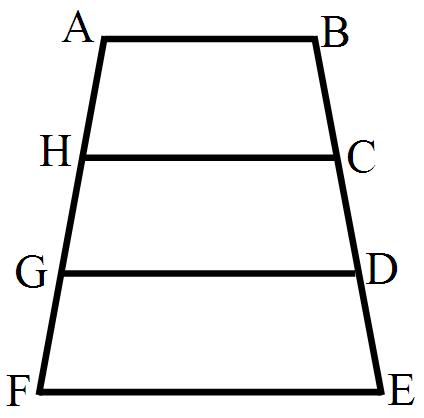
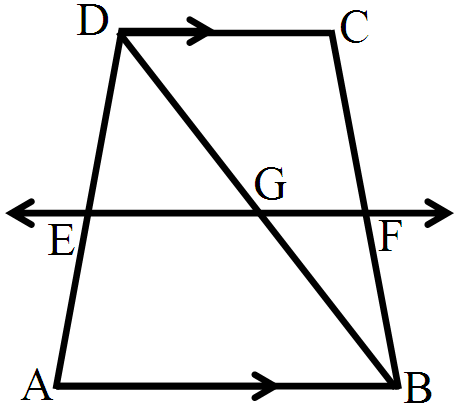
✓
Answer
| (i) | (b) | 30cm |
| (ii) | (c) | 135, 135 |
| (iii) | (c) | Trapezium has 1 pair of parallel sides, and parallelogram has 2 pairs of parallel sides. |
| (iv) | (d) | equal. |
| (v) | (a) | BF = FC |
Need a full question paper?
Generate a complete, print-ready paper with questions like this in minutes — across 16+ boards, with answer keys.
Explore more
Similar questions
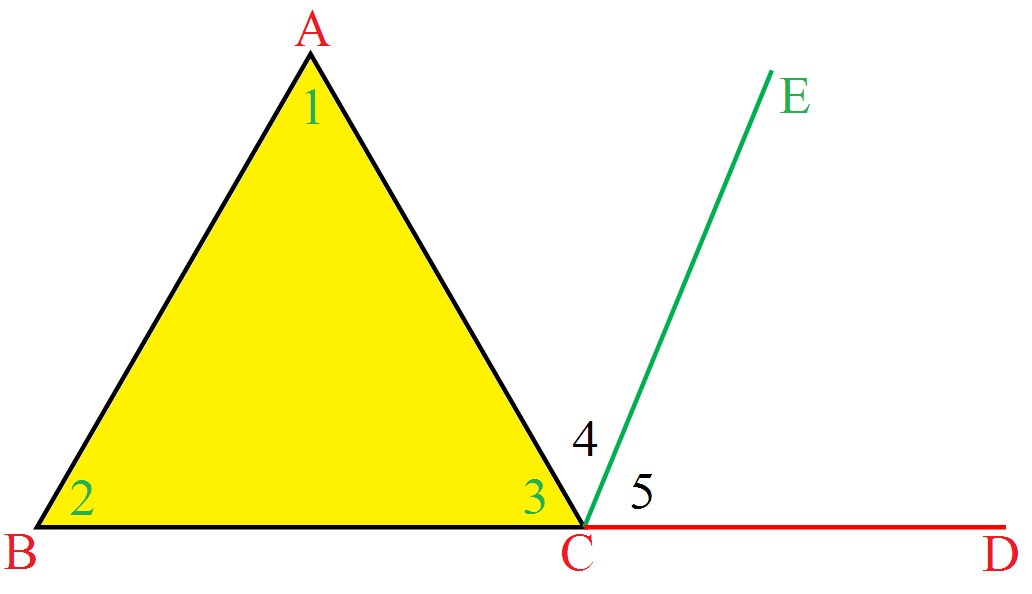
Two equilateral triangles on a straight line are shown below.
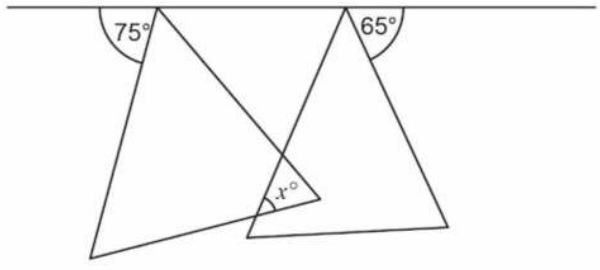
4.What is the measure of ‘x’?
A. 30
B. 40
C. 60
D. 65
A zoo is in the shape of an isosceles trapezium.
It is divided into three zones – Zone 1, Zone 2 and Zone 3.
Animals are kept without cages in Zone 1. Zone 2 is for visitors and Zone 3 is reserved for park
authorities.
It is divided into three zones – Zone 1, Zone 2 and Zone 3.
Animals are kept without cages in Zone 1. Zone 2 is for visitors and Zone 3 is reserved for park
authorities.
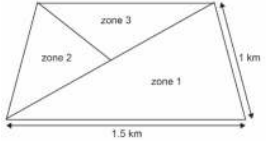
To avoid the entry of animals in zones 2 and 3, a 1.8 km long wired fencing is installed.
7. Which of the following calculations shows the area for animals?
A. √1.35×0.65×1.15
B. 2.15×0.35×0.65×1.15
C. √3.15×1.35×1.65×1.15
D. √4.30×1.35×0.65×1.15
8. “The area reserved for animals is twice the area reserved for the zoo authorities.” Do you have enough information to support this statement? Explain your answer.
Glass buildings can be strengthened using iron frames. A glass structure and its iron frame are
shown below.
shown below.
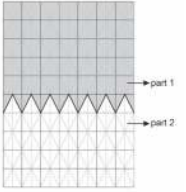
The frame consists of equal triangles. The dimensions of a triangle are shown below.
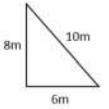
1. How much area is enclosed by one triangle?
2. What is the area of part 1 of the frame?
A. 84 m²
B. 1680 m²
C. 3360 m²
D. 3696 m²
3. Is the area of part 1 equal to the area of part 2? Why?
4. Maintenance of the building’s exterior is done by a company. The company charges Rs 750 per square meter per month.
Which of the following calculations represents the monthly maintenance charges?
A. 24 × 12
B. 750 × 24
C. 3024 × 750
D. 6720 × 750
Read the Source/ Text given below and answer any four questions: There were two parallel roads $AM$ and $XY$ in New Delhi. Due to increasing pollution, $\text{MCD}$ planned to get planted trees on these roads. On the road $AM,$ plants of Ashoka were planted by one company. While on the road $XY$ mango trees were planted by another company.
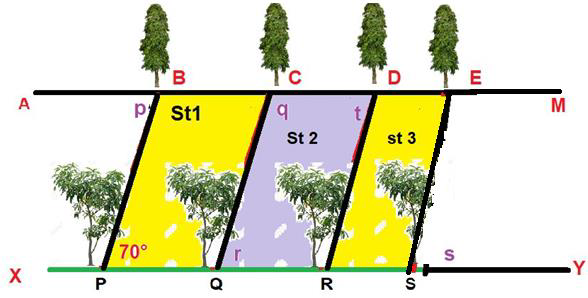
Between these roads three streets $St_1, St_2$ and $St_3$ were situated. During the survey, $\angle\text{BPQ}$ was measured to be $70^\circ$ and other angles $\text{p, q, r, s}$ and t were also measured. Now answer the following questions:
→Between these roads three streets $St_1, St_2$ and $St_3$ were situated. During the survey, $\angle\text{BPQ}$ was measured to be $70^\circ$ and other angles $\text{p, q, r, s}$ and t were also measured. Now answer the following questions:
- What is the measure of $\angle\text{p}?$
- $60^\circ$
- $70^\circ$
- $160^\circ$
- $100^\circ$
- What is the measure of $\angle\text{q}?$
- $60^\circ$
- $70^\circ$
- $160^\circ$
- $110^\circ$
- What is the value of $\frac{\text{p}+\text{q}+\text{t}}{5}?$
- $50^\circ$
- $70^\circ$
- $160^\circ$
- $100^\circ$
- What is the measure of $\angle\text{EsY}?$
- $60^\circ$
- $140^\circ$
- $70^\circ$
- $110^\circ$
- What is value of ${4p - (q + r) - (r - s)}$?
- $50^\circ$
- $100^\circ$
- $160^\circ$
- $180^\circ$
Sodium silicate is one of the constituents in liquid soap. The graph shows the amount of sodium
silicate in liquid soap.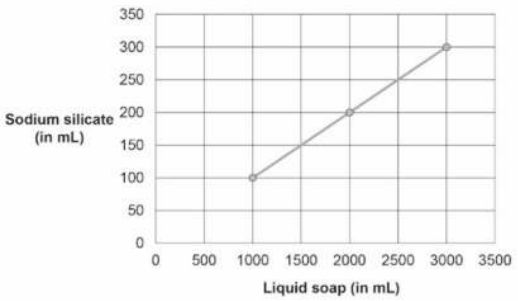
$5$. How much sodium silicate $(ml)$ is used for making $10\ L$ of soap?
$6$. Write an equation to show the relation between quantities of sodium silicate and liquid soap.
→→silicate in liquid soap.
$5$. How much sodium silicate $(ml)$ is used for making $10\ L$ of soap?
$6$. Write an equation to show the relation between quantities of sodium silicate and liquid soap.
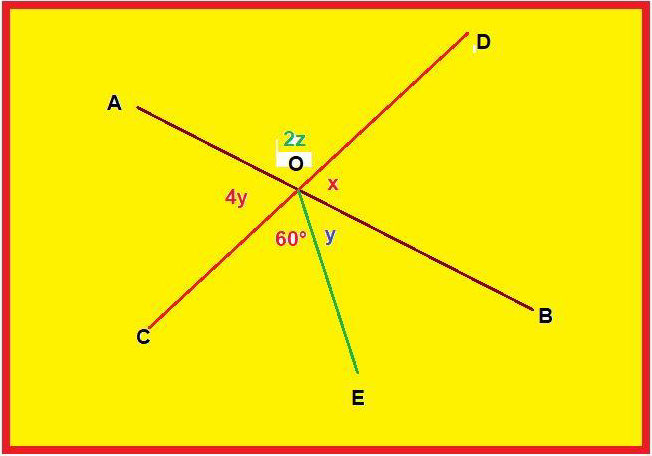
In a school camp, 40 students were divided into two groups to play a game.
The table given below shows the scores of team A and team B.
The table given below shows the scores of team A and team B.
Time(s) in minutes | Cumulative Score of Team A | Cumulative Score of Team A |
| 0-5 | 14 | 20 |
| 5-10 | 35 | 27 |
| 10-15 | 30 | 31 |
| 15-20 | 35 | 31 |
| 20-25 | 44 | 37 |
| 25-30 | 52 | 50 |
7. How many score points did team A get between 10-15 minutes?
A. 6
B. 24
C. 30
D. 68
8. Which team scored more points during last 5 minutes? Justify your answer.
9. What is the mean number of score points obtained by team A in a 5-minute interval rounded to the nearest whole number?
Read the Source/ Text given below and answer these questions:
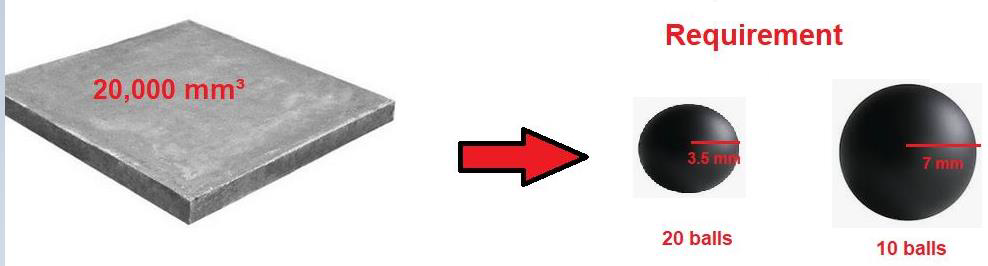
In Agra in a grinding mill, there were installed $5$ types of mills. These mills used steel balls of radius $5\ mm, 7\ mm,10\ mm, 14\ mm$ and $16\ mm$ respectively. All the balls were in the spherical shape. For repairing purpose mills need $10$ balls of $7\ mm$ radius and $20$ balls of $3.5\ mm$ radius. The workshop was having $20000\ mm^3$ steel. This $20000\ mm^3$ steel was melted and $10$ balls of $7\ mm$ radius and $20$ balls of $3.5\ mm$ radius were made and the remaining steel was stored for future use.
Answer the following questions:
→In Agra in a grinding mill, there were installed $5$ types of mills. These mills used steel balls of radius $5\ mm, 7\ mm,10\ mm, 14\ mm$ and $16\ mm$ respectively. All the balls were in the spherical shape. For repairing purpose mills need $10$ balls of $7\ mm$ radius and $20$ balls of $3.5\ mm$ radius. The workshop was having $20000\ mm^3$ steel. This $20000\ mm^3$ steel was melted and $10$ balls of $7\ mm$ radius and $20$ balls of $3.5\ mm$ radius were made and the remaining steel was stored for future use.
Answer the following questions:
- What was the volume of $10$ balls of radius $7\ mm$?
- $14373.3\ mm^3$
- $14000\ mm^3$
- $7000\ mm^3$
- $20000\ mm^3$
- What was the volume of $20$ balls of radius $3.5\ mm$?
- $2000\ mm^3$
- $1800\ mm^3$
- $1796.6\ mm^3$
- $3593.3\ mm^3$
- How much steel was kept for future use?
- $1250\ mm^3$
- $2033.3\ mm^3$
- $1300\ mm^3$
- $2200\ mm^3$
- What was the surface
- area of one ball of $7\ mm$ radius?
- $600\ mm^2$
- $616\ mm^2$
- $308\ mm^2$
- $400\ mm^2$
- What was the surface area of one ball of $3.5\ mm$ radius?
- $600\ mm^2$
- $616\ mm^2$
- $308\ mm^2$
- $154\ mm^2$