Question
Read the text given below and answer the questions that follow:
India has three cropping seasons — rabi, kharif and zaid. Rabi crops are sown in winter from October to December and harvested in summer from April to June. Some of the important rabi crops are wheat, barley, peas, gram and mustard. Though these crops are grown in large parts of India, states from the north and north-western parts such as Punjab, Haryana, Himachal Pradesh, Jammu and Kashmir, Uttarakhand and Uttar Pradesh are important for the production of wheat and other rabi crops. Availability of precipitation during winter months due to the western temperate cyclones helps in the success of these crops. Kharif crops are grown with the onset of monsoon in different parts of the country and these are harvested in September-October. Important crops grown during this season are paddy, maize, jowar, bajra, tur (arhar), moong, urad, cotton, jute, groundnut and soyabean. Some of the most important rice-growing regions are Assam, West Bengal, coastal regions of Odisha, Andhra Pradesh, Telangana, Tamil Nadu, Kerala and Maharashtra, particularly the (Konkan coast) along with Uttar Pradesh and Bihar. In between the rabi and the kharif seasons, there is a short season during the summer months known as the Zaid season. Some of the crops produced during ‘zaid’ are watermelon, muskmelon, cucumber, vegetables and fodder crops. TERM-1, 2021
  1. Availability of ______________ during winter months due to western temperate cyclones help in the success of the Green Revolution.
  1. Sunshine.
  2. Precipitation.
  3. Cold climate.
  4. Hot climate.
  1. Crops grown during Rabi season are ______________ and ____________.
  1. Tea and Coffee.
  2. Cotton and Jute.
  3. Wheat and Peas.
  4. Aus and Aman.
  1. Kharif crops are harvested in:
  1. September and October.
  2. June and July.
  3. April and June.
  4. December and January.
  1. Crops which are grown in states like Assam, Bengal and Odisha during kharif season are –
  1. Rice, Wheat and Maize.
  2. Bajra, Rice and Wheat.
  3. Aus, Aman and Boro.
  4. Pulses, Cotton and Jute.

Answer

  1. (b) Precipitation.
  2. (c) Wheat and Peas.
  3. (a) September and October.
  4. (c) Aus, Aman and Boro.

Need a full question paper?

Generate a complete, print-ready paper with questions like this in minutes — across 16+ boards, with answer keys.

Start Generating Free

Similar questions

Read the source given below and answer the following questions.
Democracy is based on political equality and all individuals have equal right to choose their representative. But along with this (political equality) we can see growing economic inequality among the individuals. A small number of ultra-rich enjoys a highly disproportionate share of wealth and income. Due to these reasons, their share in total income of the country is increasing. On the other hand, the income of poor is declining. Sometimes they (poor) find it difficult to meet their basic needs of life, such as food, clothing. house, education and health. Though poor constitutes a large proportion of voters, yet the democratic governments are not keen to take up the question of poverty. The situation is much worse in some other countries. Like Bangladesh where more than half of its population lives in poverty, even people of poor countries are now dependent on the rich countries for food supplies.
Q.1. Democracy is based on which factor?
Q.2. Does democracy hold its purposes?
Q.3. What is the present scenario of the society?
Read the passage below and answer the questions that follow:
Sri Lanka emerged as an independent country in 1948. The leaders of the Sinhala community sought to secured dominance over government by virtue of their majority. As a result, the democratically elected government adopted a series of MAJORITARIAN measures to establish Sinhala supremacy. In 1956, an Act was passed to recognize Sinhala as the only official language, thus disregarding Tamil. The governments followed preferential policies that favoured Sinhala applicants for university positions and government jobs. A new constitution stipulated that the state shall protect and foster Buddhism.
  1. In which country Majoritarianism is followed?
  1. Sri Lanka.
  2. India.
  3. Belgium.
  4. None of the above.
  1. Most of the Sinhala speaking people in Sri Lanka are:
  1. Hindu
  2. Buddhist
  3. Telugu
  4. Christian
  1. Name the most vibrant minority social group in Sri Lanka?
  1. Sinhala
  2. Buddhist
  3. Tamil
  4. Christian
  1. Which of the following are the ethnic communities of Sri Lanka?
  1. Indian Tamils and Sri Lankan Tamils.
  2. Tamils, Buddhists, Hindus.
  3. Indian Tamils, Sri Lankan Tamils and Buddhists.
  4. Sinhala speakers, Sri Lankan Tamils and Indian Tamils.
Read the given extract and answer the following questions.
In a democracy, we are most concerned with ensuring that people will have the right to choose their rulers and people will have control over the rulers. Whenever possible and necessary, citizens should be able to participate in decision making, that affects them all. Therefore, the most basic outcome of democracy should be that it produces a government that is accountable to the citizens, and responsive to the needs and expectations of the citizens. Some people think that democracy produces less effective government. It is, of course, true that nondemocratic rulers are very quick and efficient in decision making and implementation, whereas, democracy is based on the idea of deliberation and negotiation. So, some delay is bound to take place. But, because it has followed procedures, its decisions maybe both more acceptable to the people and more effective. Moreover, when citizens want to know if a decision was taken through the correct procedures, they can find this out. They have the right and the means to examine the process of decision making. This is known as transparency. This factor is often missing from a non-democratic government. There is another aspect in which democratic government is certainly better than its alternatives: democratic government is legitimate government. It may be slow, less efficient, not always very responsive, or clean. But a democratic government is people's own government.
Answer the following MCQs by choosing the most appropriate option:
  1. People's right to choose their own rulers is called as the:
  1. Right to Initiate.
  2. Right to Plebiscite.
  3. Right to Vote.
  4. Right to Referendum.
  1. Which of the following options helps in promoting transparency in the governance?
  1. Right to education.
  2. Right to information.
  3. Right against exploitation.
  4. Right to speech and expression.
  1. __________ make/ s the government legitimate.
  1. Credibility of politicians.
  2. People's movements.
  3. Free and fair elections.
  4. Holding of powers.
  1. Decisions in a democracy are more acceptable to the people because they are:
  1. Taken swiftly and implemented quickly.
  2. Taken by giving privileges to the people.
  3. Taken through elites' votes.
  4. Taken after following due processes.
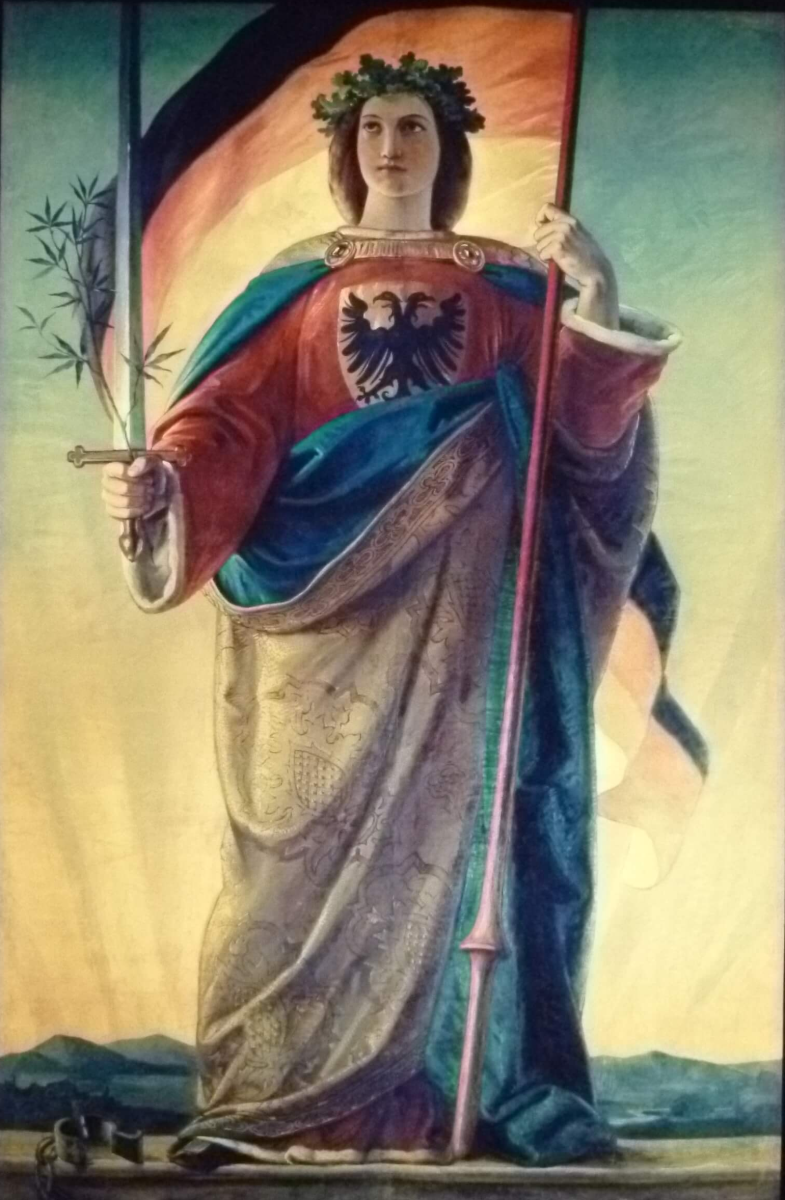
Recognise the picture below and answer the following questions:
  1. Whose painting is it? Who painted it and when?
  2. What does it signify
A dam is a barrier across flowing water that obstructs, directs or retards the flow. often creating a reservoir, lake or impoundment. "Dam" refers to the reservoir rather than the structure. Most dams have a section called a spillway or weir over which or through which it is intended that water will flow either intermittently or continuously. Dams are classified according to structure, intended purpose or height. Based on structure and the materials used, dams are classified as timber dams, embankment dams or masonry dams, with several subtypes. According to the height, dams can be categorised as large dams and major dams or alternatively as low dams, medium height dams and high dams
i. What does the word 'Dam' actually refer to? (1)
ii. Mention any one benefit of a Multi-purpose River Valley Project. (1)
iii. How have multi-purpose river valley projects a cause of social movements?
Explain. (2)
Read the passage given below and answer the following questions:
Agriculture has been the backbone of the Indian economy though its share in the Gross Domestic Product (GDP) has registered a declining trend from 1951 onwards; According to Census of India 2011 about 54.6 per cent of the total work force was employed by the farm sector which makes more than half of the Indian Population dependent on agriculture for sustenance. The declining share of agriculture in the GDP is a matter of serious concern because any decline and stagnation in agriculture will lead to a decline in other spheres of the economy having wider implications for society. Considering the importance of agriculture in India, the Government of India made concerted efforts to modernise agriculture. Establishment of Indian Council of Agricultural Research (ICAR), agricultural universities, veterinary services and animal breeding centres, horticulture development, research and development in the field of meteorology and weather forecast, etc. were given priority for improving Indian agriculture.
Q.1. What steps are taken by the government to modernise agriculture?
Q.2. What is the purpose of establishment of ICAR?
Q.3. Why is the declining share of agriculture a matter of concern?
Read the following passage and answer the questions that follow:
Agriculture and industry are not exclusive of each other. They move hand in hand. For instance, the agro- industries in India have given a major boost to agriculture by raising its productivity. They depend on the latter for raw materials and sell their products such as irrigation pumps, fertilisers, insecticides, pesticides, plastic and PVC pipes, machines and tools, etc. to the farmers. Thus, development and competitiveness of manufacturing industry has not only assisted agriculturists in increasing their production but also made the production processes very efficient.
In the present day world of globalisation, our industry needs to be more efficient and competitive. Self- sufficiency alone is not enough. Our manufactured goods must be at par in quality with those in the international market. Only then, will we be able to compete in the international market.
Q.1. How are agriculture and industry connected?
Q.2. Name the products made by the industry for agriculture.
Q.3. How should industry respond to globalisation?
Read the source given below and answer the following questions:
Ford Motors, an American company, is one of the world's largest automobile manufacturers with production spread over 26 countries of the world. Ford Motors came to India in 1995 and spent Rs.1700 crore to set up a large plant near Chennai. This was done in collaboration with Mahindra and Mahindra, a major Indian manufacturer of jeeps and trucks. By the year 2004, Ford Motors was selling 27,000 cars in the Indian markets, while 24,000 cars were exported from India to South Africa, Mexico and Brazil. The company wanted to develop Ford India as a component supplying base for its other plants across the globe.
Answer the following MCQs by choosing the most appropriate option:
  1. The passage given above relates to which of the following options?
  1. Increased employment.
  2. Foreign investment.
  3. Foreign collaboration.
  4. International competition.
  1. According to the given passage, Ford Motors can be termed as a Multi-National Company based on which of the following options?
  1. Production of different types of automobiles.
  2. Largest automobile manufacturer in the world.
  3. Because of large scale export of cars across globe.
  4. Industrial and commercial ventures across globe.
  1. By setting up their production plants in India, Ford Motors wanted to:
  1. Collaborate with a leading Indian Automobile company.
  2. Satisfy the demands of American, African, and Indian markets.
  3. Tap the benefits of low-cost production and a large market.
  4. Take over small automobile manufacturing units in India.
  1. 'Ford Motors' wish to develop Ford India as a component supplying base for its other plants across the globe is an evidence of:
  1. Promoting local industries of India.
  2. Merging trade from different countries.
  3. Supplying jobs to factory workers in India.
  4. Interlinking of production across countries.
Read the extract given below and answer the questions that follow:
''Here are many activities that are undertaken by directly using natural resources. Since most of the natural products we get are from agriculture, dairy, fishing, forestry, this sector is also called agriculture and related sectors. The secondary sector covers activities in which natural products are changed into other forms through ways of manufacturing. This could be in a factory, a workshop, or at home. For example, using cotton fibre from the plant, we spin yarn and weave cloth. Since this sector gradually became associated with the different kinds of industries that came up, it is also called the industrial sector. After primary and secondary, there is a third category of activities that falls under the tertiary sector and are different from the above two. These are activities that help in the development of the primary and secondary sectors. These activities, by themselves, do not produce a good but they are an aid or support for the production process. For example, goods that are produced in the primary or secondary sector would need to be transported by trucks or trains and then sold in wholesale and retail shops. At times, it may be necessary to store these in godowns. Transport, storage, communication, banking, trade are some examples of tertiary activities. Since these activities generate services rather than goods, the tertiary sector is also called the service sector. The service sector also includes some essential services that may not directly help in the production of goods. For example, we require teachers, doctors, and those who provide personal services such as washermen, barbers, cobblers, lawyers, and people to do administrative and accounting work''
  1. Secondary sector: Workers in a match factory, Tertiary sector: _______.
  1. Beekeeper.
  2. Milk vendor.
  3. Handloom worker.
  4. Tailor.
  1. Which is the correct option for classification based on nature of activities?
  1. Organised and unorganised sector.
  2. Public sector and private sector.
  3. Primary, secondary and tertiary sector.
  4. None of these.
  1. "After primary and secondary, there is a third category of activities that falls under the tertiary sector and is different from the above two." Which of the following is incorrect regarding the given statement?
  1. These activities do not produce a good by themselves.
  2. These activities help in the development of the primary and secondary sectors.
  3. These activities are an aid or support for the production process.
  4. These activities generate goods rather than services.
  1. Choose the incorrect pair:
  1. Call centre employee-Secondary sector.
  2. IT specialists-Quaternary sector.
  3. Potter-Primary Sector.
  4. Money Lender-Tertiary sector.
Read the source given below and answer the questions that follow:
Following the defeat of Napoleon in 1815, European governments were driven by a spirit of conservatism. Conservatives believed that established, traditional institutions of state and society-like the monarchy, the Church, social hierarchies, property and the family-should be preserved. Most conservatives, however, did not propose a return to the society of pre-revolutionary days. Rather, they realised, from the changes initiated by Napoleon, that modernisation could in fact strengthen traditional institutions like the monarchy. It could make state power more effective and strong. A modern army, an efficient bureaucracy, a dynamic economy, the abolition of feudalism and serfdom could strengthen the autocratic monarchies of Europe.
In 1815, representatives of the European powers-Britain, Russia, Prussia and Austria-who had collectively defeated Napoleon, met at Vienna to draw up a settlement for Europe. The Congress was hosted by the Austrian Chancellor Duke Metternich. The delegates drew up the Treaty of Vienna of 1815 with the object of undoing most of the changes that had come about in Europe during the Napoleonic wars. The Bourbon dynasty, which had been deposed during the French Revolution, was restored to power, and France lost the territories it had annexed under Napoleon. A series of states were set up on the boundaries of France to prevent French expansion in future.
Answer the following MCQs by choosing the most appropriate options:
  1. Which of the following statements correctly describes about European conservative ideology?
  1. Preservation of beliefs introduced by Napoleon.
  2. Preservation of two sects of Christianity.
  3. Preservation of traditionalist beliefs in state and society.
  4. Preservation of socialists’ ideology in economic sphere.
  1. Identify the purpose to convene Vienna of Congress of Vienna in 1815 from the following options.
  1. To declare completion of German unification.
  2. To declare war against France.
  3. To start the process of Italian unification
  4. To restore conservative regime in Europe.
  1. What did conservatives focus on at the Congress of Vienna? Select the appropriate option.
  1. To establish socialism in Europe.
  2. To re-establish peace and stability in Europe.
  3. To introduce democracy in France.
  4. To set up a new Parliament in Austria.
  1. How did the Congress of Vienna ensure peace in Europe? Select the appropriate option.
  1. Laying out a balance of power between all the great powers in Europe.
  2. With the restoration of Bourbon Dynasty.
  3. Austria was not given the control of Northern Italy.
  4. By giving power to the German confederation.