MCQ
Reagent $(A)$ and $(B)$ in above reaction are
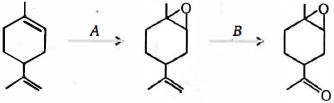
- A$A = RCO_3 H , B = H_2O_2$
- B$A = RCO_3H , B = HIO_4$
- ✓$A = RCO_3 H, B = O_3$
- D$A = O_3 , B = RCO_3H$
Generate a complete, print-ready paper with questions like this in minutes — across 16+ boards, with answer keys.
| Column $I$ | Column $II$ |
| $(A)$ $\mathrm{CH}_3 \mathrm{CH}_2 \mathrm{CH}_2 \mathrm{CN}$ | $(p)$ Reduction with $\mathrm{Pd}-\mathrm{C} / \mathrm{H}_2$ |
| $(B)$ $\mathrm{CH}_3 \mathrm{CH}_2 \mathrm{OCOCH}_3$ | $(q)$ Reduction with $\mathrm{SnCl}_2 / \mathrm{HCl}$ |
| $(C)$ $\mathrm{CH}_3-\mathrm{CH}=\mathrm{CH}-\mathrm{CH}_2 \mathrm{OH}$ | $(r)$ Development of foul smell on treatment with chloroform and alcoholic $\mathrm{KOH}$ |
| $(D)$ $\mathrm{CH}_3 \mathrm{CH}_2 \mathrm{CH}_2 \mathrm{CH}_2 \mathrm{NH}_2$ | $(s)$ Reduction with diisobutylaluminium hydride $(DIBAL-H)$ |
| $(t)$ Alkaline hydrolysis |
Reason : The higher oxidation states for the group $14$ elements are more stable for the heavier members of the group due to ‘inert pair effect’.