MCQ
Reason of lanthanoid contraction is
  • negligible screening effect of $'f'-$orbitals
  • B
    increasing nuclear charge
  • C
    decreasing nuclear charge
  • D
    decreasing screening effect.

Answer

Correct option: A.
negligible screening effect of $'f'-$orbitals
a
Lanthanoid contraction is the regular decrease in atomic and ionic radii of lanthanides. This is due to the imperfect shielding [or poor screening effect ] of $l-$orbitals due to their diffused shape which unable to counterbalance the effect to the increased nuclear charge. Hence, the net result is a contraction in size of lanthanoids.

Need a full question paper?

Generate a complete, print-ready paper with questions like this in minutes — across 16+ boards, with answer keys.

Start Generating Free

Similar questions

Choose the correct structure for $PF_3Cl_2$ molecule. (electron Affenity : $Cl > F)$
Match the column $(I)$ with column $(II)$ and mark the appropriate choice
   column $(I)$   column $(II)$ 
$(A)$ Kohlraush law $(i)$ $\Lambda _{eq}^o = \Lambda _c^o + \Lambda _a^o$
$(B)$ Molar
Conductivity
$(ii)$ $\Lambda _m = \frac{{K \times 1000}}{M}$
$(C)$ Degree of
Dissociation
$(iii)$ $\alpha  = {\Lambda _m}/\Lambda _m^o$
$(D)$ Dissociation
Constant
$(iv)$ ${k_a} = C{\alpha ^2}/1 - \alpha $
Optically inactive compound is
In the equilibrium $N_2 + 3H_2$ $\rightleftharpoons$ $2NH_3 + 22$ $k\,cal,$ the formation of ammonia is favoured by
Which is the strongest acid ($pk_a$ value is given)?
A solution of $500\,ml$ of $0.2\,M\,KOH$ and $500\,ml$ of $0.2\,M\,HCl$ is mixed and stirred; the rise in temperature is ${T_1}$. The experiment is repeated using $250\,ml$ each of solution, the temperature raised is ${T_2}$. Which of the following is true
If the standard electrode potential for a cell is $2\,V$ at $300\,K,$ the equilibrium constant $(K)$ for the reaction

$Zn\,(s)\,\, + \,\,C{u^{2 + }}\,(aq)\, \rightleftharpoons \,Z{n^{2 + \,}}\,(aq)\, + Cu\,(s)$

At $300\,K$ is approximately $(R = 8 \,JK^{-1}\,mol^{-1},\, F = 96000\,C\,mol^{-1})$
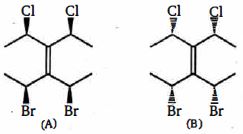
Relationship between above pair $(A)$ & $(B)$ is
Alkaline oxidative fusion of $MnO _2$ gives “A” which on electrolytic oxidation in alkaline solution produces B. A and B respectively are:
Which of the following reactions leads to the formation of chloritone