Question

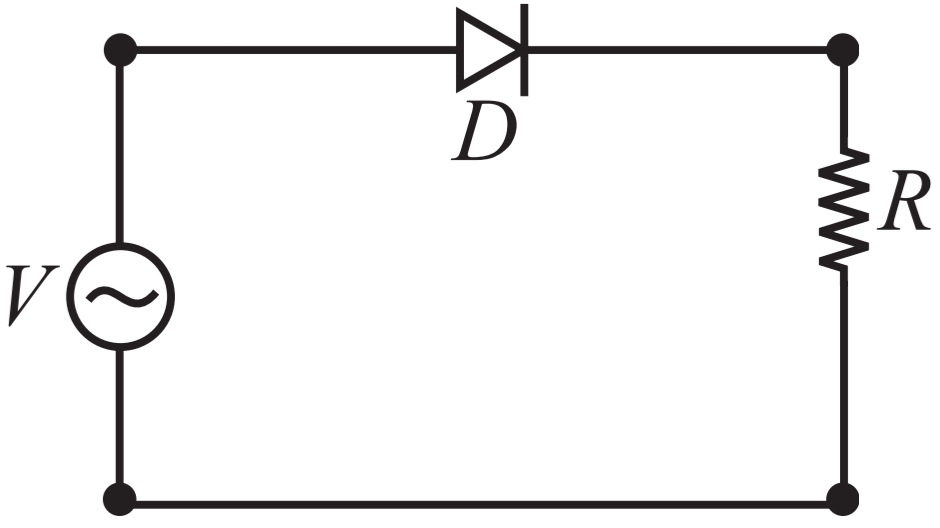
Rectifier is a device which is used for converting alternating current or voltage into direct current or voltage. Its working is based on the fact that the resistance of p-n junction becomes low when forward biased and becomes high when reverse biased. A half-wave rectifier uses only a single diode while a full wave rectifier uses two diodes as shown in figures (a) and (b).
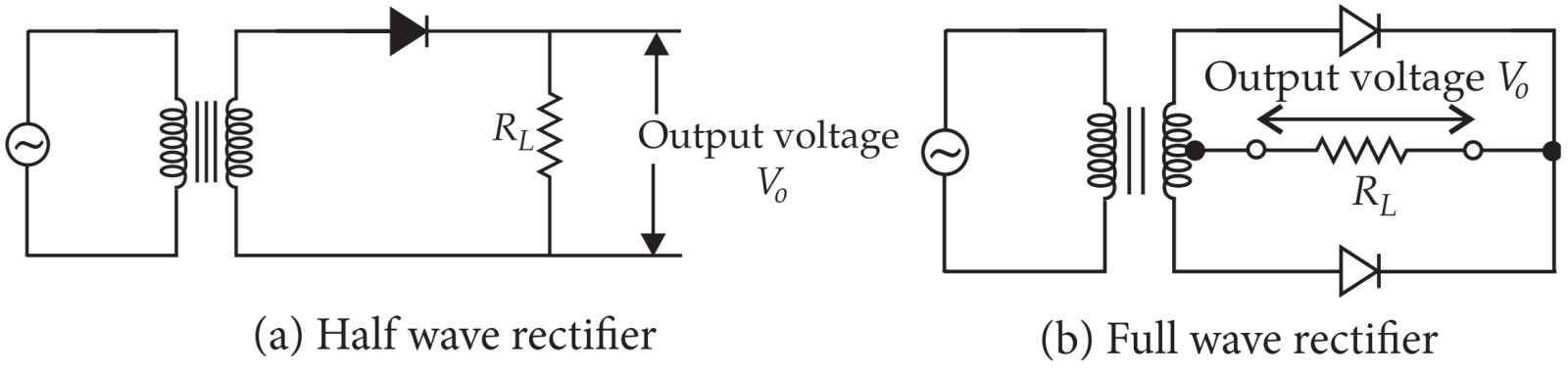
  1. If the rms value of sinusoidal input to a full wave rectifier is $\frac{\text{V}_0}{\sqrt{2}}$ then the rms value of the rectifier's output is:
  1. $\frac{\text{V}_0}{\sqrt{2}}$
  2. $\frac{\text{V}_0^2}{\sqrt{2}}$
  3. $\frac{\text{V}_0^2}{2}$
  4. $\sqrt{2}\text{V}_0^2$
  1. In the diagram, the input ac is across the terminals A and C. The output across B and D is:
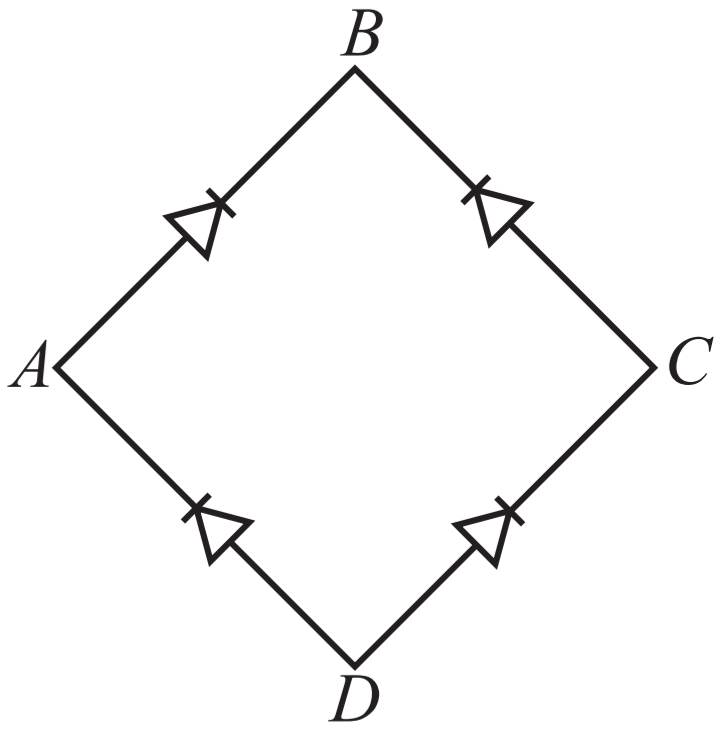
  1. Same as the input.
  2. Half wave rectified.
  3. Zero.
  4. Full wave rectified.
  1. A bridge rectifier is shown in figure. Alternating input is given across A and C. If output is taken across BD, then it is:
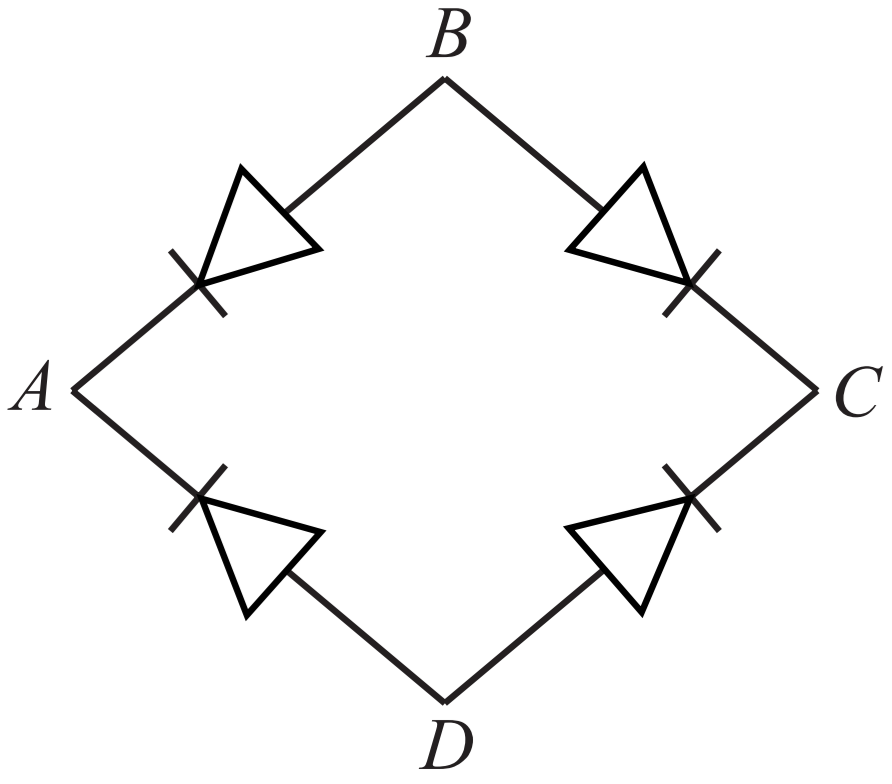
  1. Zero.
  2. Same as input.
  3. Half wave rectified.
  4. Full wave rectified.
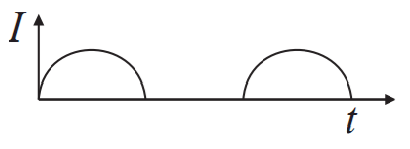
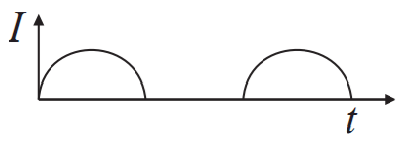
  1. A p-n junction (D) shown in the figure can act as a rectifier. An alternating current source (V) is connected in the circuit. The current (I) in the resistor (R) can be shown by:

  1. With an ac input from 50Hz power line, the ripple frequency is:
  1. 50Hz in the de output of half wave as well as full wave rectifier.
  2. 100Hz in the de output of half wave as well as full wave rectifier.
  3. 50Hz in the de output of half wave and I 00Hz in de output of full wave rectifier.
  4. 100Hz in the de output of half wave and 50Hz in the de output of full wave rectifier.
Answer

  1. (a) $\frac{\text{V}_0}{\sqrt{2}}$
Explanation:
Therms value of the output voltage at the load resistance, $\frac{\text{V}_0}{\sqrt{2}}.$
  1. (d) Full wave rectified.
  2. (a) Zero.
  3. (c)

Explanation:
The given circuit works as a half wave rectifier. In this circuit, we will get current through R when p-n junction is forward biased and no current when p-n junction is reverse biased. Thus the current (I) through resistor (R) will be shown in option (c).
  1. (c) 50Hz in the de output of half wave and I 00 Hz in de output of full wave rectifier.

Need a full question paper?

Generate a complete, print-ready paper with questions like this in minutes — across 16+ boards, with answer keys.

Start Generating Free

Similar questions

Explain the refraction by an equilateral prism and derive the formula $\delta=i+e- A$ in case of triangular prism of glass.
In an electromagnetic wave both the electric and magnetic fields are perpendicular to the direction of propagation, that is why electromagnetic waves are transverse in nature. Electromagnetic waves carry energy as they travel through space and this energy is shared equally by the electric and magnetic fields. Energy density of an electromagnetic waves is the energy in unit volume of the space through which the wave travels.
  1. The electromagnetic waves propagated perpendicular to both $\vec{\text{E}}$ and $\vec{\text{B}}.$ The electromagnetic waves travel in the direction of.
  1. $\vec{\text{E}}\times\vec{\text{B}}$
  2. $\vec{\text{E}}\times\vec{\text{B}}$
  3. $\vec{\text{B}}\times\vec{\text{E}}$
  4. $\vec{\text{B}}\times\vec{\text{E}}$
  1. Fundamental particle in an electromagnetic wave is:
  1. Photon
  2. Electron
  3. Phonon
  4. Proton
  1. Electromagnetic waves are transverse in nature is evident by:
  1. Polarisation
  2. Interference
  3. Reflection
  4. Diffraction
  1. For a wave propagating in a medium, identify the property that is independent of the others.
  1. Velocity
  2. Wavelength
  3. Frequency
  4. All these depend on each other.
  1. The electric and magnetic fields of an electromagnetic waves are:
  1. In opposite phase and perpendicular to each other.
  2. In opposite phase and parallel to each other.
  3. In phase and perpendicular to each other.
  4. In phase and parallel to each other.
Complete the following table:
Car Model
Driver $X$
Reaction time $0.20s$
Driver $Y$
Reaction time $0.30s$
$A\ ($deceleration on hard braking $= 6.0\ m/s^2)$
Speed $= 54\ km/h$
Braking distance
$a = ...$
Total stopping distance
$b = ...$
Speed $= 72\ km/h$
Braking distance
$c = ...$
Total stopping distance
$d = ...$
$B\ ($deceleration on hard braking $= 7.5\ m/s^2)$
Speed $= 54\ km/h$
Breaking distance
$e = ...$
Total stopping distance
$f = ...$
Speed $72\ km/h$
Braking distance
$g = ...$
Total stopping distance
$h = ...$
The magnetic moment of the assumed dipole at the earth's centre is $8.0 \times 10^{22}A-m^2.$ Calculate the magnetic field $B$ at the geomagnetic poles of the earth. Radius of the earth is $6400\ km.$
A child has near point at 10cm. What is the maximum angular magnification the child can have with a convex lens of focal length 10cm?
A slide projector has to project a 35mm slide (35mm × 23mm) on a 2m × 2m screen at a distance of 10m from the lens. What should be the focal length of the lens in the projector?
Establish the relation between mean value and peak value of AC.
Discuss the Einstien's explanation for the photoelectric effect.
The electron beam in a colour $TV$ is accelerated through $32\ kV$ and then strikes the screen. What is the wavelength of the most energetic $X-$ray photon?
This energy possessed by a system of charges by virtue of their positions. When two like charges lie infinite distance apart, their potential energy is zero because no work has to be done in moving one charge at infinite distance from the other.
In carrying a charge q from point $A$ to point $B, $ work done $W = q(V_A - V_B)$. This work may appear as change in $\frac{\text{KE}}{\text{PE}}$ of the charge. The potential energy of two charges $q_1$ and $q_2$ at a distance $r$ in air is $\frac{\text{q}_1\text{q}_2}{1\pi\epsilon_0\text{r}}.$ It is measured in joule. It may be positive, negative or zero depending on the signs of $q_1$ and $q_2$.
  1. Calculate work done in separating two electrons form a distance of $1m$ to $2m$ in air, where e is electric charge and $k$ is electrostatic force constant.
  1. $ke^2$
  2. $\frac{\text{e}^2}{2}$
  3. $-\frac{\text{ke}^2}{2}$
  4. Zero
  1. Four equal charges $q$ each are placed at four corners of a square of side a each. Work done in carrying a charge $-q$ from its centre to infinity is:
  1. $\text{Zero}$
  2. $\frac{\sqrt{2}\text{q}^2}{\pi\epsilon_0\text{a}}$
  3. $\frac{\sqrt{2}\text{q}}{\pi\epsilon_0\text{a}}$
  4. $\frac{\text{q}^2}{\pi\epsilon_0\text{a}}$
  1. Two points $A$ and Bare located in diametrically opposite directions of a point charge of $+2\mu\text{C}$ at distances 2m and 1m respectively from it. The potential difference between $A$ and $B$ is:
  1. $3 \times 10^3V$
  2. $6 \times 10^4V$
  3. $-9 \times 10^3V$
  4. $-3 \times 10^3V$
  1. Two point charges $A = + 3nC$ and $B = + 1nC$ are placed $5\ cm$ apart in air. The work done to move charge $B$ towards $A$ by $1\ cm$ is:
  1. $2.0 \times 10^{-7}J$
  2. $1.35 \times 10^{-7}J$
  3. $2.7 \times 10^{-7}J$
  4. $12.1 \times 10^{-7}J$
  1. $A$ charge $Q $ is placed at the origin. The electric potential due to this charge at a given point in space is $V.$ The work done by an external force in bringing another charge $q$ from infinity up to the point is:
  1. $\frac{\text{V}}{\text{q}}$
  2. $Vq$
  3. $V + q$
  4. $V$