MCQ
Refer to the figure. When does the the galvanometer (G) deflect?
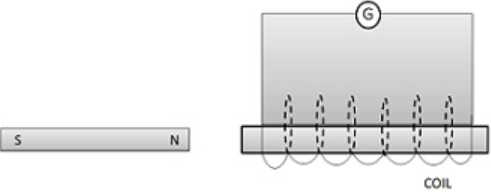
- AThe magnet is pushed into the coil
- BThe magnet is rotated into the coil
- CThe magnet is stationary at the centre of the coil.
- DThe number of turns in the coil is reduced.
Explanation:
The deflection in the galvanometer (G) occurs, when the magnet is pushed into the coil. This is because the relative motion between the two induces an emf into the coil.
Generate a complete, print-ready paper with questions like this in minutes — across 16+ boards, with answer keys.
Ratio between total intensity of magnetic field at equator to poles is
| (a) 1 : 1 | (b) 1 : 2 | (c) 2 : 1 | (d) 1 : 4 |
Focal length of a converging lens in air is R. If it is dipped in water of refractive index 1.33, then its focal length will be around (Refractive index of lens material is 1.5)
|
(a) R |
(b) 2R |
(c) 4R |
(d) R / 2 |
The new resistance of wire of R W, whose radius is reduced half, is
|
(a) 16 R |
(b) 3 R |
(c) 2R |
(d) R |
An electron is moving towards x-axis. An electric field is along y-direction then path of electron is
|
(a) Circular |
(b) Elliptical |
(c) Parabola |
(d) None of these |
The magnitude of electric field E in the annular region of a charged cylindrical capacitor
|
(a) Is same throughout |
|
(b) Is higher near the outer cylinder than near the inner cylinder |
|
(c) Varies as 1/r, where r is the distance from the axis |
|
(d) Varies as |
$\text{f}=\frac{\text{R}}{2}$
$\text{f}=\text{R}$
$\text{f}=-\text{R}$
$\text{f}=2\text{R}$
The refractive index of a piece of transparent quartz is the greatest for
|
(a) Red light |
(b) Violet light |
(c) Green light |
(d) Yellow light |
