Question
Represent $\sqrt{10.5}$ on the number line.

Answer

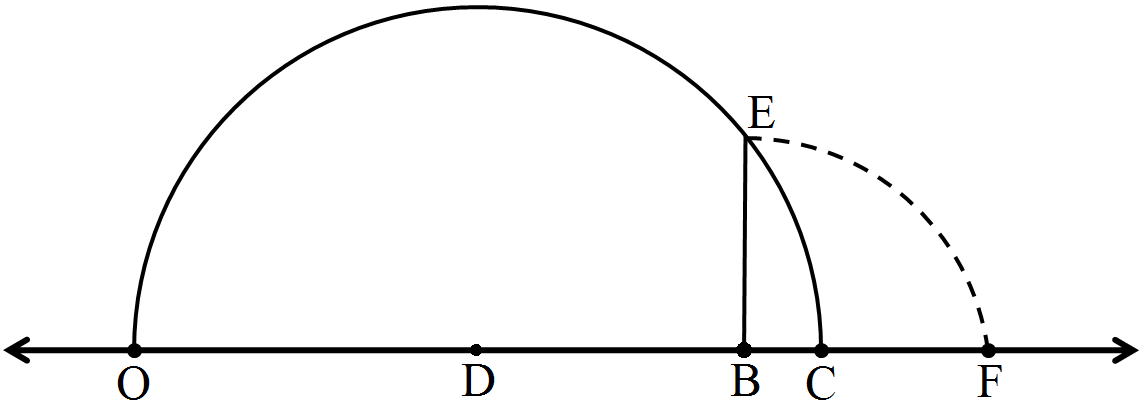
Draw a line segment $OB = 10.5$ units and extend it to $C$ such that $BC = 1$ unit.
Find the midpoint $D$ of $OC$. With $D$ as centre and $DO$ as radius, draw a semicircle.
Now, draw $\text{BE}\perp\text{AC},$ intersecting the semicircle at $E$.
Then, $\text{BE}=\sqrt{10.5}\ \text{units}.$ With $B$ as centre and $BE$ as radius, draw an arc, meeting $AC$ produced at $F$.

Then, $\text{BF}=\text{BE}=\sqrt{10.5}\text{units}.$

Need a full question paper?

Generate a complete, print-ready paper with questions like this in minutes — across 16+ boards, with answer keys.
Start Generating Free

Similar questions

$ABC$ is a triangle in which $BE$ and $CF$ are, respectively, the perpendiculals to the side $AC$ and $AB$. if $\text{BE}=\text{CF},$ prove that $\triangle\text{ABC}$ is isosceles.
The sides of a triangle are in the ratio $5 : 12 : 13$ and its perimeter is $150\ m$. Find the area of the triangle.
The students of Vidyalaya were asked to participate in a competition for making and decorating pen holders in the shape of a cylinder with a base, using cardboard. Each pen holder was to be of radius $3\ cm$ and height $10.5\ cm$. The Vidyalaya was to supply the competitors with cardboard. If there were $35$ competitors, how much cardboard was required to be bought for the competition?
O is the circumcentre of the triangle ABC and D is the mid-point of the base BC. Prove that $\angle\text{BOD}=\angle\text{A}.$
ABCD is a rhombus in which altitude from D to side AB bisects AB. Find the angles of the rhombus.
A solid cube of side 12cm is cut into eight cubes of equal volume. What will be the side of the new cube? Also, find the ratio between their surface areas.
P, Q, R and S are respectively the mid-points of sides AB, BC, CD and DA of quadrilateral ABCD in which AC = BD and $\text{AC}\bot\text{BD}.$ Prove that PQRS is a square.
$ABC$ is a right triangle such that $AB = AC$ and bisector of angle $C$ intersects the side $AB$ at $D.$ Prove that $AC + AD = BC.$
A line segment $AB$ is of length $5\ cm$. Draw a circle of radius $4\ cm$ passing through $A$ and $B$. Can you draw a circle of radius $2\ cm$ passing through $A$ and $B$? Give reason in support of your answer.
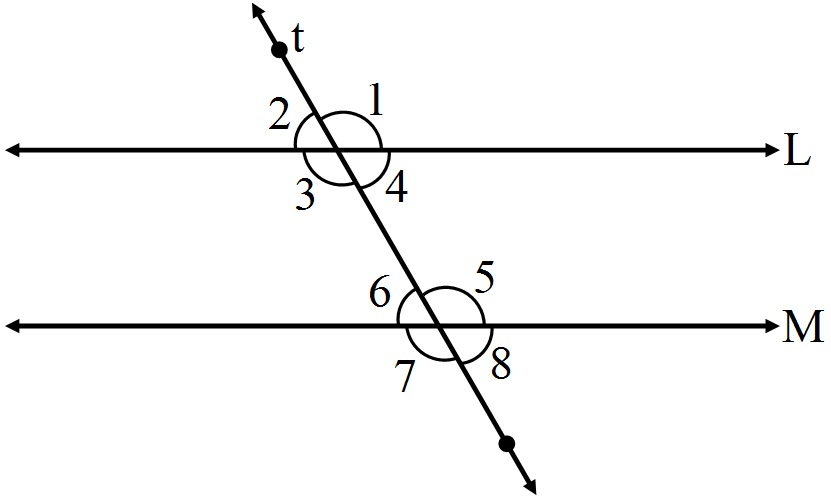
In the given figure, $l || m$ and a transversal $t$ cuts them, If $\angle1=120^\circ,$ find the measure of each of the remaining marked angles.