Question
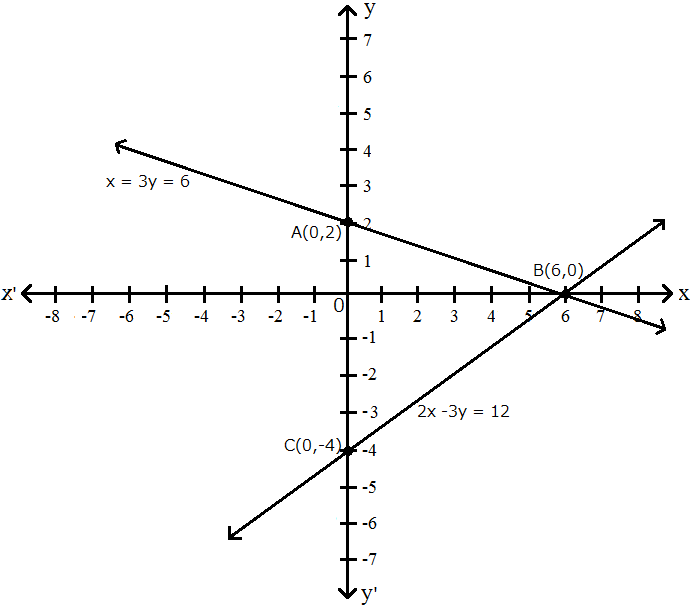
Represent the following pair of equations graphically and write the coordinates of points where the lines intersects y-axis.
x + 3y = 6,
2x - 3y = 12.

Answer

The given equations are
x + 3y = 6 ......(i)
2x - 3y = 12 ........(ii)
Putting x = 0 in equation (i) we get,
⇒ 0 + 3y = 6
⇒ y = 2
⇒ x = 0, y = 2
Putting y = 0 in equation (i) we get,
⇒ x + 3 × 0 = 6
⇒ x = 6
⇒ x = 6, y = 0
Use the following table to draw the graph.
x
0
6
y
2
0
The graph of (i) can be obtained by plotting the two points A(0, 2), B(6, 0).
2x - 3y = 12 ......(ii)
Putting x = 0 in equation (ii) we get,
⇒ 2 × 0 - 3y = 12
⇒ y = -4
⇒ x = 0, y = -4
Putting y = 0 in equation (ii) we get,
⇒ 2x - 3 × 0 = 12
⇒ x = 6
⇒ x = 6, y = 0
Use the following table to draw the graph.
x
0
6
y
-4
0
Draw the graph by plotting two points C(0, -4), D(6, 0) from table.

Graph of lines represented by the equations x + 3y = 6, 2x - 3y = 12 meet y-axis at A(0, 2), C(0, -4) respectively.

Need a full question paper?

Generate a complete, print-ready paper with questions like this in minutes — across 16+ boards, with answer keys.
Start Generating Free

Similar questions

Solve the following quadratic equation:
$2^{2x} - 3.2^{(x+2)} + 32= 0$
Solve the following systems of equations:
$\frac{\text{x}}{2}+\text{y}=0.8,$
$\frac{7}{\text{x}+\frac{\text{y}}{2}}=10.$
An ice cream cone full of ice cream having radius 5cm and height 10cm as shown in the Fig. Calculate the volume of ice cream, provided that its $\frac{1}{6}$ part is left unfilled with ice cream.
If $\tan\theta=\frac{20}{21},$ show that $\frac{\big(1-\sin\theta+\cos\theta\big)}{\big(1+\sin\theta+\cos\theta\big)}=\frac37.$
A man travels $370 \ km,$ partly by train and partly by car. If he covers $250 \ km$ by train and the rest by car, it takes him $4$ hours. But, if he travels $130 \ km$ by train and the rest by car, he takes $18$ minutes longer. Find the speed of the train and that of the car.
Find the mean of each of the following frequency distributions:
Classes
25-29
30-34
35-39
40-44
45-49
50-54
55-59
Frequency
14
22
16
6
5
3
4
Solve the following quadratoic equations by factorization:
$\frac{1}{2\text{a}+\text{b}+2\text{x}}=\frac{1}{2\text{a}}+\frac{1}{\text{b}}+\frac{1}{2\text{x}}$
Find the number of term of the AP -12, -9, -6, ....,21. If i is added to each term of this AP then find the sum of all terms of the AP thus obtained.
Find the coordinates of the point R on the line segment joining the points P(-1, 3) and Q(2, 5) such that $\text{PR}=\frac{3}{5}\text{PQ}.$
if -5 is a root of the quadratic equation $2x^2 + px - 15 = 0$ and the quadratic equation $p(x^2 - x) + k = 0$ has equal roots, find the value of k.