MCQ
Resolving power of a microscope depends upon
  • A
    Wavelength of light used, directly
  • Wavelength of light used, inversely
  • C
    Frequency of light used
  • D
    Focal length of objective

Answer

Correct option: B.
Wavelength of light used, inversely
b
( b)Resolving power of microscope $ \propto \frac{1}{\lambda }$

Need a full question paper?

Generate a complete, print-ready paper with questions like this in minutes — across 16+ boards, with answer keys.
Start Generating Free

Similar questions

Two bulbs of $(40 \;W, 200\; V)$ and $(100\; W, 200 \;V)$. Then correct relation for their resistance
A common example of alpha decay is ${ }_{82}^{238} U \longrightarrow{ }_{80}^{234} Th +{ }_2 He ^4+ Q$.  ( Given : ${ }_{92}^{238} U =238.05060 u ,$ ${ }_{90}^{234} Th =234.04360 u ,$ ${ }_2^4 He =4.00260 u \text {, and }$ $1 u =931.5 \frac{ MeV }{ c ^2} )$. The energy released $(Q)$ during the alpha decay of ${ }_{92}^{238} U$ is $......\,MeV$
Which of the following phenomena contributes significantly to the reddish appearance of the sun at sunrise or sunset?
Statement$-I :$ Energy is released when heavy nuclei undergo fission or light nuclei undergo fusion and Statement$-II:$ For heavy nuclei, binding energy per nucleon increases with increasing $Z$. while for light nuclei it decreases with increasing $Z$.
If the current is doubled, the deflection is also doubled in:
In beta decay, the typical $Q$ value is approximately:
The correct curve between the magnetic induction $(B)$ along the axis of a long solenoid  due to current flow $i$ in it and distance $x$ from one end is :
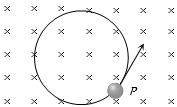
A particle having a charge of $10.0\,\mu C$ and mass $1\,\mu g$ moves in a circle of radius $10\,cm$ under the influence of a magnetic field of induction $0.1\,T$. When the particle is at a point $P$, a uniform electric field is switched on so that the particle starts moving along the tangent with a uniform velocity. The electric field is......$V/m$
The angle of dip at the magnetic equator is....$^o$
A capacitor of capacitance $10\, mF$ is connected to a battery of emf $2\,V.$ It is found that it takes $50\, ms$ for the charge on the capacitor to become $12.6 \,mC.$ Then the resistance of the circuit is :.......$\, k \Omega$ (Take $1/e = 0.37$):-