MCQ
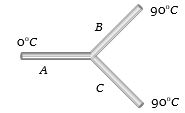
Three rods made of the same material and having the same cross section have been joined as shown in the figure. Each rod is of the same length. The left and right ends are kept at ${0^o}C$ and ${90^o}C$ respectively. The temperature of the junction of the three rods will be ...... $^oC$
  • A
    $45$
  • $60$
  • C
    $30$
  • D
    $20$

Answer

Correct option: B.
$60$
b
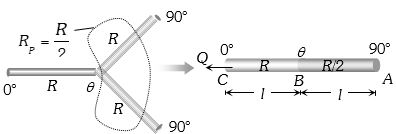
(b) Let the temperature of junction be $\theta$. Since roads $B$ and $C$ are parallel to each other (because both having the same temperature difference).

Hence given figure can be redrawn as follows
( $\frac{Q}{t} = \frac{{({\theta _1} - {\theta _2})}}{R}$ and ${\left( {\frac{Q}{t}} \right)_{AB}} = {\left( {\frac{Q}{t}} \right)_{BC}}$

==> $\frac{{(90 - \theta )}}{{R/2}} = \frac{{(\theta - 0)}}{R}$

==> $180 - 2\theta = \theta $

==>$\theta = 60^\circ C$

Need a full question paper?

Generate a complete, print-ready paper with questions like this in minutes — across 16+ boards, with answer keys.

Start Generating Free

Similar questions

A body of mass $m$ is moving in a circular orbit of radius $R$ about a planet of mass $M$. At some instant, it splits into two equal masses. The first mass moves in a circular orbit of radius $\frac{R}{2}$ , and the other mass, in a circular orbit of radius $\frac{3R}{2}$. The difference between the final and initial total energies is
The two nearest harmonics of a tube closed at one end and open at other end are $220\,\, Hz$ and $260\,\, Hz.$ What is the fundamental frequency of the system .... $Hz$ ?
Two cylinders $A$ and $B$ fitted with pistons contain equal amounts of an ideal diatomic gas at $300 K$ . The piston of $A$ is free to move while that of $B$  is held fixed. The same amount of heat is given to the gas in each cylinder. If the rise in temperature of the gas in $A$ is $30 K$ , then the rise in temperature of the gas in $B$ is ..... $K$
A cricketer hits a ball with a velocity $25\,\,m/s$ at ${60^o}$ above the horizontal. How far above the ground it passes over a fielder $50 m$ from the bat  ........ $m$ (assume the ball is struck very close to the ground)
If $\overrightarrow{ a }= a _{ x } \hat{ i }+ a _{ y } \hat{ j }+ a _{ z } \hat{ k }$ and $\overrightarrow{ b }= b _{ x } \hat{ i }+ b _{ y } \hat{ j }+ b _{ z } \hat{ k }$ then the cross product $\overrightarrow{ a } \times \overrightarrow{ b }$ is given by:
An organ pipe $P_1$ closed at one end vibrating in its first overtone. Another pipe $P_2$ open at both ends is vibrating in its third overtone. They are in a resonance with a given tuning fork. The ratio of the length of $P_1$ to that of $P_2$ is :
A body of mass $M$ thrown horizontally with velocity $v$ from the top of the tower of height $\mathrm{H}$ touches the ground at a distance of $100 \mathrm{~m}$ from the foot of the tower. A body of mass $2 \mathrm{M}$ thrown at a velocity $\frac{v}{2}$ from the top of the tower of height $4 \mathrm{H}$ will touch the ground at a distance of. . . . ..  
A metre scale is balanced on a knife edge at its centre. When two coins, each of mass $10\, g$ are put one on the top of the other at the $10.0\, cm$ mark the scale is found to be balanced at $40.0\, cm$ mark. The mass of the metre scale is found to be $x \times 10^{-2}$ $kg$. The value of $x$ is
The angle made by the vector $A = \hat i + \hat j$ with $x-$ axis is ....... $^o$
A projectile is thrown in the upward direction making an angle of $60^o $ with the horizontal direction with a velocity of $147\ ms^{-1}$ . Then the time after which its inclination with the horizontal is $45^o $ , is    ......... $\sec$