Question
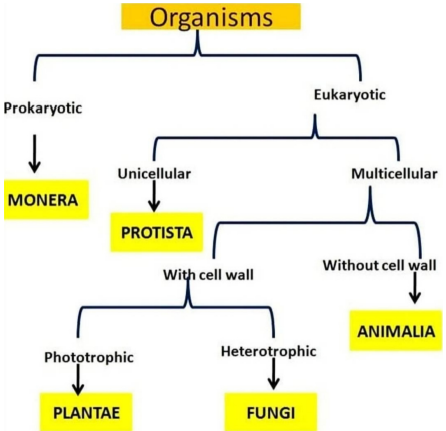
✓
Answer
i. All organisms are multicellular, eukaryotes with heterotrophic mode of nutrition.
ii.
iii. Linnaeus used artificial system kingdom of classification.
Drawbacks of Linnaeus two kingdom classification:
• Linnaeus developed a Two Kingdom system of classification with Plantae and Animalia kingdoms.
• This system did not distinguish between eukaryotes and prokaryotes, unicellular and multicellular organisms, photosynthetic (green algae) and non-photosynthetic (fungi) organisms.
OR
No, Fungi-Autotrophic (Photosynthetic) and Heterotrophic is not correct match. The walls of the fungi were made of chitin, whereas the green plants had a cellulose cell wall.
ii.
| Prokaryotic cell | Eukaryotic cell |
| Genetic material is not enclosed in a nuclear envelope and is present suspended in the cytoplasm in a region called nucleoid. | Genetic material is enclosed within the nucleus by a nuclear envelope and is not present in direc contact with cytoplasm. |
| Cell wall is made up of peptidoglycan. | Cell wall is made up of chitin in fungi and cellulose in plants. |
| Nucleolus is absent. | Nucleolus is present. |
Drawbacks of Linnaeus two kingdom classification:
• Linnaeus developed a Two Kingdom system of classification with Plantae and Animalia kingdoms.
• This system did not distinguish between eukaryotes and prokaryotes, unicellular and multicellular organisms, photosynthetic (green algae) and non-photosynthetic (fungi) organisms.
OR
No, Fungi-Autotrophic (Photosynthetic) and Heterotrophic is not correct match. The walls of the fungi were made of chitin, whereas the green plants had a cellulose cell wall.
Need a full question paper?
Generate a complete, print-ready paper with questions like this in minutes — across 16+ boards, with answer keys.
Explore more
Similar questions
Describe the structure of chloroplast graphically.
Structure of human body is made up of different type of cells .These cells
predominantly consist of forms two states of matter solid and Liquid with gaseous state
dissolve in its one type of tissue. This all three form of matter in human body form the
basis of human body structure. How beautifully nature has already connected
Chemistry and Biology.
Many famous players like Sachin Tendulkar ,Raffel Nadal,suffered from muscle and
bone detachment problems which also shows the significance of connective tissue for
athletes too.
Based on above paragraph answer the following:
(1). Name the connective tissue present in liquid form in our body.
(2). Which tissue connects bones to muscles is _______
(3). The liquid connective tissue contains no-
(a) Fibre (b)Matrix (c)Cell (d)all the above
(4). Areolar tissue connects _______
(a).Two Bones
(b).Muscle & Bone
(c).Muscle & fat tissue
(d).muscles and their compounds
(5). Tip of the nose and external ears have
(a). Areolar tissue (b).Ligament (c).cartilage (d).bone
predominantly consist of forms two states of matter solid and Liquid with gaseous state
dissolve in its one type of tissue. This all three form of matter in human body form the
basis of human body structure. How beautifully nature has already connected
Chemistry and Biology.
Many famous players like Sachin Tendulkar ,Raffel Nadal,suffered from muscle and
bone detachment problems which also shows the significance of connective tissue for
athletes too.
Based on above paragraph answer the following:
(1). Name the connective tissue present in liquid form in our body.
(2). Which tissue connects bones to muscles is _______
(3). The liquid connective tissue contains no-
(a) Fibre (b)Matrix (c)Cell (d)all the above
(4). Areolar tissue connects _______
(a).Two Bones
(b).Muscle & Bone
(c).Muscle & fat tissue
(d).muscles and their compounds
(5). Tip of the nose and external ears have
(a). Areolar tissue (b).Ligament (c).cartilage (d).bone
Give a brief account of viruses with respect to their structure and nature of genetic material. Also name four common viral diseases.
Write comments on the following :
(i) Myasthenia gravis (ii) Muscular dystrophy (iii) Tetany (iv) Osteoporosis.
(i) Myasthenia gravis (ii) Muscular dystrophy (iii) Tetany (iv) Osteoporosis.
Make a labeled diagram of Singer and Nicolson improved model of the structure of cell membrane and briefly describe it.
Write any two functions of leaves found in fern. Write any four differences between green algae and red algae.
Lipids form a heterogeneous group but all are made up of carbon hydrogen and oxygen. These are insoluble in water and soluble in organic solvents like acetone, ether, alcohol etc. The number of oxygen atoms is very small compared to carbon atoms. They need a large amount of oxygen for their oxidation to release energy. They could be simple lipids, compound lipids, and derived lipids. Simple lipids are esters of fatty acid and alcohol. Compound lipids are formed when simple lipids combine with another compounds for example glycolipids, phospholipids and lipoproteins. Derived lipids are of various types and important example being steroids.
(1) Lipids mainly consist of
(a) Carbon only
(b) carbon hydrogen and nitrogen
(c) carbon hydrogen and oxygen
(d) Hydrogen only
(2) Among the given options non-polymeric molecule is
(a) Nucleic acids (b) proteins (c) Lipids (d) polysaccharides
(3) An example of unsaturated fatty acid is
(a) oleic acid (b) stearic acid (c) Linoleic acid (d) both a and c
(4) The number of carbon atoms as compared to oxygen atoms in lipids is
(a) same (b) much less (c) much more (d) none of these.
(5) Steroids are an example of
(a) derived lipids (b) conjugated lipids (c) simple lipids (d) lipo proteins
(1) Lipids mainly consist of
(a) Carbon only
(b) carbon hydrogen and nitrogen
(c) carbon hydrogen and oxygen
(d) Hydrogen only
(2) Among the given options non-polymeric molecule is
(a) Nucleic acids (b) proteins (c) Lipids (d) polysaccharides
(3) An example of unsaturated fatty acid is
(a) oleic acid (b) stearic acid (c) Linoleic acid (d) both a and c
(4) The number of carbon atoms as compared to oxygen atoms in lipids is
(a) same (b) much less (c) much more (d) none of these.
(5) Steroids are an example of
(a) derived lipids (b) conjugated lipids (c) simple lipids (d) lipo proteins
Polysaccharides or the macro molecules consisting of long chains of sugar. Only carbohydrates they are not sweet and are insoluble in water. The two ends of the polysaccharide chain are called reducing and non-reducing ends. Based upon their monomeric units these are homo polysaccharides or heteropolysaccharides. Depending upon their location polysaccharides play multiple functions in living world few examples of polysaccharides include Cellulose, chitin, inulin etc.
(1) All the listed polysaccharides are homopolymers except
(a) Starch (b) glycogen (c) Chitin (d) Cellulose
(2) Inulin is a polymer of
(a) glucose (b) fructose (c) glucose and sucrose (d) fructose and galactans
(3) Murein is a heteropolysaccharide like
(a) araban (b) xylan (c) hyaluronic acid (d) agar
(4) A polysaccharide found in the exoskeleton of crabs is
(a) Cellulose (b) pectin (c) murine (d) chitin
(5) The right end of the polysaccharide chain is called
(a) reducing end (b) non-reducing end (c) right end (d) none of these
(1) All the listed polysaccharides are homopolymers except
(a) Starch (b) glycogen (c) Chitin (d) Cellulose
(2) Inulin is a polymer of
(a) glucose (b) fructose (c) glucose and sucrose (d) fructose and galactans
(3) Murein is a heteropolysaccharide like
(a) araban (b) xylan (c) hyaluronic acid (d) agar
(4) A polysaccharide found in the exoskeleton of crabs is
(a) Cellulose (b) pectin (c) murine (d) chitin
(5) The right end of the polysaccharide chain is called
(a) reducing end (b) non-reducing end (c) right end (d) none of these