Question
Describe the structure of chloroplast graphically.

Answer

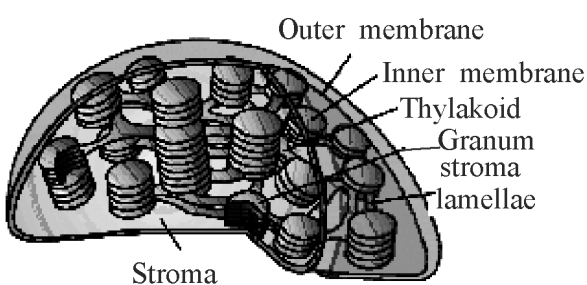
Chloroplast: It was discovered by Schimper in 1864. Majority of the chloroplasts of the green plants are found in the mesophyll cells of the leaves. These are lens- shaped, oval, spherical, discoid or even ribbon-like organelles having variable length (5-10µm) and width (2-4µm). Their number varies from 1 per cell of the Chlamydomonas, a green alga to 20-40 per cell in the mesophyll. The chlorophyll is surrounded by two membranes. The space between these two membranes is called periplastidial space. There are two main parts inside the membranes:
(a) Stroma: This is a colourless part in which different types of enzymes are found, where the dark reaction of photosynthesis takes place.
(b) Grana: It is a structure like a pack of coins of thylakoid lamellae which is called grana. Light reaction of photosynthesis occurs in grana. Two adjacent grana are connected to each other by intergranal lamellae or stroma lamellae. There are 40 to 60 grana in a chloroplast.
Image
Many enzymes are found in the stroma of chlorophyll which are necessary for carbohydrate and protein synthesis. Small, double-stranded circular DNA molecules and ribosomes are found in these. The ribosome (70S) found in chlorophyll is smaller than the cytoplasmic ribosome (80S).
Functions: The main functions of chloroplast are as follows:
(i) To absorb light energy.
(ii) Formation of NADHP-H2 by light reaction and release O2 .
(iii) Making starch from CO2 obtained from air.

Need a full question paper?

Generate a complete, print-ready paper with questions like this in minutes — across 16+ boards, with answer keys.

Start Generating Free

Similar questions

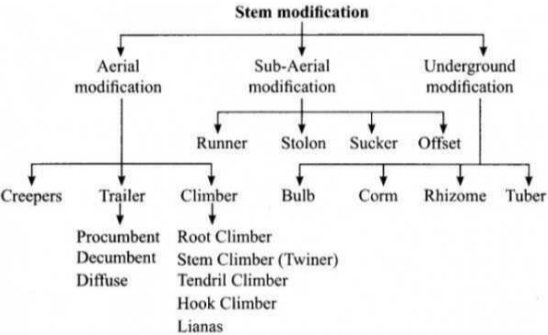
Various parts of the plant such as stems leaves, and even fruits are modified into underground parts to perform various functions such as stems, leaves, and even fruits.
The stems in ginger and banana are underground and swollen due to storage of food. They are called rhizome. Rhizome of ginger is a modification of stem because it bears nodes, internodes, terminal buds, scaly leaves and buds, which give rise to aerial shoots. It is not a root because root does not have nodes and internodes. Also, rhizome does not perform the function of roots i.e. anchorage and absorption, rather it serve as reservoir for storage of food. Similarly, corm is an underground stem in Colocasia (jimikand) The tips of the underground stem in potato become swollen due to accumulation of food and forms tuber.

Image

i. Observe the given flow chart and mention what are the four types of Underground stem modification also mention one example of each. (1)
ii. Ginger is an underground stem but why it is distinguished from a root? (1)
iii. Why do the tips of modified stems in potatoes become swollen? (2)

OR

Are all underground parts of a plant roots? (2)
Write any four differences between Agnatha and Gnathostomata.
Write the functions of human kidney.
The process to standardize the naming of living organisms is called nomenclature. Obviously, the nomenclature is only possible when the organism is described correctly and we know to what organism the name is attached to this is identification. The system of providing scientific name with two components is called Binomial Nomenclature. The scientific name ensures that each organism is identified by only one name all across the world. They also ensures that such a name has not been used for any other known organism. Scientific names for plants are provided in ICBN and for animals, in ICZN.

(1). Who proposed binomial nomenclature?
(A) Carolus Linnaeus  (B) Charles Darwin  (C) Francis crick  (D) Albert Einstein

(2)Which of the following is an example of binomial scientific name?
(A) Green algae  (B) Rana tigrina  (C) Snow leopard  (D) China rose

(3). In binomial nomenclature, the name of organism consists of
(A) kingdom   (B) genus   (C) species   (D) Both B and C

(4). ICBN stands for
(A) Internal botanical congress names
(B) International center of botanical names
(C) International code of botanical nomenclature
(D) Internal code of botanical nomenclature

(5). In binomial nomenclature,------- epithet starts with small letter
(A) Genus
(B) Species
(C) Both A and B
(D) None of the above
Describe the general rules of Carolus Linnaeus's binomial system.
Write four differences between lined and unlined sutures.
(i) Which factor is secreted due to increased blood flow in the atriums of the heart? Write one function of it.
(ii) Write any four differences in the urinary tract of men and women.
Give a brief account of viruses with respect to their structure and nature of genetic material. Also name four common viral diseases.
Write the names of four groups of bacteria on the basis of shape. Name any four diseases caused by bacteria and draw any two picture of bacteria.