MCQ
Roads are banked on curves so that
  • The speeding vehicles may not fall outwards
  • B
    The frictional force between the road and vehicle may be decreased
  • C
    The wear and tear of tyres may be avoided
  • D
    The weight of the vehicle may be decreased

Answer

Correct option: A.
The speeding vehicles may not fall outwards
a
(a) By doing so component of weight of vehicle provides centripetal force.

Need a full question paper?

Generate a complete, print-ready paper with questions like this in minutes — across 16+ boards, with answer keys.
Start Generating Free

Similar questions

From the top of a tower, two stones whose masses are in the ratio $1 : 2$ are thrown, one straight up with an initial speed $u$ and the second straight down with same speed $u.$ neglecting air resistance,
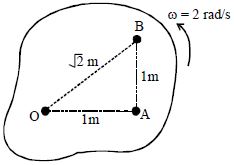
A rigid lamina is rotating about an axis passing perpendicular to its plane through point $O$ as shown in figure. The angular velocity of point $B$ w.r.t $A$ is ....... $rad/s$.
Which of the following is correct, when a person walks on a rough surface
A particle moves in a straight line with a constant acceleration . It changes its velocity from $10 \,ms^{-1 }$ to $ 20\, ms^{-1 }$ while passing through a distance $135\,m$ in $t$ second. The value of $t$ is..........$s$
A loaded spring gun of mass $M$ fires a 'shot' of mass $m$ with a velocity at an angle of elevation $\theta.$ The gun is initially at rest on a horizontal frictionless surface. After firing, the centre of mass of the gun$-$shot system.
A body is projected vertically upward direction from the surface of earth. If upward direction is taken as positive, then acceleration of body during its upward and downyard jourhey are respectively
If heat is supplied to a solid, its temperature:
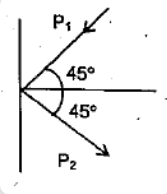
A ball moving with a momentum of $5\ \ce{kgm/ s}$ strikes against a wall at an angle of $45^\circ$ and is reflected at the same angle. The change in momentum will be $\ce{(kg-m/ s):}$​​​​​​​
Which of the following quantities are always positive in a simple harmonic motion?
A non-isotropic solid metal cube has coefficients of linear expansion as:

$5 \times 10^{-5} /^{\circ} \mathrm{C}$ along the $\mathrm{x}$ -axis and $5 \times 10^{-6} /^{\circ} \mathrm{C}$ along the $y$ and the $z-$axis. If the coefficient of volume expansion of the solid is $\mathrm{C} \times 10^{-6} /^{\circ} \mathrm{C}$ then the value of $\mathrm{C}$ is