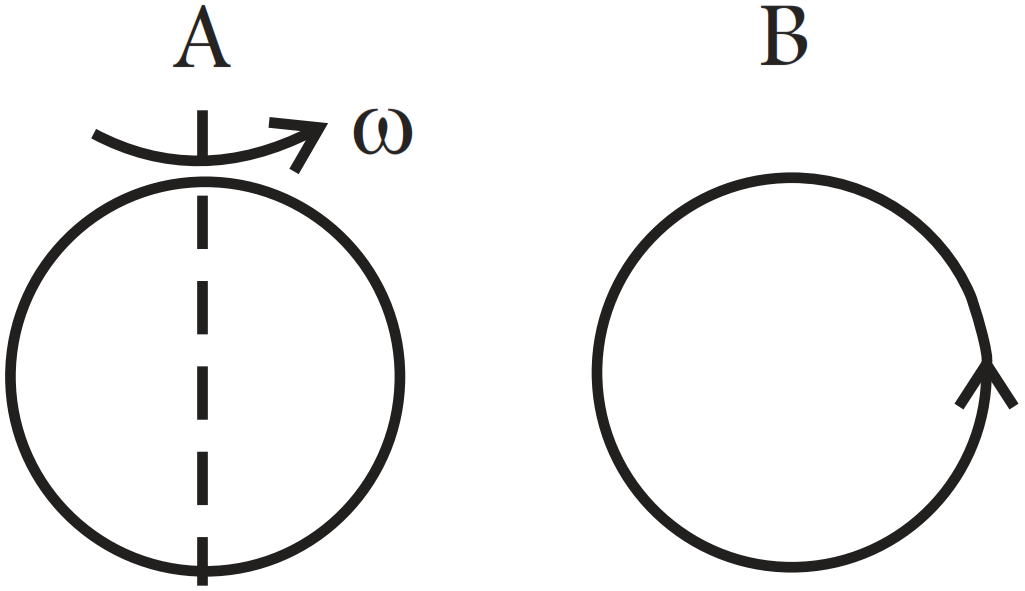
- AConstant current clockwise.
- BVarying current clockwise.
- CVarying current counterclockwise.
- DConstant current counterclockwise.

Solution:
Key concept: In this problem, the Lenz’s law is applicable so let us introduce Lenz’s law first.
Lenz's law gives the direction of induced emf/induced current. According to this law, the direction of induced emf or current in a circuit is such as to oppose the cause that produces it. This law is based upon law of conservation of energy.
When the current in coil B (at t = 0) is counter-clockwise and the coil A is considered above it. The counter clockwise flow of the current in coil B is equivalent to north pole of magnet and magnetic field lines are eliminating upward to coil A. When coil A starts rotating at t = 0, the current in A is constant along clockwise direction by Lenz's rule.
Generate a complete, print-ready paper with questions like this in minutes — across 16+ boards, with answer keys.
If
and
are the wavelengths of characteristic X-rays and gamma rays respectively, then the relation between them is
|
(a) |
(b) |
(c) |
(d) |
To deposit one gm equivalent of an element at an electrode, the quantity of electricity needed is
|
(a) One ampere |
(b) 96000 amperes |
(c) 96500 farads |
(d) 96500 coulombs |
A cathode emits 1.8
electrons per second, when heated. When 400V is applied to anode all the emitted electrons reach the anode. The charge on electron is 1.6
. The maximum anode current is
|
(a) 2.7 μA |
(b) 29 μA |
(c) 72 μA |
(d) 29 μA |
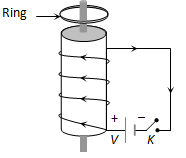
A conducting ring is placed around the core of an electromagnet as shown in fig. When key K is pressed, the ring

|
(a) Remain stationary |
|
(b) Is attracted towards the electromagnet |
|
(c) Jumps out of the core |
|
(d) None of the above |
In an electrolyte 3.2 bivalent positive ions drift to the right per second while 3.6
monovalent negative ions drift to the left per second. Then the current is
|
(a) 1.6 amp to the left |
(b) 1.6 amp to the right |
(c) 0.45 amp to the right |
(d) 0.45 amp to the left |
The current in a coil of inductance 5 H decreases at the rate of 2 A/s. The induced e.m.f. is
|
(a) 2 V |
(b) 5 V |
(c) 10 V |
(d) – 10 V |
The capacitance of a metallic sphere will be 1μF, if its radius is nearly
|
(a) 9 km |
(b) 10 m |
(c) 1.11 m |
(d) 1.11 cm |
In a parallel plate capacitor of capacitance C, a metal sheet is inserted between the plates, parallel to them. If the thickness of the sheet is half of the separation between the plates. The capacitance will be
|
(a) |
(b) |
(c) 4C |
(d) 2C |