MCQ
Select correct statement $(s)$.
- ACyanamide ion $(CN_2\,^{2-})$ is isoelectronic with $CO_2$ and has the same linear structure
- B$Mg_2C_3$ reacts with water to form propyne
- C$CaC_2$ has $NaCl$ type lattice
- ✓All of the above
In $(CN_2^{2-})$, we have $22(6+7+7+2=22)$ electrons. Both $CO_2$ and $(CN_2^{2-})$ have linear structures. Thus, statement $(a)$ is correct.
$M{{g}_{2}}{{C}_{3}}+4{{H}_{2}}O\to 2Mg{{(OH)}_{2}}+\underset{\Pr opyne}{\mathop{C{{H}_{3}}C\equiv CH}}\,$
i.e., statement $(b)$ is also correct.
The structure of $CaC_2$ is of $NaCl$ type
i.e., statement $(c)$ is also correct.
Generate a complete, print-ready paper with questions like this in minutes — across 16+ boards, with answer keys.


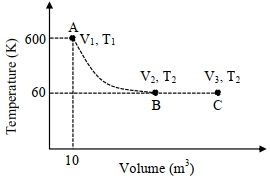
(image)
$A \rightarrow B$ is an adiabatic process. If the total heat absorbed in the entire process ( $A \rightarrow B$ and $B \rightarrow C$ ) is $R T_2 \ln 10$, the value of $2 \log V_3$ is . . . . . [Use, molar heat capacity of the gas at constant pressure, $\mathrm{C}_{\mathrm{p}, \mathrm{m}}=\frac{5}{2} \mathrm{R}$ ]