Question
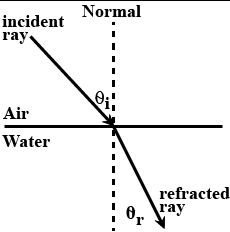
Select the correct alternative, The angle between the normal and refracted ray is called:
Answer

  1. Angle of refraction
Explanation:
The angle formed between the normal and refracted ray at the point of refraction is called angle of refraction.

Need a full question paper?

Generate a complete, print-ready paper with questions like this in minutes — across 16+ boards, with answer keys.

Start Generating Free

Similar questions

A frictionless dielectric plate $S$ is kept on a frictionless table $T$. A charged parallel plate capacitance $C\ ($of which the plates are frictionless$)$ is kept near it. The plate $S$ is between the plates. When the plate $S$ is left between the plates
A very thin film in reflected white light appears:
The rays of different colours fail to converge at a point after going through a converging lens. This defect is called:
A student has $10$ resistors of resistance $' r\ '.$ The minimum resistance made by him from given resistors is
A heavy mass is attached to a thin wire and is whirled in a vertical circle. The wire is most likely to break.
  1. When the mass is at the highest point.
  2. When the mass is at the lowest point.
  3. When the wire is horizontal.
  4. At an angle of $\cos^{-1}\Big(\frac{1}{3}\Big)$ from the upward vertical.
A signal emitted by an antenna from a certain point can be received at another point of the surface in the form of(a) Sky wave(b) Ground wave(c) Sea wave(d) Both (a) and (b)
       
A microscope is focused on a mark. Then a glass slab of refractive index 1.5 and thickness 6 cm is placed on the mark. To get the mark again in focus the microscope should be moved
An electron is travelling along the X-direction. It encounters a magnetic field in the Y-direction. Its subsequent motion will be:
A ferromagnetic material is placed in an external magnetic field. The magnetic domains:
When radiation is incident on a photoelectron emitter, the stopping potential is found to be $9$ volts. If $e/m$ for the electron is $1.8\times 10^{11} \mathrm{Ckg}^{-1}$ the maximum velocity of the ejected electrons is