MCQ
Select the incorrect statement about the specific heats of a gaseous system.
  • A
    Specific heat at no exchange condition, $C_A=0$
  • B
    Specific heat at constant temperature, $C_T=\infty$
  • C
    Specific heat at constant pressure, $C_P=\frac{\gamma R}{\gamma-1}$
  • Specific heat at constant volume, $C_V=\frac{R}{\gamma}$
Answer

Correct option: D.
Specific heat at constant volume, $C_V=\frac{R}{\gamma}$
d
(d)

The correct value of $C_V=\frac{R}{\gamma-1}$

Need a full question paper?

Generate a complete, print-ready paper with questions like this in minutes — across 16+ boards, with answer keys.

Start Generating Free

Similar questions

A screw gauge gives the following readings when used to measure the diameter of a wire

Main scale reading : $0 \,\mathrm{~mm}$

Circular scale reading $: 52$ $divisions$

Given that $1\, \mathrm{~mm}$ on main scale corresponds to $100\, divisions$ on the circular scale. The diameter of the wire from the above data is ...... $cm$

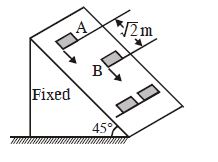
Two blocks $A$ and $B$ of equal masses are sliding down along straight parallel lines on an inclined plane of $45^o$ . Their coefficients of kinetic friction are $\mu _A = 0.2$ and $\mu _B = 0.3$ respectively. At $t = 0$ , both the blocks are at rest and block $A$ is $\sqrt 2$ metre behind block $B$ . The time and distance from the initial position where the front faces of the blocks come in line on the inclined plane as shown in figure. (Use $g = 10\, ms^{-2}$ )
Find the quantity of heat required to convert $40\; gm$ of ice at $-20^{\circ} C$ into water at $20^{\circ} C$. Given $L _{\text {ice }}$ $=0.336 \times 10^6 J / kg$.

specific heat of ice $=2100 \;J / kg - K$ sp heat of water= $4200\; J / kg - K$

A body takes $10\, minutes$ to cool from $60\,^oC$ to $50\,^oC$. The temperature of surroundings is constant at $25\,^oC$. Then, the temperature of the body after next $10\, minutes$ will be approximately ....... $^oC$
Distance does not depend on $.............$
Which of the following do not require medium for transmission
The wettability of a surface by a liquid depends primarily on
The spectral energy distribution of star is maximum at twice temperature as that of sun. The total energy radiated by star is
A material has Poisson's ratio $0.50.$ If a uniform rod of it suffers a longitudinal strain of $2 \times {10^{ - 3}}$, then the percentage change in volume is
A source and a detector move away from each other in absence of wind with a speed of $20\, {m} / {s}$ with respect to the ground. If the detector detects a frequency of $1800\, {Hz}$ of the sound coming from the source, then the original frequency of source considering speed of sound in air $340\, {m} / {s}$ will be ${Hz}$