MCQ
The wettability of a surface by a liquid depends primarily on
  • A
    surface tension
  • B
    density
  • angle of contact between the surface and the liquid
  • D
    viscosity

Answer

Correct option: C.
angle of contact between the surface and the liquid
c
The wettability of a surface by a liquid depends primarily on angle of contact between the surface and the liquid.

Need a full question paper?

Generate a complete, print-ready paper with questions like this in minutes — across 16+ boards, with answer keys.
Start Generating Free

Similar questions

When a body of mass $1.0\, kg$ is suspended from a certain light spring hanging vertically, its length increases by $5\, cm$. By suspending $2.0\, kg$ block to the spring and if the block is pulled through $10\, cm$ and released the maximum velocity in it in $m/s$ is : (Acceleration due to gravity $ = 10\,m/{s^2})$
Satellites orbiting the earth have a finite life and sometimes debris of satellites fall to the earth. This is because,
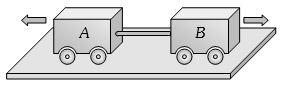
Two carts of masses $200\, kg$ and $300 \,kg$ on horizontal rails are pushed apart. Suppose the coefficient of friction between the carts and the rails are same. If the $200 \,kg$ cart travels a distance of $36 \,m$ and stops, then the distance travelled by the cart weighing $300 \,kg$ is ........ $m$
A closed organ pipe of length $l$ is sounded together with another closed organ pipe of length $l + x (x << l)$ both in fundamental mode. If $v$ = speed of sound, the beat frequency heard is
The energy contained in a small volume through which an electromagnetic wave is passing oscillates with:
A particle starts moving rectilinearly at time $t = 0$ such that its velocity $'v'$ changes with time $'t'$ according to the equation $v = t^2 - t$ where $t$ is in seconds and $v$ is in $m/s.$ The time interval for which the particle retards is
A drop of liquid of diameter $2.8\, mm$ breaks up into $125$ identical drops. The change in energy is nearly ........ $erg$ (S.T. of liquid = $75\, dynes/cm$)
The ratio of the volume of the atom to the volume of the nucleus is of the order of:
The correct formula to determine Youngs Modulus of elasticity will be:
When two sound sources of the same amplitude but of slightly different frequencies $v_1$ and $v_2$ are sounded simultaneously, the sound one hears has a frequency equal to