Question
Select wrong statement about simple,harmonic motion

Answer

(a)

In $S.H.M.$

$a=-\omega^2 x$

Thus acceleration varies linearly with time.

Need a full question paper?

Generate a complete, print-ready paper with questions like this in minutes — across 16+ boards, with answer keys.

Start Generating Free

Similar questions

One end of a taut string of length $3 \ m$ along the $x$-axis is fixed at $x=0$. The speed of the waves in the string is $100 \ m / s$. The other end of the string is vibrating in the $y$-direction so that stationary waves are set up in the string. The possible waveform$(s)$ of these stationary waves is (are)

$(A)$ $y(t)=A \sin \frac{\pi x}{6} \cos \frac{50 \pi t}{3}$

$(B)$ $y(t)=A \sin \frac{\pi x}{3} \cos \frac{100 \pi t}{3}$

$(C)$ $y(t)=A \sin \frac{5 \pi x}{6} \cos \frac{250 \pi t}{3}$

$(D)$ $y(t)=A \sin \frac{5 \pi x}{2} \cos 250 \pi t$
Outside a nucleus
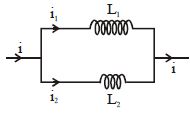
Two inductors $L_1$ and $L_2$ are connected in parallel and $a$ time varying current flow  as shown the Ratio of currents $i_1/i_2$ at any time $t$ is
The focal length of convex lens is $30 cm$ and the size of image is quarter of the object, then the object distance is........$cm$
A $p-n$ photodiode is manufactured from a semiconductor with band gap of $3.1 \,eV$. Which of the following wavelengths can be detected by it?
Which reagent is used to form glucosazone
A solid sphere of radius $R$ and density $\rho$ is attached to one end of a mass-less spring of force constant $k$. The other end of the spring is connected to another solid sphere of radius $R$ and density $3 p$. The complete arrangement is placed in a liquid of density $2 p$ and is allowed to reach equilibrium. The correct statement$(s)$ is (are)

$(A)$ the net elongation of the spring is $\frac{4 \pi R^3 \rho g}{3 k}$

$(B)$ the net elongation of the spring is $\frac{8 \pi R^3 \rho g}{3 k}$

$(C)$ the light sphere is partially submerged.

$(D)$ the light sphere is completely submerged.
Newton-second is the unit of
A force of $- P \hat{k}$ acts on the origin of the coordinate system. The torque about the point $(2,-3)$ is $P(a \hat{i}+b \hat{j})$, the ratio of $\frac{a}{b}$ is $\frac{x}{2}$. The value of $x$ is
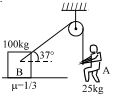
Block $B$ of mass $100 kg$ rests on a rough surface of friction coefficient $\mu = 1/3$. $A$ rope is tied to block $B$ as shown in figure. The maximum acceleration with which boy $A$ of $25 kg$ can climbs on rope without making block move is: