A circular disc of mass $10 \;kg$ is suspended by a wire attached to its centre. The wire is twisted by rotating the disc and released. The period of torsional oscillations is found to be $1.5 \;s$. The radius of the disc is $15\; cm .$ Determine the torsional spring constant of the wire in $N\;m\;rad^{-1}$. (Torsional spring constant $\alpha$ is defined by the relation $J=-\alpha \theta,$ where $J$ is the restoring couple and $\theta$ the angle of twist).
Medium
Download our app for free and get started
Mass of the circular disc, $m=10 \,kg$
Radius of the disc, $r=15 \,cm =0.15\, m$
The torsional oscillations of the disc has a time period, $T=1.5\, s$
The moment of inertia of the disc is:
${I}=\frac{1}{2} m r^{2}$
$={2} \times(10) \times(0.15)^{2}$
$=0.1125 \,kg\, m ^{2}$
$T=2 \pi \sqrt{\frac{I}{\alpha}} a$
Time period,
is the torsional constant.
$\alpha=\frac{4 \pi^{2} I}{T^{2}}$
$=\frac{4 \times(\pi)^{2} \times 0.1125}{(1.5)^{2}}$
$=1.972\, Nm / rad$
Hence, the torsional spring constant of the wire is $1.972\, Nm$ $rad$ $^{-1}$.

Download our appand get started for free
Experience the future of education. Simply download our apps or reach out to us for more information. Let's shape the future of learning together!No signup needed.*
Similar Questions
- 1A spring whose unstretched length is $\ell $ has a force constant $k$. The spring is cut into two pieces of unstretched lengths $\ell_1$ and $\ell_2$ where, $\ell_1 = n\ell_2$ and $n$ is an integer. The ratio $k_1/k_2$ of the corresponding force constants, $k_1$ and $k_2$ will beView Solution
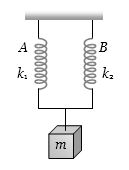
- 2A mass $m$ is suspended by means of two coiled spring which have the same length in unstretched condition as in figure. Their force constant are $k_1$ and $k_2$ respectively. When set into vertical vibrations, the period will beView Solution
- 3View SolutionIn case of a forced vibration, the resonance wave becomes very sharp when the
- 4The maximum velocity and the maximum acceleration of a body moving in a simple harmonic oscillator are $2\,m/s$ and $4\,m/{s^2}.$ Then angular velocity will be ..... $rad/sec$View Solution
- 5A particle moves on $x-$ axis according to the equation $x = x_0\,\,sin^2\,\omega t,$ the motion is simple harmonicView Solution
- 6A particle is oscillating according to the equation $X = 7\cos 0.5\pi t$, where $t$ is in second. The point moves from the position of equilibrium to maximum displacement in time ..... $\sec$View Solution
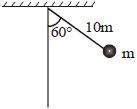
- 7View SolutionIf pendulum is released from given position find velocity of Bob when it reaches the lowest position
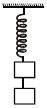
- 8Two small bodies of mass of $2\, kg$ each attached to each other using a thread of length $10\, cm$, hang on a spring whose force constant is $200\, N/m$, as shown in the figure. We burn the thread. What is the distance between the two bodies when the top body first arrives at its highest position .... $cm$ ? (Take $\pi^2 = 10$)View Solution
- 9View SolutionWhen the displacement is half the amplitude, the ratio of potential energy to the total energy is
- 10For a body executing $S.H.M. :$View Solution
$(a)$ Potential energy is always equal to its $K.E.$
$(b)$ Average potential and kinetic energy over any given time interval are always equal.
$(c)$ Sum of the kinetic and potential energy at any point of time is constant.
$(d)$ Average $K.E.$ in one time period is equal to average potential energy in one time period.
Choose the most appropriate option from the options given below: