Question
Sensitivity of potentiometer can be increased by:

Answer

  1. Increasing the length of the potentiometer.

Need a full question paper?

Generate a complete, print-ready paper with questions like this in minutes — across 16+ boards, with answer keys.
Start Generating Free

Similar questions

Two thin wire rings each having a radius $R$ are placed at a distance $d$ apart with their axes coinciding. The charges on the two rings are $+q$ and $-q.$ The potential difference between the centres of the two rings is
At a certain place, the horizontal component $B _0$ and the vertical component $V _0$ of the earth's magnetic field are equal in magnitude. The total intensity at the place will be
Earth’s magnetism was discovered by:
The resonant frequency of an L - C circuit is.
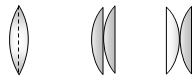
Two similar plano$-$convex lenses are combined together in three different ways as shown in the adjoining figure. The ratio of the focal lengths in three cases will be
Consider a magnetic dipole kept in the north to south direction. Let $P_1, P_2, Q_1, Q_2$ be four points at the same distance from the dipole towards north, south, east and west of the dipole respectively. The directions of the magnetic field due to the dipole are the same at:
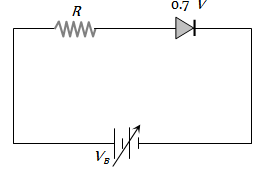
The junction diode in the following circuit requires a minimum current of $1\ mA$ to be above the knee point $(0.7 V)$ of its $I-V$ characteristic curve. The voltage across the diode is independent of current above the knee point. If $V_B = 5V,$ then the maximum value of $R$ so that the voltage is above the knee point, will be
The e.m.f. of a cell is E volts and internal resistance is r ohm. The resistance in external circuit is also r ohm. The p.d. across the cell will be(a) E/2(b) 2E(c) 4E       (d) E/4
       
Which of the following is an amorphous solid(a) Glass(b) Diamond(c) Salt    (d) Sugar
       
A particle of mass $M$ and charge $Q$ moving with velocity $\overrightarrow{\mathrm{v}}$ describes a circular path of radius $R$ when subjected to a uniform transverse magnetic field of induction $B.$ The work done by the field when the particle completes one full circle is