Question
Serious draw back of the semiconductor device is (a) They cannot be used with high voltage (b) They pollute the environment (c) They are costly(d) They do not last for long time


Answer

(a) They cannot be used with high voltage

Need a full question paper?

Generate a complete, print-ready paper with questions like this in minutes — across 16+ boards, with answer keys.
Start Generating Free

Similar questions

Two lenses of focal lengths $+100\ cm$ and $+5\ cm$ are used to prepare an astronomical telescope. The minimum tube length will be $: ($final image is at $\infty )$
Nature of electron beam travelling in same direction with same velocity is:
When a battery is connected across a series combination of self inductance $L$ and resistance $R,$ the variation in the current $i$ with time $t$ is best represented by
Nucleus of an atom whose atomic mass is 24 consists of(a) 11 electrons, 11 protons and 13 neutrons(b) 11 electrons, 13 protons and 11 neutrons(c) 11 protons and 13 neutrons(d) 11 protons and 13 electrons
   
   
One microgram of matter converted into energy will give
Which of the following particles will have minimum frequency of revolution when projected with the same velocity perpendicular to a magnetic field?
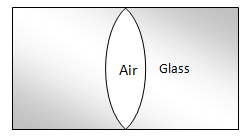
In the figure, an air lens of radii of curvature $10 \ cm (\mathrm{R}_1=\mathrm{R}_2= 10 \ cm)$ is cut in a cylinder of glass $(\mu = 1.5).$ The focal length and the nature of the lens is
Match List I with List II and select the correct answer using the codes given below the lists :
List I
(Position of the object)
List II
(Magnification)
(I) An object is placed at focus before a convex mirror (A) Magnification is -∞
(II) An object is placed at centre of curvature before a concave mirror (B) Magnification is 0.5
(III) An object is placed at focus before a concave mirror (C) Magnification is +1
(IV) An object is placed at centre of curvature before a convex mirror (D) Magnification is  -1
  (E) Magnification is 0.33
Codes :(a) I-B, II-D, III-A, IV-E(b) I-A, II-D, III-C, IV-B(c) I-C, II-B, III-A, IV-E(d) I-B, II-E, III-D, IV-C
   
   
A pure semiconductor behaves slightly as a conductor at(a) Room temperature(b) Low temperature(c) High temperature(d) Both (b) and (c)
   
   
What is the S.I. unit of electric potential?