Question
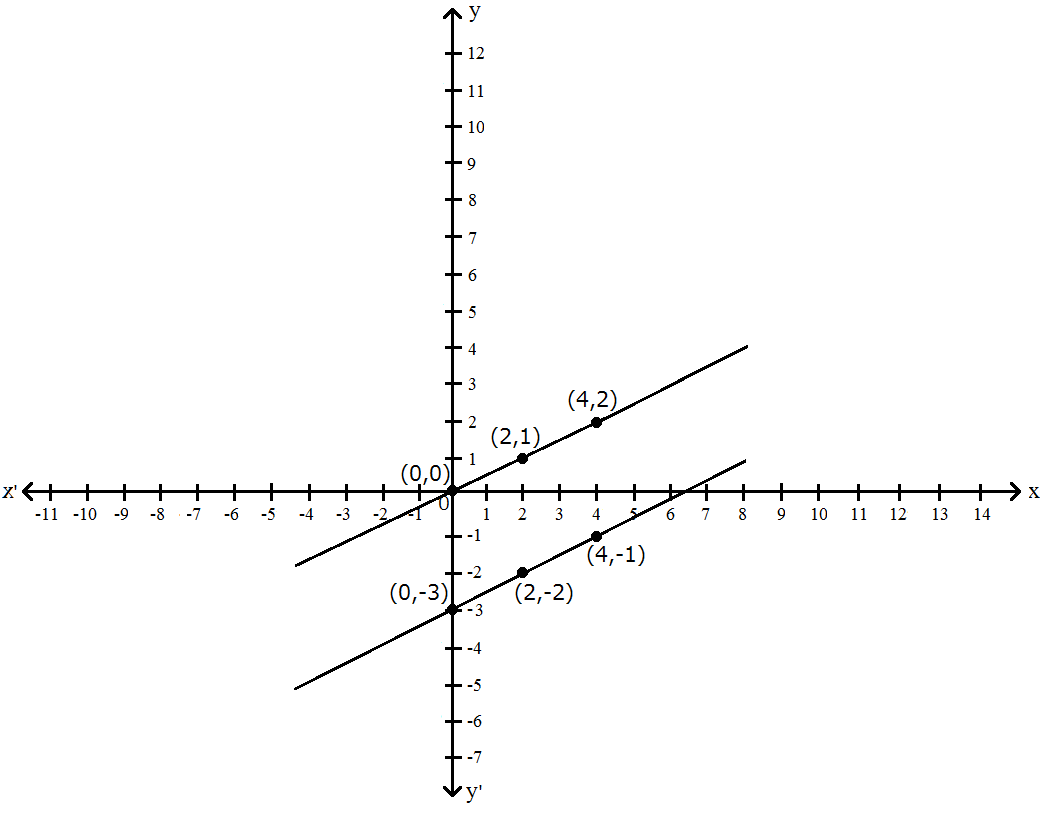
Show graphically that the following system of equation is in-consistent (i.e. has no solution):
$x - 2y = 6$
$3x - 6y = 0$

Answer

The given equations are,
$x - 2y = 6 .......(i)$
$3x - 6y = 0 ........(ii)$
From (i), $\text{y}=\frac{\text{x}-6}{2}\ ......(\text{iii})$
Putting $x = 0$ in $(iii),$ we get $y = -3$
Putting $x = 2$ in $(iii),$ we get $y = -2$
Putting $x = 4$ in $(iii)$, we get $y = -1$
$x$
$0$
$2$
$4$
$y$
$-3$
$-2$
$-1$
From (ii), $\text{y}=\frac{3\text{x}}{6}\ ......(\text{iv})$
Putting $x = 0$ in $(iv),$ we get $y = 0$
Putting $x = 2$ in $(iii),$ we get $y = 1$
Putting $x = 4$ in $(iii),$ we get $y = 2$
$x$
$0$
$2$
$4$
$y$
$0$
$1$
$2$

When we plot these points on graph paper we observe that both linesare parallel to each other means they have no solution so they are in-consistent.

Need a full question paper?

Generate a complete, print-ready paper with questions like this in minutes — across 16+ boards, with answer keys.

Start Generating Free

Similar questions

Solve the following systems of equations:
$\frac{4}{\text{x}}+5\text{y}=7,$
$\frac{3}{\text{x}}+4\text{y}=5.$
If $AD$ and $PM$ are medians of triangles $ABC$ and $PQR,$ respectively where $\triangle ABC \sim \triangle PQR,$ Prove that $\frac{{AB}}{{PQ}} = \frac{{AD}}{{PM}}$
Find the zeros of the following quadratic polynomial and verify the relationship between the zeros and their coefficients:
$\text{g(x)}=\text{a(x}^2+1)-\text{x(a}^2+1)$
Solve the following system of equations by the method of cross-multiplication:
$\frac{\text{x}}{\text{b}}=\frac{\text{y}}{\text{b}},$
$\text{ax}+\text{by}=\text{a}^2+\text{b}^2.$
Solve the following equations by using the method of completing the square:
$\text{4x}^2+4\sqrt3+3=0$
Prove the following identities:
$\frac{\sec\theta+\tan\theta}{\sec\theta-\tan\theta}=(\sec\theta+\tan\theta)^2$
$=1+2\tan^2\theta+2\sec\theta\tan\theta$
Find the median of the following data by making a 'less than ogive'.
Marks
$0-10$
$10-20$
$20-30$
$30-40$
$40-50$
$50-60$
$60-70$
$70-80$
$80-90$
$90-100$
Number of students
$5$
$3$
$4$
$3$
$3$
$4$
$7$
$9$
$7$
$8$
A right triangle whose sides are $15\ cm$ and $20\ cm$ (other than hypotenuse), is made to revolve about its hypotenuse. Find the volume and surface area of the double cone so formed. (Choose value of $\pi$ as found appropriate)
Draw a $\triangle\text{ABC},$ right-angled at $B$ such that $AB = 3\ cm$ and $BC = 4\ cm$. Now, Construct a triangle a triangle similar to $\triangle\text{ABC},$ each of whose sides is $\frac75\text{times}$ the correponding side of $\triangle\text{ABC}.$
Solve the following system of linear equation graphically and shade the region between the two lines and x-axis:
$3x + 2y -4 = 0$
$2x - 3y -7 = 0.$