Question
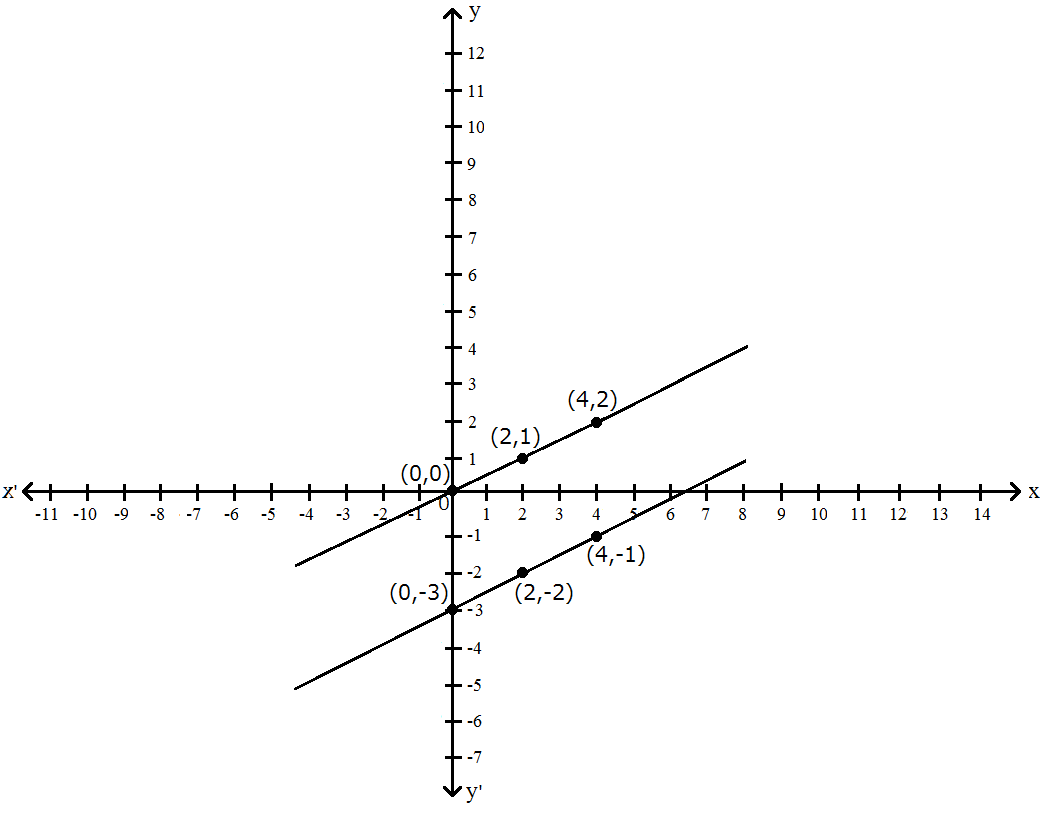
Show graphically that the following system of equation is in-consistent (i.e. has no solution):
x - 2y = 6
3x - 6y = 0

Answer

The given equations are,
x - 2y = 6 .......(i)
3x - 6y = 0 ........(ii)
From (i), $\text{y}=\frac{\text{x}-6}{2}\ ......(\text{iii})$
Putting x = 0 in (iii), we get y = -3
Putting x = 2 in (iii), we get y = -2
Putting x = 4 in (iii), we get y = -1
x
0
2
4
y
-3
-2
-1
From (ii), $\text{y}=\frac{3\text{x}}{6}\ ......(\text{iv})$
Putting x = 0 in (iv), we get y = 0
Putting x = 2 in (iii), we get y = 1
Putting x = 4 in (iii), we get y = 2
x
0
2
4
y
0
1
2

When we plot these points on graph paper we observe that both linesare parallel to each other means they have no solution so they are in-consistent.

Need a full question paper?

Generate a complete, print-ready paper with questions like this in minutes — across 16+ boards, with answer keys.

Start Generating Free

Similar questions

How many coins 1.75 cm in diameter and 2 mm thick must be melted to form a cuboid 11 cm ✖ 10 cm ✖ 7 cm?
Show that the following points are the vertices of a square:
A(6, 2), B(2, 1), C(1, 5) and D(5, 6)
A tent of a circus is such that its lower part is cylindrical and upper part is conical. The diameter of the base of the tent is $48 \mathrm{~m}$ and the height of the cylindrical part is $15 \mathrm{~m}$. Total height of the tent is $33 \mathrm{~m}$. Find area of canvas required to make the tent. Also find volume of air in the tent.
A solid is in the shape of a cone surmounted on a hemisphere, the radius of each of them being $3.5\ cm$ and the total height of the solid is $9.5\ cm.$ Find the volume of the solid.
Find the values of a and b for which the following system of equations has infinitely many solutions:
$2x - (2a + 5)y = 5$
$(2b + 1)x - 9y = 15$
Draw a circle with center O and radius 3 cm. Take the point P and the point Q at a distance of 7 cm from the center of the circle on the opposite side of the circle at the intersection passing through the center of the circle Draw a tangent to the circle from the point P and the point Q.
Solve the following quadratic equation:
$abx^2 +(b^2 - ac)x - bc = 0$
If $\cot\theta=2,$ find the value of the all T-ratios of $\theta.$
Find the area of a quadrant of a circle hose circumference is 44cm.
If the sum of first p terms of an A.P. is equal to the sum of first q terms then show that the sum of its first (p + q) terms is zero. (p ≠ q)