Question
Show that $\text{AB} + \overline{\text{AB}}$ is always 1.

Answer

Given,
$\text{X}=\text{AB} + \overline{\text{AB}}$
Let,
$\text{AB}=\text{y}$
$\therefore\text{X}=\text{y} + \overline{\text{y}}$
$\text{For y} = 0,$
$\text{X}=0+1$
$=1$
$\text{For y} = 1,$
$\text{X}=1+0$
$=1$
thus, X = 1 for all values of y = AB.

Need a full question paper?

Generate a complete, print-ready paper with questions like this in minutes — across 16+ boards, with answer keys.
Start Generating Free

Similar questions

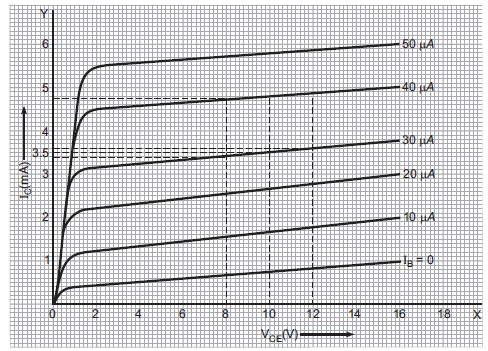
Output characteristics of an $n-p-n$ transistor in $CE$ configuration is shown in the figure. Determine:
  1. Dynamic output resistance.
  2. $Dc$ current gain and.
  3. $Ac$ current gain at an operating point $V_{CE} = 10V,$ when $ I_B =30\mu\ A$.
  1. Write the functions of three segments of a transistor.
  2. Draw the circuit diagram for studying the input and output characteristics of $n-p-n$ transistor in common emitter configuration. Using the circuit, explain how input, output characteristics are obtained.
How is a galvanometer converted into a voltmeter and an ammeter? Draw the relevant diagrams and find the resistance of the arrangement in each case. Take resistance of galvanometer as G.
  1. In Young's double slit experiment, two slits are $1\ mm$ apart, and the screen is placed $1m$ away from the slits. Calculate the fringe width when light of wavelength $500\ nm$ is used.
  2. What should be the width of each slit in order to obtain $10$ maxima of the double slits pattern within the central maximum of the single slit pattern?
Why is it not possible to make permanent magnets from paramagnetic materials?
Does the force on a charge due to another charge depend on the charges present nearby?
A resistor R and an inductor L are connected in series to a source $\text{V}=\text{V}_0\sin\omega\text{t}.$
Find:
  1. Peak value of the voltage drops across R and across L,
  2. Phase difference between the applied voltage and current. Which of them is ahead?
A proton has spin and magnetic moment just like an electron. Why then its effect is neglected in magnetism of materials?
A radioactive material is reduced to $\frac{1}{16}$ of its original amount in $4$ days. How much material should one begin with so that $4 \times 10^{-3}\ kg$ of the material is left after $6$ days?
A convex lens produces a double size real image when an object is placed at a distance of 18cm from it. Where should the object be placed to produce a triple size real image?